Pope Leo XIV Releases First Encyclical Calling for AI Guardrails — Magnifica Humanitas Warns Against Unchecked Technological Power

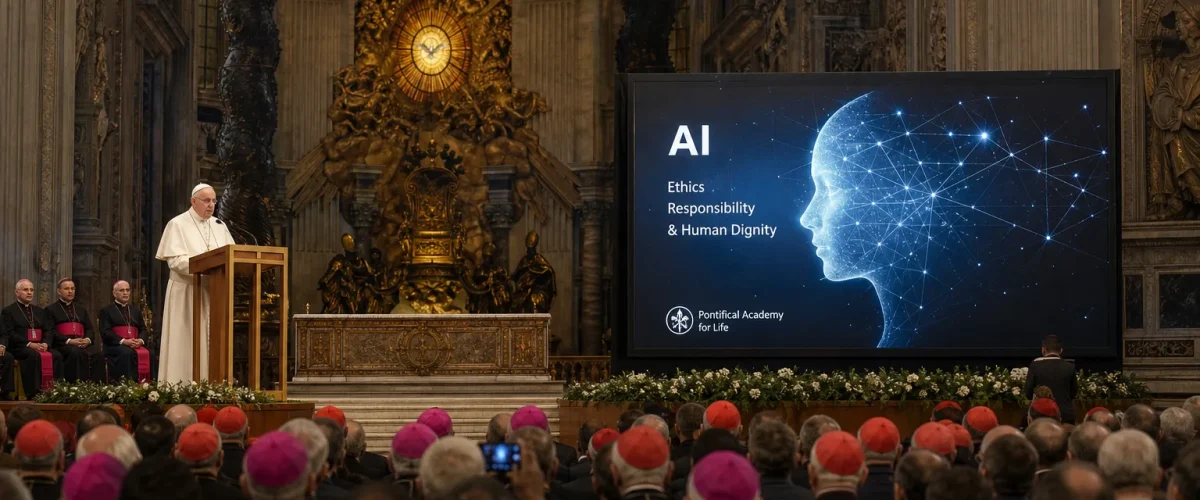
In a landmark moment at the intersection of faith and technology, Pope Leo XIV has published his first encyclical — a sweeping 42,000-word document titled Magnifica Humanitas (Latin for “Humanity in Its Grandeur”) — calling for urgent legal and ethical guardrails on artificial intelligence. The encyclical, signed on May 15 and formally presented at the Vatican on May 25, 2026, represents the most comprehensive statement by a world religious leader on the promises and perils of AI, and arrives at a time when the technology is transforming everything from warfare and politics to healthcare and creative expression.
In a break with Vatican tradition, Pope Leo chose to present the encyclical personally rather than delegating the task to cardinals. The presentation was attended by a notable audience that included AI researchers, ethicists, diplomats, and — in a particularly significant gesture — Anthropic co-founder Chris Olah, one of the leading figures in AI safety research. Olah was invited to speak at the event, symbolizing the Vatican’s engagement with the technology community in seeking shared solutions.
The Core Message: Technology Is Never Neutral
At the heart of Magnifica Humanitas is the assertion that technology is never neutral — a position that challenges the common Silicon Valley refrain that tools are only as good or bad as the people who use them. Pope Leo argues that the design choices embedded in AI systems reflect the values, biases, and priorities of their creators, and that without deliberate guardrails, these systems will amplify existing inequalities and power imbalances.
“Humanity faces a choice,” writes Pope Leo, “between constructing Babel and rebuilding Jerusalem — between remote, prideful power and human-centered community.” The metaphor, drawn from the Biblical narrative of the Tower of Babel, serves as a warning against the hubris of building increasingly powerful AI systems without adequate reflection on their societal impact.
The encyclical draws a direct line from the Catholic Church’s historical engagement with technological disruption — beginning with Leo XIII’s 1891 encyclical Rerum Novarum, which responded to the upheaval of the Industrial Revolution — to the present AI moment. Just as the Industrial Revolution demanded new social frameworks to protect workers’ rights, Pope Leo argues, the AI revolution demands new legal and ethical frameworks to protect human dignity.
AI in Warfare: Just War Theory Is ‘Outdated’
Perhaps the most provocative section of the encyclical concerns the use of AI in warfare. Pope Leo condemns the development and deployment of autonomous weapons systems, stating unequivocally that reducing human control of weaponry makes it harder to justify any armed conflict.
“The ‘just war’ theory which has all too often been used to justify any kind of war, is now outdated,” the encyclical declares — a remarkable statement from the leader of a church that developed and refined just war doctrine over centuries. The Pope argues that autonomous weapons, by removing the human decision-maker from the kill chain, fundamentally undermine the moral responsibility that any legitimate use of force requires.
This position takes on added urgency in the context of the ongoing US-Iran conflict, which has seen extensive use of AI-guided weapons systems on both sides. Defence analysts have noted the increasing role of AI in target identification, missile guidance, and strategic decision-making throughout the conflict.
Deepfakes, Democracy, and AI Arms Race
The encyclical also addresses the growing threat of AI-generated deepfakes to democratic processes. Pope Leo warns that the ability to create convincing fake videos, audio, and images of political leaders undermines public trust in shared reality — a foundation of democratic governance.
“When citizens can no longer distinguish truth from fabrication, the very basis of democratic deliberation collapses,” the encyclical states. It calls on governments to mandate clear labelling of AI-generated content and to establish criminal penalties for the use of deepfakes to influence elections or incite violence.
Additionally, Magnifica Humanitas warns against an AI arms race between nations, arguing that competition to develop ever-more-powerful AI systems without commensurate investment in safety research is reckless. The Pope calls for an international AI safety framework — analogous to nuclear non-proliferation agreements — that would ensure responsible development while preventing a dangerous race to the bottom on safety standards.
An Apology and a Forward Look
In a section that generated significant attention, the encyclical includes an apology for the Catholic Church’s historical role in slavery — framing it as an example of how powerful institutions can become complicit in dehumanization when they fail to apply ethical principles to emerging economic systems. The parallel with AI is implicit but clear: institutions that fail to engage critically with AI risk repeating the pattern of enabling exploitation in the name of progress.
The encyclical concludes with a series of concrete recommendations:
- International AI Treaty: The Vatican calls for a binding international agreement on AI governance, with particular focus on autonomous weapons, surveillance, and data rights.
- AI Impact Assessments: Mandatory human rights and ethical impact assessments for all AI systems deployed at scale.
- Worker Protections: New labour frameworks to protect workers displaced by AI automation, including retraining programmes and universal basic income pilots.
- Children’s Protection: Strict regulations on children’s exposure to AI-generated content, particularly in education and social media.
- Open Research: Support for open AI safety research and international cooperation on alignment and interpretability.
Reactions from the Tech World
The tech industry’s response has been notably positive, particularly from the AI safety community. Chris Olah, speaking at the Vatican presentation, praised the encyclical for its “moral clarity” and noted that many of the Pope’s concerns aligned with the research priorities of organizations like Anthropic, OpenAI, and DeepMind.
“The Pope is asking the right questions,” Olah said. “What values are we embedding in these systems? Who benefits, and who is harmed? These are not just technical questions — they are fundamentally moral questions, and I’m grateful that a voice as influential as the Pope’s is engaging with them.”
Not everyone in the tech world was as enthusiastic. Some AI accelerationists criticized the encyclical as “Luddite in papal robes,” arguing that slowing AI development would cost lives by delaying advances in medicine, climate science, and poverty reduction. Marc Andreessen, the venture capitalist and prominent AI booster, called the document “well-intentioned but dangerously naive about the costs of delay.”
India’s Connection
The encyclical arrives at an interesting moment for India, where the electronics ministry is reportedly close to notifying final changes to the IT Rules that would affect AI governance. India’s approach to AI regulation has been characteristically cautious — seeking to balance innovation with protection — and Magnifica Humanitas provides a moral framework that may influence the public discourse around these regulatory decisions.
As the world grapples with the transformative power of artificial intelligence, Pope Leo XIV’s first encyclical serves as both a warning and a guide — reminding humanity that the measure of technological progress is not power but purpose, and that the most sophisticated systems ever created must ultimately serve the most fundamental human values.
Related Articles
- Trump Scraps AI Executive Order at Last Minute After David Sacks Raises Concerns About Hurting US Tech Dominance
- Anthropic’s AI Model Discovers Over 10,000 Critical Bugs Across Open-Source Software Projects in Landmark Security Initiative
- Quad Foreign Ministers Meet in New Delhi — Jaishankar Hosts Rubio, Wong and Motegi for Indo-Pacific Security Talks
Explore more: AI

- India’s Startup Funding Crosses $7.2 Billion in H1 2026 - July 1, 2026
- After Ireland Shock, India’s T20I Side Faces Bigger Test - July 1, 2026
- Ireland Stun World Champions India 2-0 in Belfast, Sooryavanshi Debate Rages On - June 29, 2026