Twin Earthquakes Kill at Least 188 in Venezuela as Rescue Teams Race Against Time

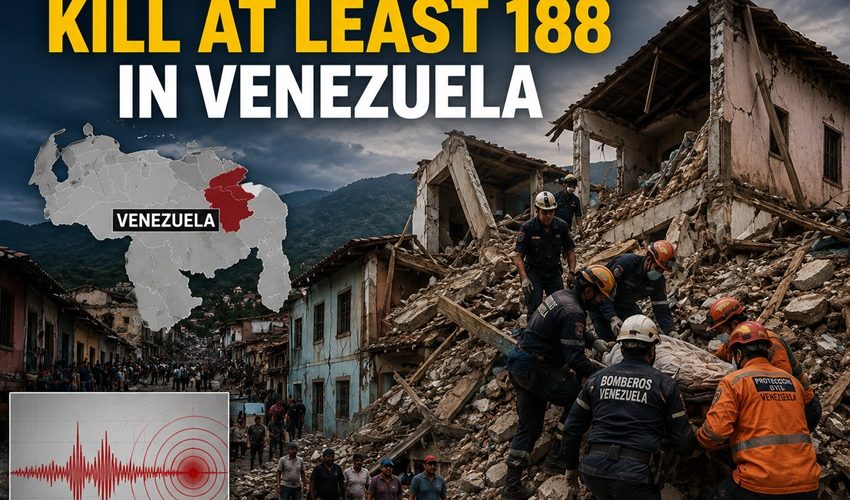
Two powerful earthquakes struck northern Venezuela within 39 seconds of each other on the evening of 24 June 2026, collapsing hundreds of buildings in and around Caracas and killing at least 188 people, according to Jorge Rodríguez, president of Venezuela’s National Assembly. More than 1,520 people were reported injured, and at least 157 remain missing as rescue teams work through the rubble of an estimated 250 collapsed or damaged structures.
The United States Geological Survey recorded the first tremor — a 7.2 magnitude foreshock — at approximately 6:04 p.m. local time near San Felipe, the capital of Yaracuy state, roughly 160 kilometres west of Caracas. The second, larger quake, measuring 7.5 in magnitude, struck near the town of Yumare less than a minute later. Seismologists describe the twin event as among the strongest to hit Venezuela in more than a century.
Why the Damage Is So Severe
The scale of destruction reflects both the seismic intensity and the country’s structural vulnerability. Vashan Wright, a geophysicist at the University of California San Diego, told Al Jazeera that Venezuela sits in a “massive strike-slip fault zone” straddling the Caribbean and South American tectonic plates. Caracas itself sits in a deep sedimentary basin, which amplifies seismic waves — a factor that contributed to catastrophic losses in previous tremors, including a magnitude 6.3 quake in 1967.
About 80 percent of Venezuela’s population lives in seismically active zones, and a large proportion occupy informal housing not built to withstand strong ground shaking. In the hard-hit Altamira district of Caracas, buildings constructed on loose sediments proved especially fragile. “People were screaming because it was really, really hard,” María Graterol, a journalist in Caracas, told NPR’s All Things Considered, describing the moment the ground began to shake.
Wednesday was a public holiday in Venezuela — the anniversary of the 1821 Battle of Carabobo — meaning many residents were at home when the quakes struck. Those who escaped spoke of walls visibly bending, furniture launching across rooms and neighbours trapped on balconies screaming for help. Among those who got out, one Caracas resident quoted by CNN described the scene as “like a horror movie.”
State of Emergency and International Response
Acting President Delcy Rodríguez declared a nationwide state of emergency hours after the quakes, announcing the suspension of classes for a week, the closure of Simón Bolívar International Airport due to structural damage, and the cancellation of rail services across the capital. An initial $200 million reconstruction fund, drawn from International Monetary Fund resources, was announced to begin repairs to hospitals and homes.
International assistance began arriving within hours. The United States deployed urban search-and-rescue teams from Fairfax County, Virginia and Los Angeles County — together bringing approximately 80 specialists, six search dogs, three doctors, three structural engineers and nearly 70,000 pounds of heavy rescue equipment. US Secretary of State Marco Rubio confirmed Washington was also sending medical and humanitarian supplies. Mexico, France, Spain, Italy, Switzerland, Qatar, the Dominican Republic and El Salvador all pledged rescue personnel or relief materials.
The United Nations has called on Venezuelan authorities to lift restrictions on media access, warning that the ability to receive and share information could become “a matter of life and death” as search efforts continue. Internet and power connectivity dropped sharply after the quakes before recovering partially, hampering coordination across affected areas.
USGS predictive modelling, issued shortly after the quakes, estimated the most likely death toll would run into the thousands, flagging “a substantial probability of exceeding 10,000.” Officials have cautioned that figures will continue to rise as rescuers reach areas still inaccessible.
Venezuela was already in deep political and economic crisis before the quakes struck. The country had been operating under an interim government following the US-backed capture of President Nicolás Maduro earlier this year, and the UN had estimated that nearly 8 million Venezuelans were already in need of humanitarian support before Wednesday’s disaster.

- Indian Army Gets New Chief as General Dwivedi Hands Over Command Amid Push for Indigenous Defence Tech - July 1, 2026
- Ayodhya Ram Temple Donation Scandal Deepens as Trustees Resign and SIT Arrests Eight - June 29, 2026
- Bengal Seven Weeks On: Modi’s Historic Win and the Questions That Won’t Go Away - June 28, 2026