India’s Bullet Train on Track for 2027 Inaugural Run as First Shinkansen Trainsets From Japan Arrive for Testing

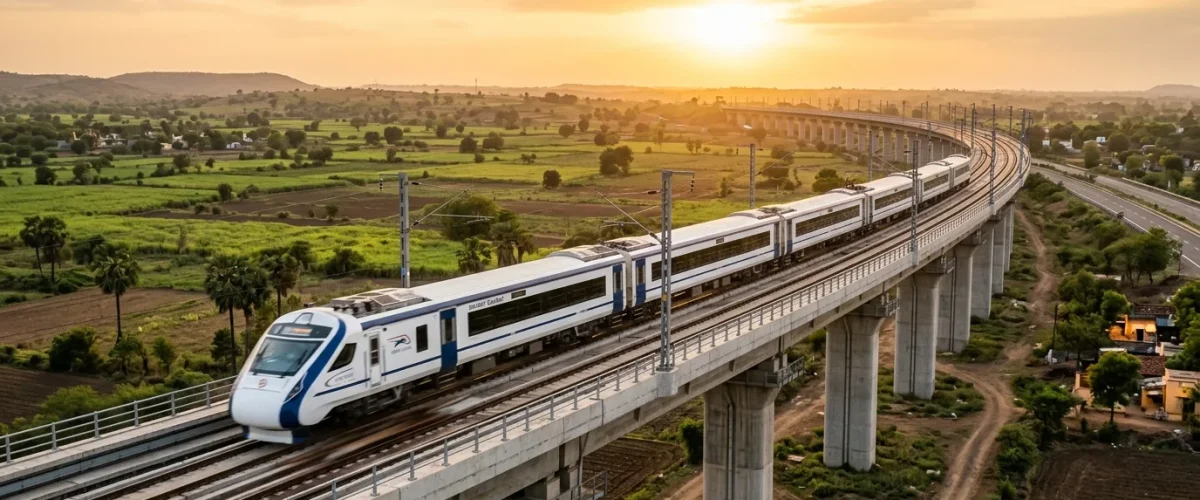
India’s most ambitious infrastructure project is entering its most critical phase. The Mumbai-Ahmedabad High Speed Rail (MAHSR) corridor — commonly known as India’s bullet train — is on track for a 2027 inaugural run as the first Japanese Shinkansen E5-series trainsets have arrived in India for testing on the Surat-Bilimora corridor. Railway Minister Ashwini Vaishnaw confirmed on April 15, 2026, that the inaugural commercial run will take place on a 50 km stretch between Surat and Bilimora in Gujarat, with the full 508 km corridor expected to be operational by 2029.
The arrival of the trainsets marks the project’s transition from a construction phase — which has faced delays, land acquisition challenges, and pandemic disruptions — to a testing and commissioning phase that will determine whether India can join the elite club of nations with high-speed rail capabilities. For Rail & Road coverage, this is the most significant rail infrastructure milestone since the Delhi Metro’s inauguration in 2002.
The Shinkansen Arrives: What Japan Has Delivered
The first set of E5-series Shinkansen trainsets — modified for Indian conditions — arrived at the Hazira port near Surat in early April 2026, shipped from Hitachi’s Kasado Works factory in Japan. The trainsets are 10-car formations capable of reaching speeds of 320 km/h, though the MAHSR corridor will initially operate at a maximum speed of 250 km/h during the testing phase.
Key modifications for the Indian variant include enhanced air conditioning systems designed for India’s tropical climate (operating range up to 50°C ambient temperature), dust-resistant exterior coatings for the Gujarat-Maharashtra corridor, wider doors to accommodate Indian passenger flow patterns, and dual-voltage capability to handle India’s power grid variations. Testing will begin on the Surat-Bilimora section, where viaduct construction is 100 percent complete and track laying has reached 95 percent completion as of April 2026. Related developments: Tamil Nadu’s Temple Circuit and Heritage Tourism Renaissance Draw
Construction Progress: Where the Project Stands
The MAHSR corridor’s overall construction progress has accelerated significantly since 2024. According to the National High Speed Rail Corporation Limited (NHSRCL), the project body, as of April 2026 the Gujarat section (348 km) is at 85 percent overall completion, with viaduct work nearly finished and station construction at six locations (Surat, Vadodara, Anand, Ahmedabad, Bilimora, and Bharuch) progressing on schedule. The Maharashtra section (160 km) is at 55 percent completion, with land acquisition — the primary bottleneck — finally resolved for 99 percent of the alignment. The underwater tunnel section beneath the Thane Creek (21 km, including 7 km undersea) is at 40 percent completion, with tunnel boring machines achieving breakthrough at the first of three segments in March 2026.
The project’s total cost has risen to approximately ₹1.20 lakh crore ($14.2 billion), up from the original estimate of ₹1.08 lakh crore, primarily due to inflation, land acquisition delays, and design modifications. Japan International Cooperation Agency (JICA) continues to fund approximately 81 percent of the project through a 50-year soft loan at 0.1 percent interest — one of the most favourable infrastructure financing arrangements in history. For Travel & Tourism, the bullet train represents the flagship of India’s transformation of its transportation network.
Vande Bharat Evolution: From Semi-High-Speed to Sleeper
While the bullet train captures global headlines, Indian Railways’ indigenous Vande Bharat program continues to expand rapidly. As of April 2026, 136 Vande Bharat Express trainsets are operational across India, connecting 228 city pairs. The program, which launched in 2019 with a single Delhi-Varanasi service, has become the backbone of Indian Railways’ modernization strategy. Coverage of related infrastructure projects: Rajasthan Heritage Circuit 2026: New Luxury Train Routes and Rest
The most anticipated development is the Vande Bharat Sleeper, India’s first indigenous semi-high-speed overnight train, which is scheduled for its maiden commercial run in September 2026. The Vande Bharat Sleeper will feature three classes (AC First, AC Two-Tier, AC Three-Tier), a maximum speed of 160 km/h (compared to 130 km/h for Rajdhani Express), GPS-based passenger information systems with estimated arrival times, bio-vacuum toilets and modular pantry cars, and anti-collision technology (Kavach) integrated as standard.
The first Vande Bharat Sleeper route will connect Delhi to Mumbai, covering the 1,384 km distance in approximately 10 hours — compared to 15-16 hours for the current Rajdhani Express. Indian Railways has ordered 200 Vande Bharat Sleeper rakes from the Integral Coach Factory (ICF) in Chennai, with deliveries expected at 8-10 rakes per month starting August 2026.
Station Redevelopment: Surat and Sabarmati
The bullet train project is also catalysing major station redevelopment in Gujarat. Surat’s new bullet train station, designed by Japanese architects Nikken Sekkei in collaboration with Indian firm Hafeez Contractor, will be a futuristic glass-and-steel structure covering 25,000 square meters, featuring seamless integration with the existing Surat Railway Station, a commercial complex with retail, dining, and co-working spaces, and green building certification (GRIHA 5-star rating). Indian Outbound Travel Hits Record 30 Million Trips in 2026 as Ja
Sabarmati station in Ahmedabad, the corridor’s western terminus, is undergoing an even more ambitious transformation as part of a ₹1,200 crore redevelopment that will turn it into a multi-modal transport hub connecting the bullet train, metro rail, bus rapid transit, and conventional rail services.
Economic Impact: What the Bullet Train Means for Western India
Economic projections for the MAHSR corridor are staggering. A 2025 study by the National Institute of Public Finance and Policy (NIPFP) estimated that the bullet train will generate ₹35,000 crore in annual economic activity along the corridor by 2032, reduce travel time between Mumbai and Ahmedabad from 7-8 hours (by road/rail) to 2 hours and 7 minutes, create 20,000 direct jobs and 60,000 indirect jobs during the operational phase, and increase property values within 5 km of stations by 15-25 percent. For businesses in Gujarat and Maharashtra, the bullet train promises to create a single integrated economic zone — allowing professionals to live in Surat or Vadodara while working in Mumbai, a concept that was previously unthinkable.
Challenges Ahead: The Maharashtra Land Problem and Cost Overruns
Despite the progress, significant challenges remain. The Maharashtra section continues to lag behind Gujarat due to more complex urban land acquisition requirements, particularly in the Mumbai Metropolitan Region. Environmental clearances for the Thane Creek underwater tunnel have faced multiple legal challenges, and the Mumbai terminus at Bandra Kurla Complex (BKC) is still in early construction stages.
India’s bullet train dream is closer to reality than ever before. The arrival of the Shinkansen trainsets transforms the project from engineering abstraction to tangible reality. If testing proceeds on schedule through 2026 and early 2027, India could become the first South Asian country to operate high-speed rail — a milestone that would reshape not just transportation, but the country’s industrial identity on the world stage.

- Indian Army Gets New Chief as General Dwivedi Hands Over Command Amid Push for Indigenous Defence Tech - July 1, 2026
- Ayodhya Ram Temple Donation Scandal Deepens as Trustees Resign and SIT Arrests Eight - June 29, 2026
- Bengal Seven Weeks On: Modi’s Historic Win and the Questions That Won’t Go Away - June 28, 2026