Sensex Crosses 95,000 for the First Time as FII Inflows and IT Earnings Drive Indian Markets Higher

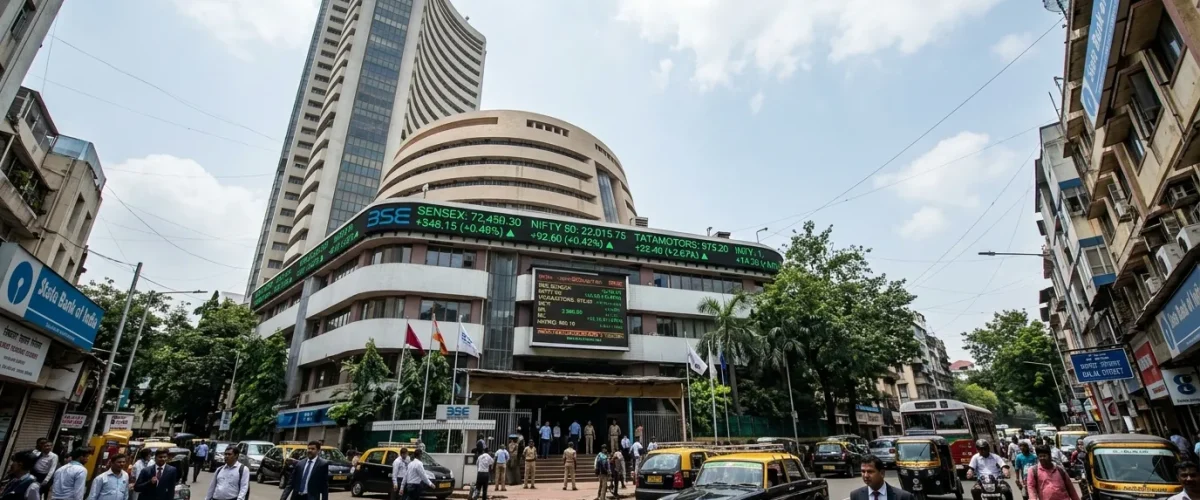
The BSE Sensex crossed 95,000 for the first time on 25 March 2026, marking a milestone that would have seemed improbable just 18 months ago when Indian stock market indices were gripped by FII outflow anxiety and global recession fears. The benchmark index closed at 95,247 — a gain of 1.3 per cent on the day — driven by broad-based buying across information technology, banking and capital goods sectors. The NSE Nifty 50 simultaneously touched 28,900, confirming that the rally is supported by fundamental economic strength rather than speculative excess.
Sensex 95000 Indian Stock Market 2026: What Drove the Rally
Three interconnected factors have pushed Indian markets to record territory. First, foreign institutional investor (FII) inflows have reversed decisively. After 14 months of net selling that saw FIIs pull out over Rs 1.8 lakh crore between October 2024 and December 2025, March 2026 has recorded net FII inflows of Rs 42,000 crore — the highest single-month figure since 2021. The reversal reflects global fund managers’ renewed confidence in India’s growth trajectory, particularly as China’s economic recovery continues to disappoint and geopolitical uncertainties make India a preferred emerging market allocation.
Second, corporate earnings for the quarter ending December 2025 exceeded expectations across multiple sectors. IT companies, which had been under pressure from delayed client spending decisions, reported revenue growth of 8-12 per cent year-on-year, with improved guidance for 2026-27. Banking sector profits hit record levels, driven by improving asset quality and loan growth above 14 per cent. Capital goods and infrastructure companies benefited from the government’s continued emphasis on public investment, with order books at all-time highs.
Third, India’s GDP growth forecast for 2026 has reinforced investor confidence. With the International Monetary Fund projecting India’s GDP to grow at 7.1 per cent in 2026-27, the country’s economic fundamentals provide a macro backdrop that few emerging markets can match. The combination of strong earnings, favourable capital flows and supportive macroeconomics has created a convergence that propelled the Sensex past 95,000.
Sector-by-Sector Breakdown: IT Leads, Banks Follow
The IT sector has been the single largest contributor to the Sensex rally in March 2026. TCS, Infosys and HCL Technologies have collectively added over 3,000 points to the index this month, driven by improved demand signals from US and European clients. The adoption of artificial intelligence across enterprise operations has created a new revenue stream for Indian IT companies, with AI-related consulting and implementation services growing at 40 per cent year-on-year.
Banking and financial services remain the bedrock of the Indian market rally. HDFC Bank, ICICI Bank and State Bank of India have reported their strongest quarterly performances in years, with net interest margins expanding despite the Reserve Bank of India’s accommodative monetary policy stance. The credit growth rate of 14.5 per cent reflects broad economic activity — from consumer loans and mortgages to corporate capital expenditure and MSME borrowing.
The capital goods and infrastructure sector has delivered exceptional returns, with companies such as Larsen & Toubro, Siemens India and ABB India benefiting from government infrastructure spending that crossed Rs 11 lakh crore in the current fiscal year. The National Infrastructure Pipeline and PM Gati Shakti programme have created a sustained order pipeline that provides visibility well into 2028.
The real estate market hitting record sales has provided additional support to market sentiment, as property developers and housing finance companies report strong demand across price segments.
Retail Investors: The Force Multiplier
India’s retail investor base has expanded dramatically, and its influence on market dynamics has become impossible to ignore. The number of demat accounts in India crossed 180 million in February 2026, up from 110 million at the start of 2024. Systematic Investment Plan (SIP) flows into mutual funds reached a record Rs 26,000 crore in February 2026, providing a steady stream of domestic capital that has partially offset FII volatility.
The democratisation of stock market access through platforms such as Zerodha, Groww and Angel One has brought millions of first-time investors into the market. While this broadening of participation is generally positive for market depth and liquidity, regulators at the Securities and Exchange Board of India (SEBI) have expressed concern about the speculative activity in derivatives markets, where daily options trading volumes now exceed Rs 400 lakh crore in notional value.
SEBI’s recent measures to curb speculative derivatives trading — including increased lot sizes, reduced weekly expiry options and higher margin requirements — have had a moderating effect on volumes without significantly dampening overall market sentiment. The regulator’s challenge is balancing financial inclusion and market access with the need to protect inexperienced investors from excessive risk.
Global Context: India as the Preferred Emerging Market
India’s market performance must be understood in a global context where alternatives are limited. China’s CSI 300 index remains 25 per cent below its 2021 peak, with ongoing concerns about property sector debt, deflationary pressures and regulatory uncertainty deterring foreign investment. Brazil and Indonesia have delivered moderate returns but lack India’s combination of scale, growth and institutional development.
The US Federal Reserve’s decision to cut interest rates three times since September 2025 has weakened the dollar and improved capital flows to emerging markets. India has been the primary beneficiary of this rotation, with its deep and liquid equity market, strong rule of law and transparent regulatory framework making it the default allocation for emerging market funds. The OpenAI’s expansion into Asia-Pacific further underscores how global technology companies view India as a strategic growth market.
Risks and Outlook: Can the Rally Sustain?
Market veterans caution that valuations at these levels require continued earnings delivery. The Sensex trades at approximately 22 times forward earnings — above its 10-year average of 19 times — suggesting that the market has priced in significant growth expectations. Any disappointment in corporate earnings, a reversal in FII flows or an unexpected global shock could trigger a correction.
Geopolitical risks, including US-China trade tensions and Middle Eastern instability affecting crude oil prices, remain relevant. India’s dependence on imported energy means that a sustained rise in crude oil prices above $90 per barrel would pressure inflation, corporate margins and the current account balance.
Despite these risks, the consensus among market strategists is that the Indian stock market bull run has structural support. Domestic consumption growth, infrastructure investment, the digital economy expansion and India’s improving position in global supply chains provide multiple engines of economic growth. The Sensex crossing 95,000 is a milestone, but the more important question is whether the underlying economic transformation can sustain returns for the years ahead.