India April CPI Inflation Expected to Rise to 3.8 Percent as LPG Price Hike and Fuel Costs Push Household Budgets Higher Amid Global Energy Crisis

India’s consumer price inflation is expected to have risen to approximately 3.8 per cent in April 2026, up from 3.4 per cent in March, as the cascading effects of higher LPG prices and elevated fuel costs began feeding into household budgets against the backdrop of the ongoing global energy crisis. The consumer price index (CPI) data, scheduled for release by the Ministry of Statistics and Programme Implementation on Tuesday, 12 May, is being closely watched by markets, the Reserve Bank of India, and policymakers as a key indicator of the domestic inflation trajectory in a period of extraordinary global uncertainty.
A Reuters poll of 46 economists forecast the annual CPI inflation rate at 3.8 per cent for April, with estimates ranging from 2.80 per cent to 4.20 per cent — a wide range that reflects the uncertainty surrounding the precise timing and magnitude of the energy price pass-through to consumer goods and services. The forecast represents a meaningful acceleration from March’s 3.4 per cent reading, though it remains below the RBI’s medium-term target of 4 per cent.
What Is Driving the Inflation Increase?
The primary driver of the expected inflation increase is the rise in energy-related costs that began with the onset of the US-Iran war in early March 2026. Indian companies raised prices of liquefied petroleum gas (LPG) — widely used as a cooking fuel in households across the country — in March after the Middle East conflict disrupted energy supplies through the Strait of Hormuz. Economists noted that the full impact of the March LPG price hike took time to flow through to the CPI basket, with the April reading expected to capture the lagged effect.
“The increase that we are seeing in part is happening because it is capturing the increase in LPG prices in March. The impact is flowing over to April as well,” said Rajani Sinha, chief economist at CareEdge Ratings. “Additionally, restaurant and accommodation services are expected to show some price increase impacted by the rise in commercial LPG supply costs.”
Beyond LPG, broader fuel and transportation costs have risen in response to crude oil prices that have remained stubbornly above $100 per barrel throughout April. While the Indian government has not officially raised petrol and diesel prices at the pump — maintaining the freeze that has been in place since before the conflict — the indirect effects of higher diesel costs on freight and logistics are beginning to manifest in the prices of food, consumer goods, and services.
Food Inflation: The Key Variable
Food inflation, which has been the most volatile component of India’s CPI basket in recent quarters, is expected to remain elevated in the April data. The National Family Health Survey data suggests that food items account for approximately 46 per cent of the CPI weight, making food price movements the single most important determinant of headline inflation.
Vegetable prices, which had been declining in the early months of 2026 due to a strong winter crop harvest, have begun to stabilise as the summer season brings higher wastage rates and increased demand. Edible oil prices continue to reflect global vegetable oil market dynamics, where supply disruptions in palm oil producing regions have kept prices elevated. Cereal prices have been broadly stable, supported by India’s robust domestic production and government buffer stocks.
One partially offsetting factor has been the decline in gold prices from their April peaks, which reduces the inflation contribution from the “personal care and effects” category in the CPI basket. However, this offset is expected to be modest compared to the upward pressure from energy-related items.
Implications for RBI Monetary Policy
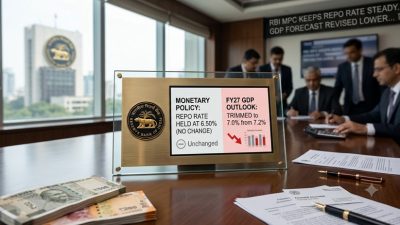
The April inflation data comes at a critical juncture for the Reserve Bank of India’s monetary policy stance. The RBI cut the repo rate by 25 basis points to 6 per cent at its April policy meeting, citing the need to support economic growth amid the global uncertainty created by the Iran conflict. However, Governor Sanjay Malhotra signalled that further cuts would depend on the inflation trajectory and the evolution of global energy prices.
An inflation reading of 3.8 per cent — while still below the 4 per cent target — would complicate the case for additional rate cuts in the near term. The RBI’s June policy meeting is expected to be a particularly difficult one, as the central bank weighs the competing imperatives of supporting growth (which has shown signs of moderation) and maintaining credibility on inflation (which is trending upward for the first time in months).
Bond markets have already begun pricing in a pause in the rate-cutting cycle. The 10-year government bond yield has risen approximately 15 basis points since mid-April, reflecting expectations that the RBI will hold steady at its next meeting rather than delivering another cut. The rupee’s weakness against the dollar adds another complicating factor, as currency depreciation feeds through to import prices and can amplify inflationary pressures.
Fuel Price Hike Decision Looms
Perhaps the most consequential near-term inflation risk is the government’s pending decision on whether to raise petrol and diesel prices. India’s state-controlled oil marketing companies — Indian Oil Corporation, Bharat Petroleum, and Hindustan Petroleum — have been absorbing losses on fuel sales as the government has maintained a price freeze despite crude oil prices surging well above the level at which pump prices were last set.
Reports indicate that the government has drawn up a plan for a gradual increase in fuel rates, potentially in the range of Rs 4 to 5 per litre for petrol and diesel. Such an increase, if implemented, would directly push up the CPI by an estimated 0.3 to 0.5 percentage points and would have cascading effects on transportation costs, food prices, and the broader cost of living. The timing of any price revision will be a key variable for the inflation outlook in the months ahead.
For Indian households already feeling the squeeze from higher LPG prices and rising food costs, the April CPI data will confirm what many have been experiencing in their daily lives — that the global energy crisis is no longer just a headline but a tangible burden on family budgets. As the government and the RBI navigate the competing challenges of growth, inflation, and fiscal sustainability, the data released today will be a critical input into decisions that affect the economic well-being of 1.4 billion people.