India Services PMI Jumps to Five-Month High of 58.8 in April 2026 as Domestic Demand Drives Strongest Expansion Since November

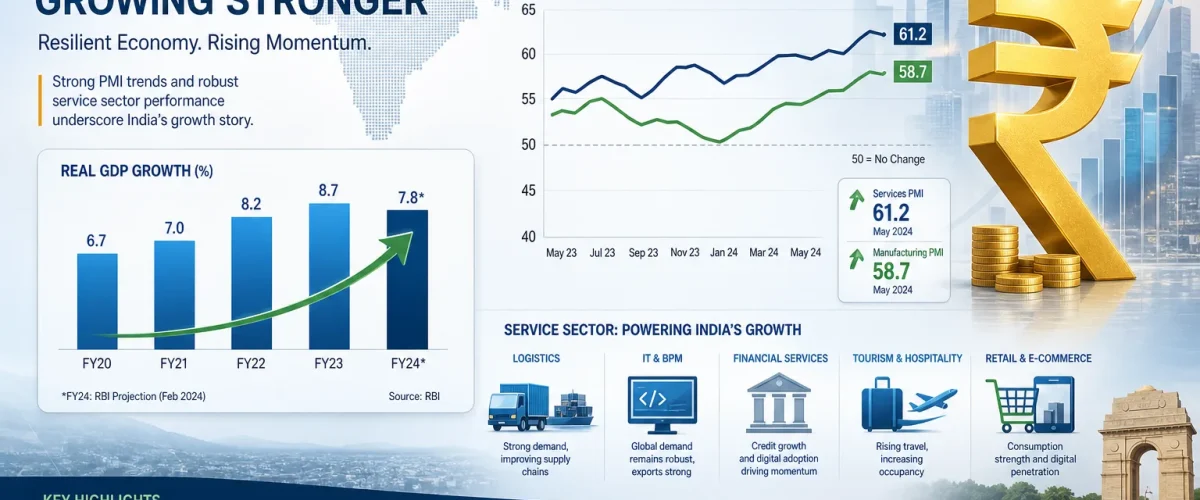
India’s services sector expanded at its strongest pace in five months during April 2026, with the HSBC India Services Purchasing Managers’ Index (PMI) rising from 57.5 in March to 58.8 in April. The reading — which marks the strongest rate of expansion since November 2025 — was driven by robust domestic demand, competitive pricing strategies, and particularly strong growth in consumer services and logistics.
A PMI reading above 50 indicates expansion, while a reading below 50 signals contraction. The April figure of 58.8 comfortably exceeds the 50-mark and points to an economy that continues to grow at a historically strong pace despite headwinds from the ongoing Middle East conflict and global trade uncertainty.
What Drove the Growth?
According to the HSBC survey, which is compiled by S&P Global and based on data collected between 08 and 28 April 2026, the expansion was broad-based across the services sector:
- Consumer Services led April’s expansion in both new orders and output, reflecting strong domestic consumption. Competitive pricing and the continued growth of e-commerce platforms contributed to this segment’s performance.
- Transport, Information and Communication followed closely, benefiting from increased demand for logistics and relocation services.
- New order inflows increased to the greatest extent in five months, driven by what survey participants described as “particularly strong customer demand for relocation and logistic services.”
Pranjul Bhandari, Chief India Economist at HSBC, summarised the findings: “India’s services PMI climbed to a five-month high of 58.8 in April. Activity and new orders strengthened, even as new export orders eased, suggesting that demand is rotating from overseas markets to domestic consumers amid the Middle East conflict.”
Export Orders Slow as Middle East Conflict Weighs
While domestic demand remained strong, the growth of international demand for Indian services lost strength during April. Companies surveyed indicated that the war in the Middle East and subdued inbound tourism dampened the expansion of export orders.
This is a notable shift from earlier in the year when India’s services exports had been growing robustly. The Strait of Hormuz crisis, which disrupted global shipping and trade routes, has had ripple effects across service industries that depend on international connectivity — including IT services, hospitality, and professional consulting.
However, the fact that domestic demand more than compensated for the export slowdown is a positive signal for the economy. It suggests that India’s consumption-driven growth engine remains intact, even as external conditions deteriorate.
Composite PMI Also Rises
The HSBC India Composite PMI Output Index — which combines manufacturing and services — rose from 57.0 in March to 58.2 in April, signalling a historically strong rate of expansion across the private sector. This follows the manufacturing PMI rising to 54.7 in April, with both sectors contributing to the overall acceleration.
The composite reading of 58.2 places India among the fastest-expanding major economies in the world, reinforcing the narrative that the country’s growth trajectory remains robust despite the challenging global environment.
Inflation Picture: Costs Rise, but Firms Absorb
The survey also revealed a nuanced inflation picture. Input cost inflation moderated in April but remained elevated, reflecting higher fuel costs and wage pressures. However, output price inflation stayed subdued, indicating that many firms are choosing to absorb higher costs rather than pass them on to consumers.
This pattern is significant for monetary policy. The Reserve Bank of India (RBI), which has maintained its repo rate at 5.25 percent in recent meetings amid a weakening rupee and rising bond yields, will likely view the moderating cost pressures as supportive of its current neutral stance. However, if input costs begin to rise again — particularly if the foreign investor outflows that surpassed the entire 2025 total continue — the central bank may face difficult choices.
Employment Trends
On the employment front, services firms continued to add staff during April, though the pace of hiring was moderate. Companies reported that increased workloads justified additional recruitment, but uncertainty about the global outlook tempered their enthusiasm for aggressive expansion.
The employment data is particularly relevant given the government’s focus on job creation. With India’s working-age population continuing to grow, the ability of the services sector — which accounts for roughly 55 percent of GDP — to generate employment at scale is a key determinant of the country’s economic trajectory.
Business Confidence and Outlook
Despite the positive headline numbers, business confidence for the year ahead was relatively muted. While firms remained optimistic overall, the degree of optimism was lower than in previous months. Uncertainty surrounding the Middle East conflict, potential fuel price increases, and the upcoming monsoon season were cited as factors dampening the outlook.
Several companies also noted that the rupee’s depreciation was increasing the cost of imported inputs, creating margin pressure even for domestically focused businesses. The interaction between currency movements, oil prices, and input costs will be a key variable to watch in the coming months.
What the PMI Means for India’s Growth Story
The strong services PMI reading reinforces the view that India’s economy is expanding at a pace that makes it an outlier among major nations. With the GDP growth rate revised upward to 7.6 percent for FY26, the economy has been powered by a manufacturing boom, strong domestic consumption, and government infrastructure spending.
The April PMI data suggests that this momentum is carrying into the new fiscal year. If both manufacturing and services continue to expand at current rates, India is well-positioned to remain the fastest-growing major economy in FY27 — a prospect that will attract both domestic and foreign investment, even as geopolitical risks remain elevated.
For policymakers, the key challenge is ensuring that the growth is sustainable and inclusive. While the PMI captures the performance of formal-sector firms, a large proportion of India’s services workforce operates in the informal economy, where the benefits of expansion may be less evenly distributed. Bridging this gap remains one of the most important economic tasks facing the country in the months and years ahead.
The next services PMI release, covering May data, will be closely watched by markets for signs of whether the domestic demand momentum is holding up or whether the external headwinds are beginning to bite more deeply. For now, the April reading is an encouraging sign that India’s economic engine remains firmly in expansion mode.