India’s Research Output Hits Record High as Anusandhan National Research Foundation Begins Funding in 2026

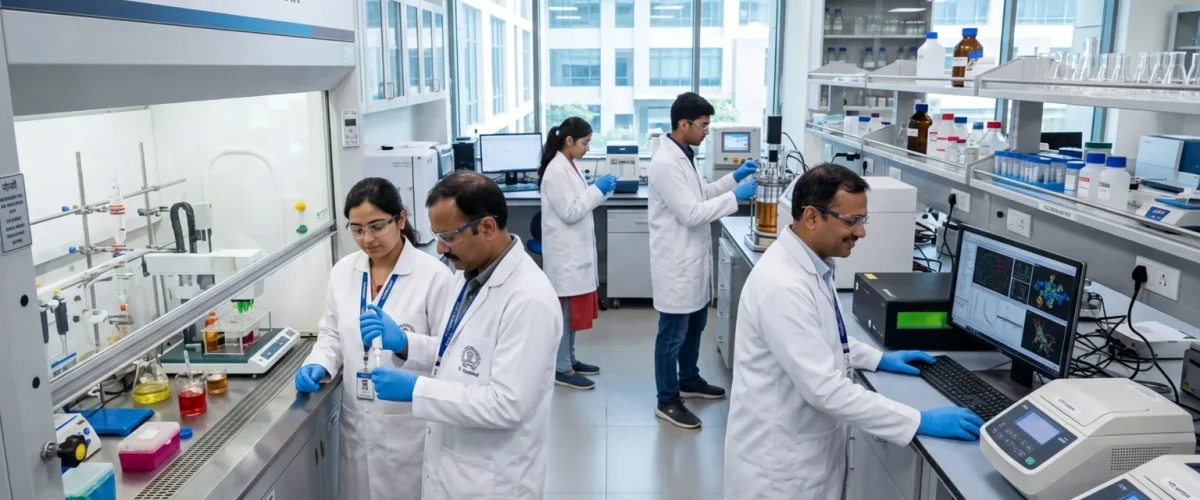
India’s research output has reached an all-time high in 2026, driven by the operationalisation of the Anusandhan National Research Foundation (ANRF), increased government science spending and a growing culture of innovation in Indian universities and research institutions. India now ranks third globally in scientific publications — behind only China and the United States — and is closing the gap in high-impact research as measured by citation indices. The ANRF, which began disbursing grants in late 2025, represents the most significant structural reform in Indian research funding in decades and is already shaping priorities across disciplines.
India Research Output ANRF 2026: The Foundation Takes Shape
The Anusandhan National Research Foundation, established by an Act of Parliament in 2023 with a mandate to seed, grow and promote research across India, has moved from planning to execution. With an initial budget of Rs 50,000 crore over five years — supplemented by private sector contributions — the ANRF represents a tenfold increase in competitive research funding compared to the agencies it subsumes, including elements of the Department of Science and Technology, the Council of Scientific and Industrial Research and the University Grants Commission’s research programmes.
The ANRF’s first round of grants, announced in December 2025, funded 2,400 projects across 14 thematic areas including artificial intelligence, clean energy, quantum computing, advanced materials, space technology and public health. The grants ranged from Rs 25 lakh for early-career researchers to Rs 15 crore for collaborative programmes involving multiple institutions. Notably, the ANRF has mandated that at least 30 per cent of grants must go to researchers at state universities and emerging institutions, addressing a long-standing concentration of research funding at elite institutions like the IITs and IISc.
This research expansion connects to India’s broader scientific ambitions, including the ISRO and AIIMS space medicine partnership that demonstrates the country’s commitment to pushing the boundaries of applied science. The ANRF’s emphasis on translational research — converting laboratory discoveries into products, policies and public benefits — distinguishes it from traditional academic funding models.
Publication Numbers Tell Only Part of the Story
India published approximately 320,000 research papers in international journals in 2025, a 15 per cent increase from 2023 and more than double the output from a decade earlier. The country’s share of global scientific publications has risen to 8.5 per cent, placing it firmly in third position. However, quantity alone does not capture research quality, and this is where the picture becomes more nuanced.
India’s average citation impact — a measure of how frequently published research is referenced by other scientists — has improved but still lags behind the global average. While the top tier of Indian research, particularly in chemistry, materials science, pharmacology and computer science, is genuinely world-class, a significant volume of publications appear in lower-impact journals and receive minimal citations. The ANRF has explicitly addressed this by tying funding renewals to quality metrics rather than pure publication counts, encouraging researchers to prioritise significant contributions over volume.
Patent filings, another indicator of research relevance, have shown encouraging growth. Indian patent filings at the Indian Patent Office crossed 90,000 in 2025, with a growing proportion originating from academic institutions rather than corporations. The Council of Scientific and Industrial Research’s (CSIR) laboratories alone filed over 1,200 patents, reflecting an institutional shift towards commercially applicable research.
Key Research Breakthroughs of 2025-26
Several Indian research achievements in the past year have attracted international attention. Researchers at IISc Bengaluru developed a novel solid-state battery electrolyte using abundantly available materials, a breakthrough that could reduce India’s dependence on imported lithium for electric vehicle batteries. The work, published in Nature Energy, was described by peer reviewers as one of the most significant advances in solid-state battery technology in recent years.
In biotechnology, the Indian Institute of Chemical Technology in Hyderabad developed a low-cost diagnostic platform for detecting multiple infectious diseases simultaneously using a single blood sample. The technology, which uses microfluidic chips manufactured in India, has potential applications across the developing world where access to sophisticated laboratory equipment is limited.
Space research continues to be a source of national pride. ISRO’s analysis of data from the Chandrayaan-3 lunar mission has produced over 40 peer-reviewed papers on lunar soil composition, thermal properties and potential water ice deposits. The climate change research reshaping Indian wildlife studies has also produced significant findings, with Indian ecologists contributing important data on how rising temperatures are affecting biodiversity in tropical and Himalayan ecosystems.
The Private Sector Steps In
One of the ANRF’s distinctive features is its mandate to mobilise private sector investment in research. India’s private sector research and development spending, at approximately 0.35 per cent of GDP, is significantly lower than in China (1.3 per cent), South Korea (2.5 per cent) and the United States (2 per cent). The ANRF is designed to change this through matching grants, tax incentives and collaborative platforms that connect corporate R&D teams with academic researchers.
Early results are promising. Tata Group has committed Rs 1,000 crore to ANRF-aligned research in materials science and AI. Reliance Industries has established a quantum computing research lab in partnership with IIT Bombay, funded jointly by the company and the ANRF. Infosys Foundation has directed Rs 500 crore towards AI research grants through the ANRF framework. These partnerships represent a cultural shift in India’s innovation ecosystem, where academic research and corporate R&D have historically operated in isolation.
The particle physics breakthrough at CERN in 2026 demonstrates how fundamental research connects to India’s broader technological ambitions, with the line between academic discovery and technological application becoming increasingly blurred.
Challenges: Brain Drain, Bureaucracy and Infrastructure
Despite progress, India’s research ecosystem faces persistent structural challenges. The brain drain of talented researchers to universities and companies in the United States, United Kingdom and Europe continues, driven by higher salaries, better-equipped laboratories and more supportive research environments. The ANRF aims to address this through competitive international-standard salaries for ANRF-funded researchers and returning scientist fellowship programmes, but reversing decades of talent outflow will take time.
Bureaucratic procurement processes remain a frustration for Indian researchers. Purchasing laboratory equipment and consumables involves multi-layered approvals that can delay research by months. ANRF grants include provisions for streamlined procurement, but the broader institutional culture of risk-averse bureaucratic approval persists at many universities.
Research infrastructure, while improving, remains inadequate outside the top-tier institutions. State universities, which educate the majority of India’s students, often lack basic laboratory facilities, library subscriptions and computing resources necessary for competitive research. The ANRF’s allocation for state universities is a positive step, but the scale of investment required to bring hundreds of institutions to research-capable standards is enormous.
India’s Research Ambitions: The Next Decade
India’s research trajectory in 2026 is unmistakably upward. The ANRF provides a funding and governance framework that, if implemented effectively, can transform India from a high-volume but inconsistent research producer into a nation that regularly generates breakthrough science with global impact. The talent exists, the funding is growing, and the political will is evident. The challenge is execution — ensuring that increased spending translates into genuine research excellence rather than administrative expansion. India’s position as the third-largest research producer in the world is a starting point, not a destination.