Blue Origin’s New Glenn Rocket Explodes at Cape Canaveral During Static Fire Test — Amazon Satellite Launch Delayed Indefinitely

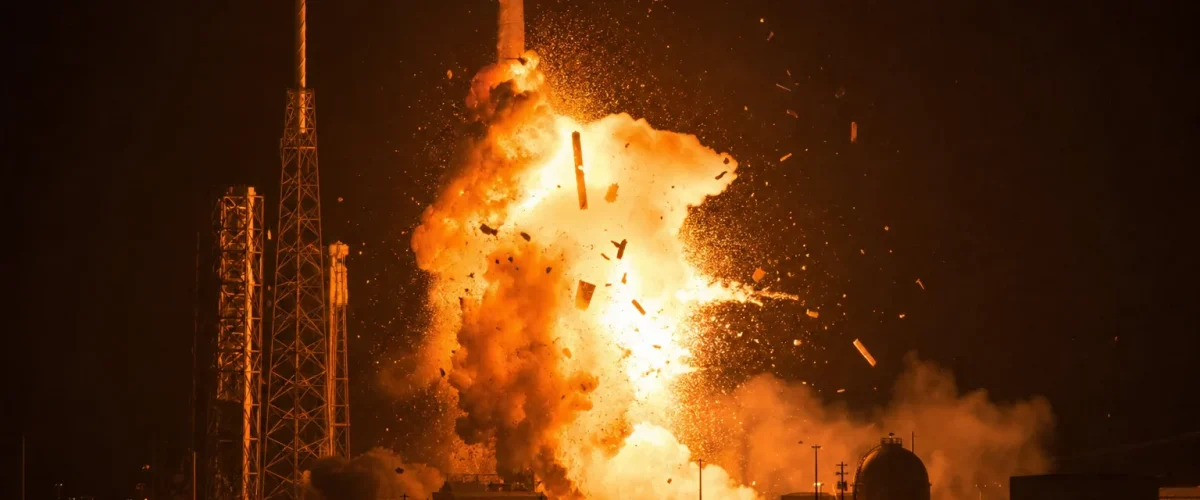
Blue Origin suffered a catastrophic setback on Thursday night when its New Glenn rocket exploded on the launch pad at Cape Canaveral Space Force Station during a routine static fire test. The explosion, which occurred at approximately 9 PM Eastern Time on May 28, caused extensive damage to Launch Complex 36 and toppled one of the facility’s 600-foot lightning protection towers. Remarkably, no injuries were reported.
“We experienced an anomaly during today’s hotfire test,” Blue Origin said in a statement. “All personnel have been accounted for. We will provide updates as we learn more.” The company offered no further details about the cause of the explosion, which was visible for miles across Florida’s Space Coast.
What Happened
The New Glenn rocket — named after astronaut John Glenn, the first American to orbit Earth — was being prepared for a launch carrying a batch of satellites for Amazon’s Leo internet constellation, formerly known as Project Kuiper. The static fire test, a standard pre-launch procedure where the rocket’s engines are briefly ignited while the vehicle remains bolted to the pad, is designed to verify engine performance before the actual launch.
The first stage booster, named No, It’s Necessary, exploded and was destroyed during the test. The satellites were not on board the rocket at the time of the explosion — a standard safety precaution during static fire tests. The planned launch date had been June 4, 2026, for what would have been designated the NG-4 mission.
Video footage from cameras positioned around the launch complex shows a massive fireball erupting from the base of the rocket, followed by a rapid sequence of explosions as fuel tanks ruptured. The blast wave toppled one of the massive lightning towers that surround the pad, sending it crashing into nearby support structures.
Damage Assessment
Launch Complex 36 at Cape Canaveral, which Blue Origin leased from the US Space Force in 2015 specifically for the New Glenn programme, has suffered extensive damage. Beyond the toppled lightning tower, the launch mount, fuel storage systems, and ground support equipment will all need to be assessed for structural integrity before any future launches can be attempted.
Industry experts estimate that pad repairs could take 12 to 18 months, depending on the extent of the damage to underground fuel lines and the launch mount itself. The loss of the first stage booster — a vehicle Blue Origin had hoped to recover and reuse, similar to SpaceX’s Falcon 9 — represents hundreds of millions of dollars in hardware costs.
The US Space Force confirmed that there were no injuries at the Florida spaceport and that emergency response teams were deployed to the site immediately after the explosion. An investigation into the cause of the anomaly has been launched, with both Blue Origin and the FAA expected to participate.
Impact on Amazon’s Satellite Constellation
The explosion deals a significant blow to Amazon’s ambitious Project Kuiper — a planned constellation of low-Earth orbit internet satellites designed to compete with SpaceX’s Starlink. Amazon had been counting on New Glenn as a primary launch vehicle for the constellation, which aims to deploy over 3,200 satellites to provide broadband internet service worldwide.
The NG-4 mission would have carried the first batch of operational Leo satellites. With the launch vehicle destroyed and the pad severely damaged, Amazon faces an indefinite delay in its constellation deployment schedule. The company may need to arrange alternative launch capacity through competitors — ironically, SpaceX’s Falcon 9 or the European Ariane 6 — to maintain its FCC-mandated deployment timeline.
Jeff Bezos, Blue Origin’s founder and Amazon’s executive chairman, posted on X (formerly Twitter) shortly after the explosion. While the content of his post was brief, it marked a rare public acknowledgment of a setback from the billionaire, who has invested over $10 billion of his personal fortune into Blue Origin.
Blue Origin’s Troubled Road
The explosion caps a difficult period for Blue Origin, which has struggled to match the pace set by SpaceX in the commercial launch market. New Glenn’s development has been plagued by delays — the rocket was originally expected to fly in 2020 but did not make its maiden launch until January 2025. That first flight, designated NG-1, successfully reached orbit but failed to recover the first stage booster during its landing attempt.
Subsequent missions, including NG-2 in late 2025 and NG-3 in early 2026, successfully demonstrated the rocket’s orbital capabilities and achieved booster recovery. The NG-4 mission was expected to mark the beginning of commercial operations, transitioning New Glenn from a developmental vehicle to a revenue-generating workhorse.
By comparison, SpaceX has launched over 400 Falcon 9 missions and recently completed a key test flight of its Starship V3 — the next-generation vehicle designed to carry over 100 tonnes to orbit. While Starship’s own development has not been without setbacks — the V3 test flight ended with an explosion in the Indian Ocean after completing its primary objectives — SpaceX’s rapid iteration cycle has allowed it to maintain a commanding lead in the commercial launch market.
Industry Implications
The New Glenn explosion underscores the inherent risks of the space launch business, even for well-funded programmes backed by the world’s wealthiest individuals. Rocket engines operate at extreme temperatures and pressures, and static fire tests — while designed to catch problems before flight — can themselves become catastrophic events.
For the broader commercial space industry, the incident raises questions about launch vehicle diversity and the risks of depending on a limited number of providers. With New Glenn sidelined, the global heavy-lift launch market is even more dominated by SpaceX, a concentration that concerns both commercial satellite operators and government agencies.
Blue Origin has not yet indicated a timeline for return to flight. The investigation into the May 28 explosion will need to identify the root cause before any corrective measures can be designed and implemented. For Jeff Bezos and his space ambitions, it is a painful reminder that reaching for the stars remains one of humanity’s most challenging endeavours.
Related Articles
- SpaceX Starship V3 Completes Key Test Objectives Before Exploding in Indian Ocean
- NASA Unveils $20 Billion Roadmap to Build Permanent Moon Base
- Red Balloon Aerospace Launches India’s First Indigenous Stratospheric Balloon