NASA Unveils $20 Billion Roadmap to Build Permanent Moon Base — Awards Nearly $1 Billion in New Lunar Contracts

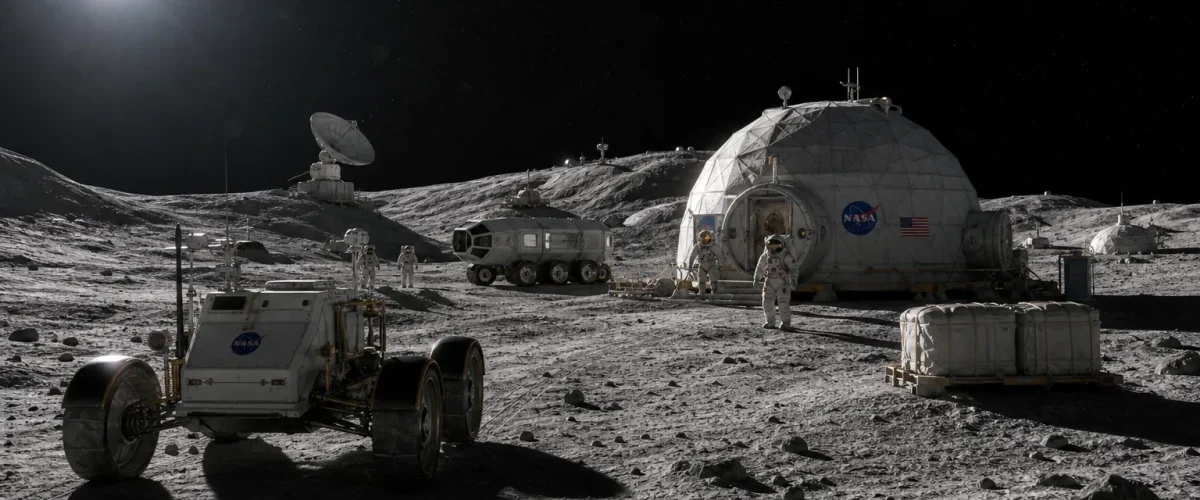
Humanity’s First Settlement on Another World Takes Shape Under Artemis Program
Less than two months after four Artemis II astronauts flew around the Moon for the first time in over half a century, NASA has announced the detailed roadmap for building humanity’s first permanent settlement on another celestial body. The space agency on Tuesday unveiled a comprehensive plan for the Moon Base program, estimated to cost approximately 20 billion US dollars over the next decade, with the initial phase involving three uncrewed cargo missions launching in 2026 to prepare the lunar South Pole for sustained human presence.
Alongside the roadmap, NASA awarded close to one billion dollars in new contracts to American companies for lunar rovers, cargo landers and hopping drones that will form the operational backbone of the Moon Base. The announcement was made by NASA Administrator Jared Isaacman, who described the Moon Base as America’s and humanity’s first outpost on another celestial world and a critical stepping stone towards eventual crewed missions to Mars.
Three Moon Base Missions Planned for 2026
The three cargo missions announced for 2026 are designed to test critical equipment and reduce operational risk before astronauts land at the lunar South Pole under the Artemis III mission, now scheduled for 2027. Each mission will deliver specific hardware and conduct experiments that will inform the design and operations of the permanent base.
The first mission, designated Moon Base I, will use Blue Origin’s cargo lander to deliver two scientific instruments to a ridge near the Moon’s South Pole. Jeff Bezos’s Blue Origin was selected over SpaceX for this initial mission, marking a significant win for the company in the increasingly competitive lunar services market. The instruments will characterise the lunar regolith, measure radiation levels and test communications systems that will be essential for future base operations.
Moon Base II will deliver a suite of engineering test articles, including prototype habitat components, power generation units and life support system prototypes. This mission will provide critical data on how these systems perform in the harsh lunar environment, where temperatures can swing from minus 173 degrees Celsius in shadow to plus 127 degrees in direct sunlight. The lander for this mission is yet to be announced, with NASA expected to open a competitive solicitation in the coming months.
Moon Base III is designed to study the unusual bright patches on the Moon’s surface known as lunar swirls and will carry equipment from both the European Space Agency and South Korea’s space agency, KARI. This mission reflects the increasingly international character of the Artemis program, with partner nations contributing both hardware and scientific expertise to the lunar exploration effort.
Rovers, Drones and Hopping Robots: The Tools of Lunar Exploration
NASA has awarded contracts worth a combined 439 million US dollars to two American companies, Astrolab and Lunar Outpost, to build the first operational Moon rovers. Astrolab received 219 million dollars for its FLEX rover, while Lunar Outpost was awarded 220 million dollars for its Mobile Autonomous Prospecting Platform. Both rovers are expected to be ready for deployment by 2028 and will be capable of traversing the challenging terrain around the lunar South Pole, including the permanently shadowed craters where water ice is believed to exist.
In addition to the rovers, NASA is also sending four small hopping drones to the Moon in 2028, designed to photograph and survey terrain that is too dangerous or difficult for wheeled rovers to reach. The drones will be capable of short hops of up to several hundred metres, allowing them to access crater rims, steep slopes and other features that would be inaccessible to conventional rovers. Firefly Aerospace has been contracted to build the spacecraft that will carry the hopping drones to the lunar surface.
Once the drones complete their survey flights, sensors left behind at each landing site will continue collecting data for months, creating a distributed network of scientific instruments across the South Pole region. This approach will provide NASA with a comprehensive understanding of the local environment before committing to permanent infrastructure construction.
Why the Lunar South Pole?
The focus on the lunar South Pole is driven by the presence of water ice in permanently shadowed craters, a resource that could be transformative for sustained lunar operations. Water can be split into hydrogen and oxygen, providing breathable air for astronauts and, critically, rocket propellant that could be manufactured on the Moon rather than transported from Earth at enormous cost. The ability to produce propellant locally, known as in-situ resource utilisation, is considered essential for making a permanent Moon base economically sustainable.
The South Pole also offers nearly continuous sunlight on certain elevated ridges, providing reliable solar power for base operations. The combination of accessible water ice and abundant solar energy makes the region uniquely suited for long-term habitation, a conclusion supported by data from India’s Chandrayaan missions, which provided some of the earliest confirmation of water ice deposits in the polar regions.
International Implications and India’s Role
NASA’s Moon Base program has significant implications for India’s space ambitions. India is a signatory to the Artemis Accords, the framework of principles governing international cooperation in lunar exploration, and has been in discussions with NASA about potential contributions to the Moon Base program. India’s expertise in lunar science, demonstrated through the Chandrayaan series of missions, positions it as a valuable partner for the international effort.
The announcement also underscores the accelerating space race between the United States and China, which has its own ambitious lunar program including the planned Chang’e-7 mission and a proposed International Lunar Research Station. The strategic competition for lunar resources and presence is driving both nations to invest heavily in lunar infrastructure, with implications for the global space industry and geopolitical alignments.
If successful, the Moon Base program will mark NASA’s first step toward a continuous, unbroken presence at the Moon’s South Pole, transforming humanity’s relationship with its nearest celestial neighbour from one of brief visits to permanent habitation.
Explore more: Science | International
Related Articles
- NASA Moon Base Strategy Under Artemis Program
- SpaceX Starship V3 Test Flight Objectives
- Red Balloon Aerospace Launches India’s First Indigenous Stratospheric Balloon Pl

- India’s Startup Funding Crosses $7.2 Billion in H1 2026 - July 1, 2026
- After Ireland Shock, India’s T20I Side Faces Bigger Test - July 1, 2026
- Ireland Stun World Champions India 2-0 in Belfast, Sooryavanshi Debate Rages On - June 29, 2026