Andhra Pradesh Launches Amaravati Quantum Valley as IISc GaN Transistor Breakthrough Signals India’s Rising Scientific Ambitions

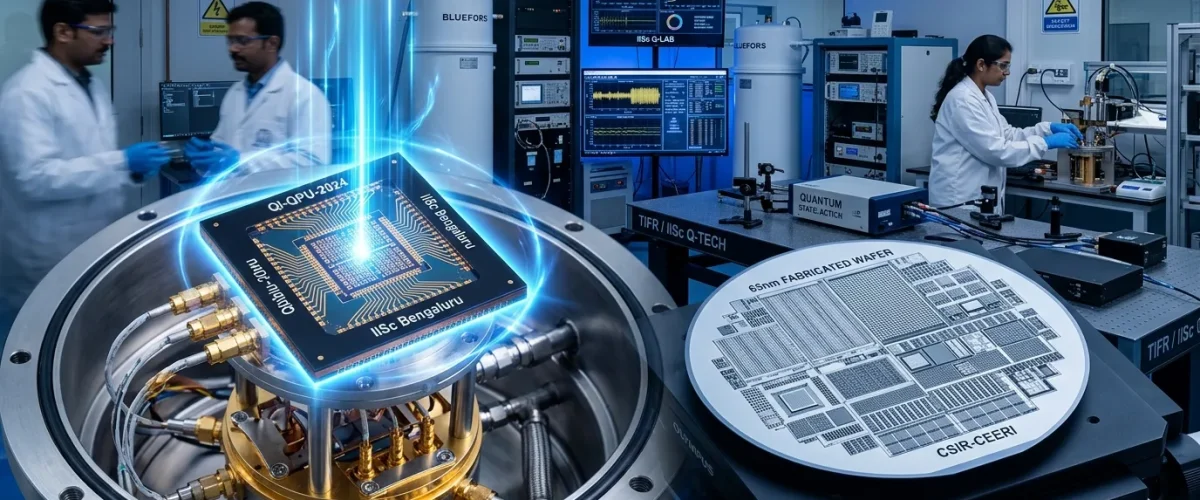
Andhra Pradesh Chief Minister N. Chandrababu Naidu is set to launch two state-of-the-art quantum computer test beds on 14 April 2026, coinciding with World Quantum Day, as part of the Amaravati Quantum Valley initiative. The launch positions the state as a central hub in India’s growing quantum technology ecosystem. In a separate development, researchers at the Indian Institute of Science in Bengaluru have achieved a major advance in gallium nitride transistor technology that could cut electric vehicle charging times by 30 per cent, while ISRO successfully completed the second Integrated Air Drop Test for the Gaganyaan mission.
Together, these developments signal the expanding scope of India’s scientific ambitions, spanning quantum computing, advanced materials and human spaceflight in a single week of April 2026.
Amaravati Quantum Valley: AP’s Bid to Lead India’s Quantum Race
The Amaravati Quantum Valley represents one of the most ambitious state-level science initiatives in India. By establishing quantum computer test beds in the state capital, Andhra Pradesh aims to attract researchers, startups and industry partners working on quantum applications in areas including cryptography, drug discovery, logistics optimisation and materials science.
Chief Minister Naidu, who has long championed technology-driven governance, sees the quantum initiative as part of a broader strategy to position Andhra Pradesh as a knowledge economy hub. The state has invested in building physical infrastructure, educational partnerships and policy frameworks to support quantum research. The choice of World Quantum Day for the launch reflects the global significance of the initiative and India’s desire to be seen as a serious participant in the quantum computing race.
India’s quantum computing programme has been gaining momentum through the National Quantum Mission, which supports both academic and commercial research. QpiAI launched India’s first full-stack 25-qubit quantum computer, and the national quantum computing programme is accelerating with increased funding and international collaboration. The Amaravati Quantum Valley adds a state-level dimension to this national effort, potentially creating a regional cluster effect that attracts talent and investment.
IISc Bengaluru’s GaN Transistor Breakthrough
Researchers at the Indian Institute of Science in Bengaluru have achieved a significant breakthrough in gallium nitride transistor technology that could have far-reaching implications for electric vehicles and data centres. The team developed a novel vertical GaN transistor structure that dissipates heat 50 per cent more effectively than existing designs, enabling twice the power density compared to silicon carbide alternatives.
The fabrication process involves epitaxial growth of GaN layers on silicon substrates, followed by selective etching to form fin-like channels and passivation with aluminium oxide for stability. In real-world testing, the transistors demonstrated 99 per cent efficiency at 1,200 volts, a performance level that could reduce EV charging times by approximately 30 per cent and cut data centre energy consumption by up to 20 per cent.
Gallium nitride has been recognised as a wide-bandgap semiconductor with enormous potential for high-efficiency power electronics, but thermal management challenges have historically limited its adoption at scale. The IISc team’s innovation addresses this core limitation, and stakeholders including automotive manufacturers have hailed the development. Future prototypes are being prepared for commercialisation, with industry partnerships expected to bring the technology to market by 2027.
The breakthrough positions India at the forefront of next-generation power electronics, an area with significant implications for the country’s growing research output and its ambitions in domestic EV manufacturing and green energy infrastructure.
ISRO Clears Another Gaganyaan Milestone
The Indian Space Research Organisation successfully completed the second Integrated Air Drop Test for the Gaganyaan mission on 9 April 2026. Union Minister Dr Jitendra Singh congratulated ISRO, describing the achievement as a significant step towards India’s first crewed spaceflight mission, scheduled for launch in 2027.
The IADT-02 test validated critical systems related to crew module recovery, including parachute deployment sequencing and splashdown procedures. These tests are essential for ensuring astronaut safety during the return phase of the mission. With the crew module having completed abort tests earlier in the year, the Gaganyaan programme is progressing through its verification milestones at a steady pace.
ISRO has mapped out its busiest year yet in 2026, with over 10 missions planned including the Gaganyaan uncrewed flight, Chandrayaan-4 preparations and multiple PSLV and GSLV launches. India’s space programme, which has historically excelled at cost-effective missions, is now tackling the more complex challenge of human spaceflight, requiring new levels of reliability and safety assurance.
Frog-Inspired Sensor and Other Research Highlights
Indian researchers have also developed a humidity-responsive neuromorphic sensor inspired by frogs, representing a breakthrough in next-generation computing. The sensor, which mimics the way biological neural networks process information, could significantly reduce energy consumption in conventional electronic systems. The innovation is part of a broader push towards neuromorphic computing, which aims to create hardware that processes information more like a human brain than traditional digital circuits.
India’s research institutions have been climbing global rankings, with 54 institutions featured in the QS World University Rankings 2026, a five-fold increase since 2015. The Anusandhan National Research Foundation, established to coordinate and fund research across the country, has launched mission-mode programmes in AI, critical minerals, energy and other priority areas.
The National Supercomputing Mission has deployed over 40 petaflops of computing capacity across IITs, IISERs and research laboratories, creating a distributed high-performance computing infrastructure that supports research across the science spectrum, from climate modelling, drug discovery and artificial intelligence. This infrastructure investment is paying dividends in the form of publications, patents and industry collaborations that are raising India’s profile in the global scientific community.
Building a Scientific Ecosystem for the Future
The week’s developments in quantum computing, semiconductor technology, space exploration and neuromorphic sensing illustrate the breadth of India’s scientific ambitions. What connects these advances is a common thread of indigenous development, with Indian institutions and researchers increasingly producing innovations that are globally competitive rather than derivative.
The challenge ahead lies in translating laboratory breakthroughs into commercial products and public goods. India’s research-to-market pipeline has historically been slower than those of the US, China or Europe, hampered by funding gaps, regulatory complexity and limited industry-academia collaboration. Initiatives like the Amaravati Quantum Valley, the IndiaAI Mission and the Anusandhan National Research Foundation are designed to address these bottlenecks, but their success will ultimately be measured by outcomes rather than announcements.
As India celebrates World Quantum Day on 14 April 2026 with a tangible infrastructure launch, the signal to the world is clear: Indian science is moving from aspiration to execution, and the pace is accelerating.

- Fentanyl Vaccine Breakthrough: Scripps Research Develops Shot That Blocks Deadly Overdoses Before They Reach the Brain - June 13, 2026
- Nipah Virus Returns to Kerala — First Case of 2026 Confirmed, State Declares High Alert - June 12, 2026
- Jill Biden Reveals She Wanted to Keep PM Modi’s 7.5-Carat Diamond Gift but Returned It After State Department Valued It at $20,000 - June 8, 2026