Japan Bans Indian Mango Imports After 20 Years Over Pest Contamination — Zero-Tolerance Policy Hits Alphonso and Kesar Exports

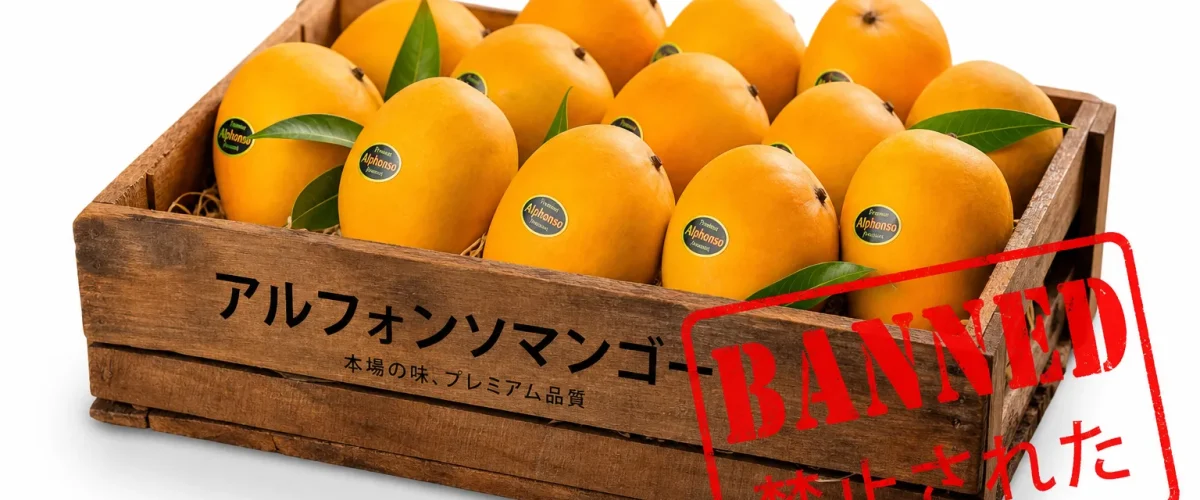
Zero-Tolerance Policy Ends Two Decades of Indian Mango Exports to Japan
Japan has imposed an immediate ban on all imports of Indian mangoes after its Plant Protection Station detected fruit fly larvae in multiple recent shipments, officials confirmed on Thursday. The ban, which covers all varieties of Indian mangoes including the prized Alphonso and Kesar, effectively ends a 20-year-old bilateral arrangement that had allowed irradiated Indian mangoes access to the strictly regulated Japanese market since 2006.
Japan follows a zero-tolerance policy for invasive pests such as the Oriental fruit fly (Bactrocera dorsalis), which is considered a major threat to domestic agriculture. The country’s Ministry of Agriculture, Forestry and Fisheries issued a notification to the Indian Embassy in Tokyo on Wednesday, formally suspending the phytosanitary protocol that governed mango imports and requiring India to demonstrate improved pest management procedures before trade can resume.
What Went Wrong — The Contamination Trail
According to Japanese food safety officials, fruit fly larvae were detected in five separate consignments of Indian mangoes at ports in Yokohama and Kobe over a three-week period in May. The contaminated shipments originated from packing facilities in Maharashtra and Gujarat, the two states that account for the bulk of India’s premium mango production. Japanese inspectors reportedly found live larvae in mangoes that had been certified as having undergone the mandatory vapour heat treatment designed to eliminate pest contamination.
The discovery raised serious questions about the effectiveness of India’s pre-export inspection and treatment protocols. The Agricultural and Processed Food Products Export Development Authority, which oversees India’s mango exports, said it had launched an investigation into the contaminated shipments and would “take strict action against any packing house found to have violated phytosanitary standards.” However, industry sources suggested that the problem may be systemic rather than limited to individual facilities.
India’s mango export infrastructure has been under strain this season due to the unprecedented heatwave and El Niño conditions that have devastated the Alphonso crop in Maharashtra’s Konkan belt. The severely reduced crop has led to frantic efforts to export whatever fruit is available, potentially leading to shortcuts in quality control and pest treatment procedures.
Economic Impact on Indian Mango Exporters
While Japan is not India’s largest mango export market by volume — that distinction belongs to the UAE, followed by the US and UK — it is among the highest-value destinations due to the premium prices that Indian mangoes command in Japanese retail. A single box of six Alphonso mangoes can retail for ¥5,000 to ¥8,000 ($33 to $53) in upscale Japanese department stores, significantly higher than prices in other export markets.
India exported approximately 1,200 metric tonnes of mangoes to Japan in 2025, generating export revenue of approximately $15 million. The ban is expected to affect around 50 licensed packing houses across Maharashtra, Gujarat and Andhra Pradesh that were authorised to export to Japan. Many of these facilities had invested heavily in vapour heat treatment equipment and quality control systems specifically to meet Japan’s stringent requirements.
The ban also comes at the worst possible time for Indian mango exporters who were already reeling from a poor domestic harvest. The combination of reduced crop volumes, elevated domestic prices and now the closure of a premium export market has created a “perfect storm” for the Indian mango trade, according to Praveen Shetty, president of the All India Mango Growers Association.
India’s Track Record with Japanese Food Safety Standards
India has a complicated history with Japan’s food safety regulations, which are among the most stringent in the world. Indian mangoes were initially granted market access in 2006 after years of bilateral negotiations, with the condition that all exported mangoes undergo vapour heat treatment at approved facilities under the supervision of Indian food safety authorities. The arrangement was suspended briefly in 2014 after fruit fly interceptions but was restored following remedial measures by India.
The current ban is the longest and most serious disruption in the bilateral mango trade. Japanese officials indicated that India would need to conduct a comprehensive review of its pest management and export inspection protocols, with Japanese inspectors potentially visiting Indian facilities to verify compliance before the ban could be lifted. Industry sources suggested the process could take six months to a year, effectively ruling out Indian mangoes from the Japanese market for the remainder of the 2026 season and potentially the 2027 season as well.
The incident also highlights the broader challenges India faces in expanding its agricultural exports to high-value markets. Despite being the world’s largest producer of mangoes, producing over 20 million tonnes annually, India exports less than 0.5 per cent of its total production. Quality control, cold chain infrastructure, and compliance with international phytosanitary standards remain persistent barriers to scaling up agricultural exports.
Government Response and Industry Remediation
Commerce Minister Piyush Goyal, who is currently on an official visit to Canada, said the government would “engage proactively with Japanese authorities to resolve the issue at the earliest” and instructed APEDA to submit a remediation plan within two weeks. The minister’s statement came against the backdrop of India’s broader trade dialogue with Japan, which includes discussions on expanding the India-Japan Comprehensive Economic Partnership Agreement.
APEDA has ordered the immediate suspension of export certification for the packing houses linked to the contaminated shipments and has directed all Japan-approved facilities to undergo emergency re-inspection. The authority is also exploring the possibility of transitioning from vapour heat treatment to irradiation treatment, which is considered more reliable for pest elimination, though this would require renegotiation of the bilateral phytosanitary protocol with Japan.
Implications for India’s Agricultural Export Ambitions
India’s mango export ban from Japan comes at a time when the government has set ambitious targets for agricultural exports, aiming to double them to $100 billion by 2030. Meeting this target requires India to gain and maintain access to premium markets like Japan, South Korea and the European Union, all of which have strict food safety and phytosanitary requirements that Indian exporters have historically struggled to meet consistently.
The ban should serve as a “wake-up call” for India’s agricultural export infrastructure, according to Ashok Gulati, agricultural economist and former chairman of the Commission for Agricultural Costs and Prices. Gulati argued that India needs to invest significantly in modernising its cold chain, packing house infrastructure and pest management systems if it wants to compete with countries like Vietnam, the Philippines and Mexico that have steadily expanded their fruit exports to premium markets.
Explore more: Business | Economy
Related Articles
- Japan Bans Indian Mango Imports After 20 Years Over Pest Contamination — Zero-Tolerance Policy Hits Alphonso and Kesar Exports
- India and Canada to Conclude CEPA by November — PM Carney Calls Comprehensive Trade Deal a ‘Game Changer’ for Both Nations
- Reliance’s Ambani Green Energy Giga Complex Ships First Batch of High-Efficiency Solar Modules from Jamnagar — India’s Clean Energy Push Gets Major Boost

- Fentanyl Vaccine Breakthrough: Scripps Research Develops Shot That Blocks Deadly Overdoses Before They Reach the Brain - June 13, 2026
- Nipah Virus Returns to Kerala — First Case of 2026 Confirmed, State Declares High Alert - June 12, 2026
- Jill Biden Reveals She Wanted to Keep PM Modi’s 7.5-Carat Diamond Gift but Returned It After State Department Valued It at $20,000 - June 8, 2026