Indian Passport Jumps 10 Spots to 75th on Henley Index 2026: Visa-Free Access to 56 Countries

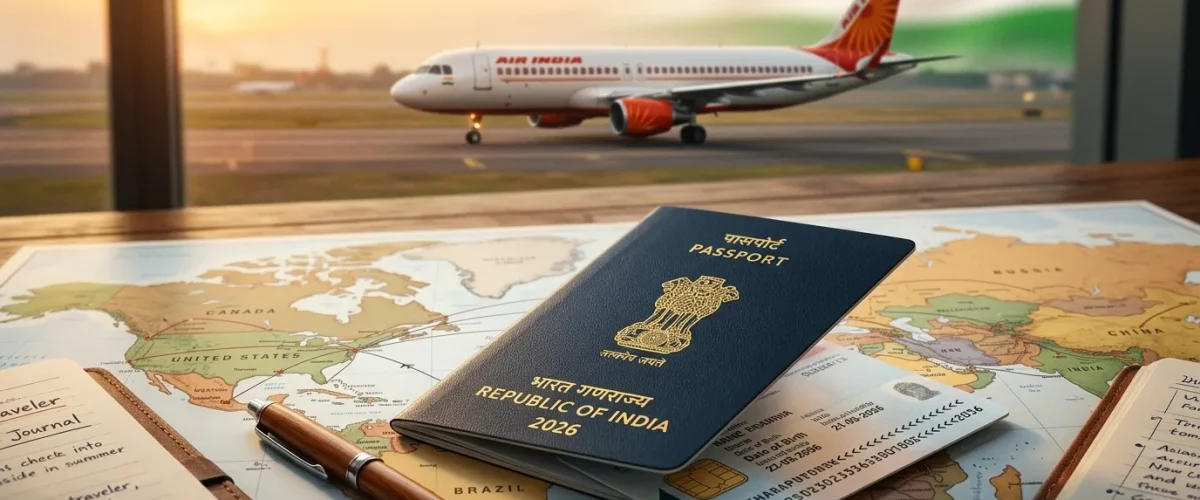
India’s passport has climbed ten spots to 75th position on the Henley Passport Index for February 2026, marking the biggest year-on-year improvement in over a decade. Indian citizens can now travel visa-free, obtain visa-on-arrival, or secure electronic travel authorisation to 56 countries — up from 52 last year. While India remains below its 2006 high-water mark of 71st, the improvement signals steady diplomatic progress and growing international recognition of Indian travellers.
The Henley Passport Index, published by London-based Henley & Partners, is considered the most authoritative global ranking of travel freedom. It uses exclusive data from the International Air Transport Association (IATA) and covers 199 passports worldwide. The 2026 ranking placed Japan and Singapore at the top with access to 195 destinations, while India’s jump from 85th to 75th was one of the steepest climbs among major economies.
Which Countries Opened Up for Indian Passport Holders?
India’s improved ranking stems from a series of bilateral agreements inked over the past 18 months. Key additions include:
- Thailand — Extended 60-day visa exemption for Indian tourists, a major boost for one of India’s most popular holiday destinations
- Sri Lanka — Expanded visa-free window to 60 days, strengthening people-to-people ties with India’s southern neighbour
- Kazakhstan — Introduced 60-day visa-free access for Indian citizens, facilitating both tourism and business travel
- Kenya and Rwanda — Scrapped advance visa requirements for Indian tourists, opening up East Africa for Indian travellers
- Barbados and Dominica — Formalised visa-on-arrival privileges for Indian passport holders
- The Gambia — Added in January 2026, becoming the latest country to waive visa requirements for Indians
Analysts also credit India’s own decision to waive short-term e-tourist visa fees for key ASEAN markets, which prompted reciprocal gestures from several Southeast Asian nations. India’s travel and tourism sector has been a major beneficiary of these policy changes.
Where Do Barriers Remain?
Despite the improved headline number, mobility experts note important nuances. The majority of India’s new visa-free destinations are leisure-focused emerging markets, while significant barriers remain for traditional business and travel hubs. The United States, China, most of the European Union, Japan, Canada, Australia, and the United Kingdom all still require Indian citizens to undergo full visa application processes, often with long wait times and extensive documentation.
Additionally, two destinations were actually lost in 2026 — Iran suspended its visa waiver programme for Indian tourists amid regional tensions, and Bolivia replaced visa-on-arrival with a paid e-visa. This means that while the gross number of accessible destinations rose, the net gain was slightly offset. In January 2026, the total briefly dipped to 55 before The Gambia’s addition brought it back to 56 in February.
India’s Outbound Tourism Boom
The passport improvement coincides with a record year for Indian outbound tourism. According to industry estimates, over 30 million Indians are expected to travel internationally in 2026, up from approximately 27 million in 2025. Southeast Asia (Thailand, Bali, Vietnam, Malaysia), the Middle East (Dubai, Abu Dhabi), and the Maldives remain the most popular destinations, while newer markets like Azerbaijan, Georgia, and East Africa are seeing rapid growth.
India’s domestic summer travel trends have also been remarkable, but the international travel segment is growing even faster. The combination of rising incomes, affordable airfares, and easier visa access has created a perfect storm for outbound tourism. For international travel enthusiasts, 2026 offers more options than ever before.
Diplomatic Strategy Behind the Climb
India’s passport improvement is not accidental — it reflects a deliberate diplomatic strategy by the Ministry of External Affairs. Under the Neighbourhood First and Act East policies, India has prioritised mobility agreements with South and Southeast Asian nations. The G20 presidency in 2023 and subsequent bilateral summits have been used as platforms to push for reciprocal travel agreements.
India’s growing economic weight — it is now the world’s fourth-largest economy with a GDP expected to grow at 6.6-6.9% in FY2026-27 — gives it leverage in these negotiations. As Indian tourists and business travellers become a more significant revenue source for destination countries, the incentive for visa liberalisation grows.
The India’s robust economic fundamentals underpin this soft-power expansion. Countries that have opened their doors to Indian tourists report significant growth in tourism receipts, incentivising further liberalisation. India’s booming property market has also attracted NRI investors, further strengthening bilateral ties.
What Could Further Improve India’s Passport Ranking?
To break into the top 50 — a stated goal of the Indian government — India would need visa-free or visa-on-arrival access to approximately 70 or more countries. This would require breakthroughs with major blocs like the European Union (Schengen visa), the United States, and East Asia. Progress on these fronts is expected to be gradual, with potential EU visa liberalisation being the most realistic near-term prospect.
For now, Indian travellers can celebrate meaningful progress. With 56 destinations available without a full visa process, planning international holidays has never been easier. As the travel industry continues to recover and expand post-pandemic, India’s improved passport ranking is a welcome development for the country’s millions of aspiring global travellers.