From Frog-Inspired Brain Sensors to India’s First CAR-T Therapy: Biotech Breakthroughs Redefining Indian Science in 2026

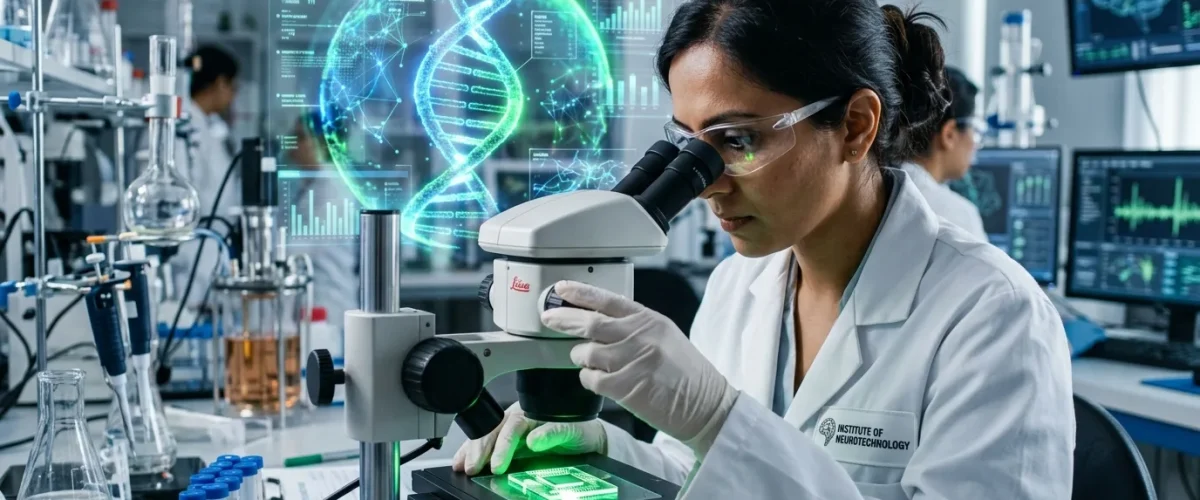
April 2026 has been a milestone month for Indian biological sciences, with breakthroughs spanning neuromorphic electronics, cancer immunotherapy, gene-editing infrastructure, and antibiotic-resistance research. These developments position India at the forefront of a global biotech revolution — and they have implications for everything from electronics to healthcare.
Frog-Inspired Brain-Like Sensor: A World First
Indian scientists have developed a humidity-responsive neuromorphic sensor inspired by frog biology that can sense, process, and store information simultaneously within a single device — mimicking how the human brain works. The research, announced in early April 2026, represents a major leap in neuromorphic electronics, a field that seeks to build computing systems modelled on biological neural networks rather than traditional silicon architectures.
The sensor is based on the remarkable ability of frogs to detect humidity changes through their skin. Researchers replicated this biological mechanism using specially engineered materials that change their electrical properties in response to moisture, while simultaneously acting as both processor and memory. Traditional electronics require separate components for sensing, computing, and storage; this device combines all three into one — potentially reducing energy consumption by orders of magnitude.
The implications are far-reaching. If scaled, neuromorphic sensors could transform fields from wearable health devices (detecting sweat composition in real time) to environmental monitoring (smart sensors in agriculture that respond autonomously to humidity changes). The research also feeds into India’s growing AI hardware ecosystem, where the convergence of biology and computation is creating new categories of intelligent devices.
India Launches First Indigenous CAR-T Cancer Therapy
In what may be the most consequential medical development from India this year, NexCAR19 — India’s first indigenous CAR-T (Chimeric Antigen Receptor T-cell) cell therapy — was launched in early April 2026 for treating leukemia and lymphoma. CAR-T therapy works by extracting a patient’s T-cells (a type of immune cell), genetically engineering them to recognise and attack cancer cells, and infusing them back into the patient. Until now, CAR-T treatments were only available from Western pharmaceutical companies at costs exceeding ₹3–4 crore per patient, putting them out of reach for virtually all Indian cancer patients.
NexCAR19, developed by ImmunoACT — a company spun out of the Indian Institute of Technology Bombay in collaboration with Tata Memorial Hospital — aims to deliver the therapy at a fraction of the international cost: initial estimates place the price at ₹30–40 lakh, still significant but transformative for a country where an estimated 15 lakh new cancer cases are diagnosed annually. Early clinical trials showed promising results in B-cell acute lymphoblastic leukemia (B-ALL), with high complete-remission rates.
This development is part of a broader trend in Indian healthcare innovation, paralleling breakthroughs in healthtech startups like Temple that are leveraging technology to reduce the cost of advanced medical care.
How Bacteria Share Antibiotic Resistance: A Startling Discovery
In a research paper published on April 16, 2026, an international team of scientists revealed a surprising new mechanism by which bacteria share antibiotic-resistance genes — through “selfless” DNA transfer mediated by Gene Transfer Agents (GTAs). Unlike traditional horizontal gene transfer, where bacteria exchange genetic material through conjugation or transformation, GTAs are tiny virus-like particles that a bacterium produces at the cost of its own survival: the host cell essentially explodes to release GTAs carrying DNA fragments, which are then taken up by neighbouring bacteria.
This discovery has profound implications for the global fight against antimicrobial resistance (AMR), which the WHO considers one of the top ten public health threats. If bacteria can spread resistance genes through self-sacrifice — a form of biological altruism — then the spread of AMR may be even more rapid and pervasive than previously modelled. The findings suggest that new strategies targeting GTAs, rather than just the bacteria themselves, may be needed to contain the resistance crisis.
CRISPR Centre of Excellence at JNCASR Bengaluru
India’s Department of Science and Technology signed a Letter of Intent to establish a Centre of Excellence for CRISPR Innovation and Translation (CoE-CIT) at the Jawaharlal Nehru Centre for Advanced Scientific Research (JNCASR) in Bengaluru, in partnership with CrisprBits, a Delhi-based biotechnology firm. The centre aims to translate cutting-edge CRISPR gene-editing discoveries from the laboratory into real-world clinical applications.
CRISPR technology — which allows scientists to edit DNA with unprecedented precision — has transformed biology globally since its invention in 2012. India, however, has lagged behind the US, China, and Europe in applying CRISPR to agriculture, medicine, and industrial biotechnology. CoE-CIT is designed to close this gap by providing shared infrastructure, regulatory guidance, and translational research support to academic labs and startups.
The centre’s initial focus will include CRISPR-based diagnostics for tropical diseases, gene therapies for sickle-cell anemia (which disproportionately affects Indian tribal populations), and agricultural applications such as drought-resistant crop varieties that could bolster India’s food security under changing climate conditions.
India’s Biotech Sector: The Bigger Picture
These four developments — neuromorphic bio-sensors, CAR-T therapy, GTA-mediated resistance, and CRISPR infrastructure — are not isolated events. They reflect a maturing Indian biotech ecosystem that is attracting both talent and capital. The Indian biotech sector was valued at approximately $130 billion in 2025 and is projected to reach $200 billion by 2030, driven by pharmaceutical exports, contract research, and a growing domestic demand for advanced healthcare.
Government investment through the Biotechnology Industry Research Assistance Council (BIRAC) and private-sector funding from venture capital firms are creating a pipeline of startups focused on synthetic biology, precision medicine, and agricultural biotech. India’s Science & Space sector is increasingly intertwined with its biotech ambitions, as satellite data for crop monitoring, AI for drug discovery, and quantum computing for protein folding begin to converge.
What’s at Stake
For India, the biotech revolution is not just about economic opportunity — it is about equity. NexCAR19’s mission to make cancer therapy affordable, CoE-CIT’s focus on tribal healthcare, and neuromorphic sensors’ potential to democratise smart agriculture all address the fundamental challenge of ensuring that scientific progress reaches the 800 million Indians who live on less than $5 a day. April 2026 is a reminder that India’s most transformative innovations may come not from Silicon Valley but from the intersection of biology and necessity.
Explore more on Biology at Daily Tips for cutting-edge science and research updates from India and the world.

- Indian Army Gets New Chief as General Dwivedi Hands Over Command Amid Push for Indigenous Defence Tech - July 1, 2026
- Ayodhya Ram Temple Donation Scandal Deepens as Trustees Resign and SIT Arrests Eight - June 29, 2026
- Bengal Seven Weeks On: Modi’s Historic Win and the Questions That Won’t Go Away - June 28, 2026