Eurovision 2026 in Vienna Faces Biggest Boycott in 70 Year History as Five Countries Withdraw Over Israel Participation and 1100 Artists Demand Ban

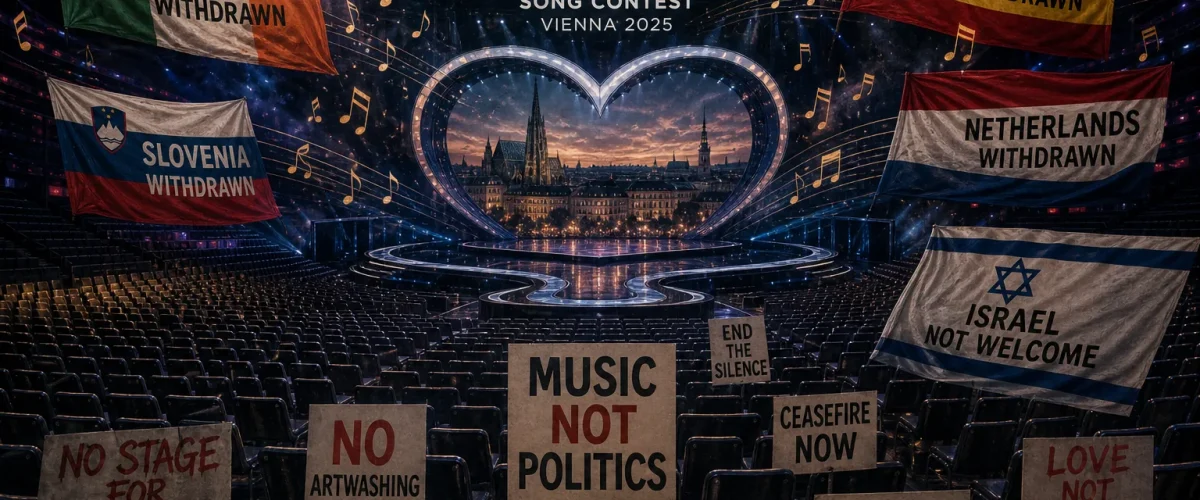
The 70th edition of the Eurovision Song Contest, scheduled to take place in Vienna, Austria this month, is facing the biggest boycott in the competition’s history as five nations have officially withdrawn and over 1,100 musicians and cultural workers have signed an open letter demanding the exclusion of Israel over its ongoing military operations in Gaza. The crisis has transformed what was supposed to be a celebration of European musical unity into a geopolitical flashpoint that threatens to fundamentally alter the competition’s future.
Iceland, Ireland, the Netherlands, Slovenia, and Spain have all officially withdrawn their entries from Eurovision 2026, citing the European Broadcasting Union’s (EBU) refusal to exclude Israel’s public broadcaster, Kan, from the competition. The withdrawals represent an unprecedented fracturing of the Eurovision community, which has historically prided itself on transcending political divisions through the universal language of music.
The Open Letter
The boycott movement gained significant momentum when campaign groups No Music for Genocide and the Palestinian Campaign for the Academic and Cultural Boycott of Israel (PACBI) published an open letter on April 21 calling on performers, fans, and broadcasters to “reject Eurovision being used to whitewash and normalise Israel’s genocide, siege and brutal military occupation against Palestinians.”
The letter, signed by over 1,100 artists, includes major international names such as Brian Eno, Macklemore, Sigur Rós, Paloma Faith, Kneecap, Massive Attack, and former Eurovision winners. The signatories accused the EBU of “hypocritical responses to Russia’s and Israel’s crimes,” referencing the organization’s decision to ban Russia from the competition in 2022 following its invasion of Ukraine while refusing to take similar action against Israel.
“How can any performer or Eurovision fan in good conscience participate at the contest’s next edition in Austria amidst US-Israeli plans for hyper-surveilled concentration camps in ‘New Gaza’?” the letter reads. “There are moments in time when passive silence is not an option. We refuse to be silent when Israel’s genocidal violence soundtracks and silences Palestinian lives.”
The Five Withdrawals
The withdrawal of five countries represents a dramatic escalation of the protest movement. Each nation cited its own reasons for pulling out, though all pointed to the EBU’s refusal to address Israel’s participation as the central issue:
Iceland’s RÚV was the first broadcaster to announce its withdrawal, citing public pressure and the recommendations of an advisory committee that included cultural figures and human rights advocates. Ireland’s RTÉ followed, with the Irish government publicly supporting the decision and calling for the EBU to “apply its own rules consistently.”
The Netherlands’ AVROTROS withdrew after a heated internal debate, with the broadcaster’s board ultimately concluding that participation would compromise its commitment to human rights values. Slovenia’s RTVSLO and Spain’s RTVE announced their withdrawals in the same week, creating a domino effect that sent shockwaves through the Eurovision community.
The Spanish withdrawal was particularly significant given Spain’s status as one of the “Big Five” countries — the largest financial contributors to the contest who are guaranteed a spot in the grand final. Spain’s departure leaves a conspicuous gap in the lineup and reduces the competition’s prestige and viewership potential.
The EBU’s Position
The European Broadcasting Union has maintained that Eurovision is a “non-political” cultural event and that the participation of member broadcasters is determined by their standing within the organization, not by the foreign policies of their respective governments. The EBU declined to put the exclusion of Israel to a vote at its December meeting, a decision that directly triggered the withdrawal cascade.
Israeli outlet Ynet reported that Israeli President Isaac Herzog assembled a team to push for Israel’s continued participation, including “direct lobbying of EBU members, aiming to prevent the assembly from moving to a binding vote that Israel feared it might lose.” The report suggests that Israel was aware it might not survive a democratic vote among EBU members — a revelation that has further fuelled the boycott movement.
In a further act of protest, the Swiss winner of the 2024 Eurovision Song Contest, Nemo, returned their trophy after Israel was cleared to participate in this year’s event. The gesture was widely covered in international media and became a symbol of the growing rift between the EBU and a significant portion of the Eurovision fanbase.
Vienna Prepares Amid Controversy
Despite the boycott, preparations for Eurovision 2026 in Vienna are continuing. The Austrian capital has invested heavily in the event, with the changing political landscape in Europe providing a complex backdrop for the competition. Vienna has unveiled a giant Eurovision mural, the traditional turquoise carpet parade has taken place, and semi-finals are scheduled to begin later this week.
However, the atmosphere is notably different from previous editions. Security has been significantly enhanced amid expectations of large-scale protests by pro-Palestinian groups. Several national selection finalists who were chosen by their broadcasters have publicly stated they will refuse to participate, creating logistical challenges for the organizing committee.
The contrast with other major international events — such as the FIFA World Cup, which has faced its own controversies but maintained full participation — highlights the unique political vulnerability of Eurovision, which relies on voluntary participation by public broadcasters who are accountable to their domestic audiences.
The Russia Precedent
Central to the boycott movement’s argument is the precedent set by Russia’s exclusion from Eurovision in 2022. Following Russia’s invasion of Ukraine, the EBU swiftly banned Russian participation, citing the invasion as a violation of the organization’s values. Boycott advocates argue that the same standards should apply to Israel, whose military operations in Gaza have been described by the International Court of Justice as potentially constituting genocide.
The EBU has pushed back against this comparison, arguing that the circumstances are different and that each case is evaluated on its own merits. However, the organization has struggled to articulate a convincing distinction, and its perceived double standard has become the most potent weapon in the boycott movement’s arsenal.
Long-Term Implications
The Eurovision 2026 boycott may have implications that extend far beyond this year’s competition. If the withdrawals prove to be permanent — or if additional countries join the boycott in future editions — the competition faces an existential challenge to its identity as a pan-European cultural institution.
Some observers have suggested that the controversy could lead to a split in the Eurovision community, with boycotting nations potentially establishing an alternative competition. Others believe that the EBU will eventually be forced to adopt a consistent policy on the participation of countries accused of serious international law violations — a policy that would affect not just Israel but potentially other members as well.
For music fans around the world, the Eurovision 2026 controversy is a stark reminder that culture and politics are never truly separable. As the semi-finals approach and the grand final draws near, the question hanging over Vienna is not just who will win the trophy, but whether Eurovision itself can survive the deepest division in its seven-decade history.

- Fentanyl Vaccine Breakthrough: Scripps Research Develops Shot That Blocks Deadly Overdoses Before They Reach the Brain - June 13, 2026
- Nipah Virus Returns to Kerala — First Case of 2026 Confirmed, State Declares High Alert - June 12, 2026
- Jill Biden Reveals She Wanted to Keep PM Modi’s 7.5-Carat Diamond Gift but Returned It After State Department Valued It at $20,000 - June 8, 2026