Census 2027 Enters Critical Phase as India Launches World First All-Digital Door-to-Door Enumeration Across Nine States With 3 Million Officials

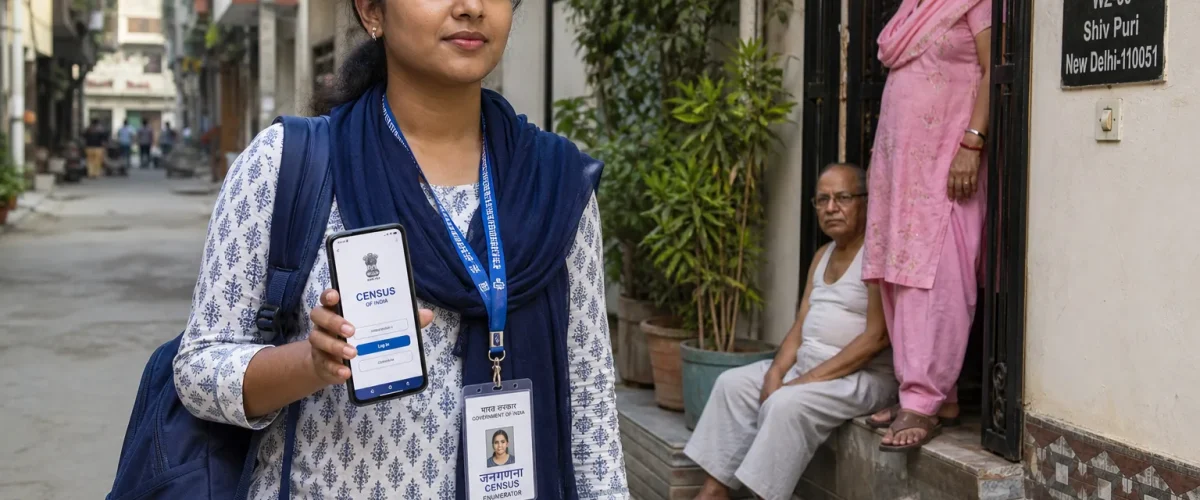
India’s long-awaited Census 2027, the world’s largest population enumeration exercise, has entered a critical operational phase as government enumerators armed with smartphones and digital applications begin door-to-door surveys across Delhi and eight other states and union territories. The exercise, which marks India’s first fully digital census after a gap of 16 years since Census 2011, aims to count and classify every household in the country using cutting-edge mobile technology rather than the traditional paper forms that have been used for over a century.
Phase 1: House Listing and Housing Census
The current phase, known as the House Listing and Housing Census (HLO), is the first of two phases that constitute Census 2027. Phase 1, which runs from April to September 2026, involves collecting detailed information about the condition of houses, amenities available to households, and assets possessed. Phase 2, the Population Enumeration, is scheduled for February 2027 and will collect individual demographic, socio-economic, educational, migration, fertility, and for the first time since 1931, detailed caste data.
The HLO phase launched in the first batch of states on 1 April 2026, with Andaman and Nicobar Islands, Delhi (NDMC and Cantonment Board areas), Goa, Karnataka, Lakshadweep, Mizoram, Odisha, and Sikkim completing their self-enumeration windows and now entering the door-to-door survey stage. Subsequent batches will cover the remaining states and union territories in a staggered rollout through September.
Digital First: How the New Census Works
For the first time in India’s census history, enumerators are collecting data exclusively through a government-developed mobile application rather than paper schedules. The Census Mobile App, built by the Registrar General of India’s office in collaboration with the National Informatics Centre, allows field workers to record household data directly on their smartphones, complete with GPS location tagging, photograph verification, and real-time data synchronisation to central servers.
The digital approach offers several advantages over the traditional method. Data quality is expected to improve significantly through built-in validation checks that flag inconsistencies in real time. The elimination of paper forms removes the months-long data entry phase that previously delayed census results by years. And GPS tagging enables precise mapping of every household to its geographic coordinates, creating what officials describe as a “living digital map” of India.
“This is a transformational moment for Indian statistics. We are moving from a system that took five to seven years from data collection to final publication to one that could deliver preliminary results within months of completing the enumeration,” said the Registrar General of India in a statement issued at the launch.
Self-Enumeration: A First for India
In another significant innovation, Census 2027 offered citizens the option of self-enumeration for the first time. Between 1 and 15 April in the first batch of states, residents could log on to a secure government web portal and enter their household information in any of 16 supported languages before the door-to-door survey began.
According to government data, approximately 12 lakh households used the online self-enumeration facility in the first batch states, representing a modest but encouraging uptake for a first-time feature. The government’s push toward digital participation in public services is consistent with broader policy initiatives aimed at leveraging technology for governance.
Households that completed self-enumeration will still receive a verification visit from an enumerator, but the process is expected to be significantly faster than a full enumeration from scratch.
Scale of the Operation: 3 Million Officials Across 640,000 Villages
The sheer scale of Census 2027 is staggering. More than 3 million enumerators, supervisors, and support officials are involved in the exercise across the country. The census will cover 7,092 sub-districts, 5,128 statutory towns, 4,580 census towns, and approximately 639,902 villages. The Union Government has approved an outlay of Rs 11,718.24 crore for the entire census operation.
In Delhi, where the door-to-door survey is now underway in NDMC and Delhi Cantonment Board areas, approximately 700 trained personnel are visiting households to collect housing data over a 30-day window. The Delhi exercise serves as a pilot of sorts for the larger rollout in the national capital’s remaining areas later in the year.
The Caste Question: Historic First Since 1931
Perhaps the most politically significant aspect of Census 2027 is the inclusion of a comprehensive caste enumeration for the first time since the 1931 Census. The decision, announced by the Union Cabinet in 2025 after years of political debate, means that every individual will be asked to declare their caste or community, with data collected for all social groups, not just Scheduled Castes and Scheduled Tribes as in previous censuses.
The caste data will be collected during Phase 2 (Population Enumeration) in February 2027, but the groundwork is being laid during Phase 1 through the collection of household-level socio-economic indicators. The results are expected to have far-reaching implications for public policy, reservation quotas, and the allocation of government welfare schemes.
Why Did the Census Take So Long?
Census 2027 is the most delayed census in independent India’s history. Originally scheduled for 2021, it was postponed indefinitely due to the COVID-19 pandemic. The decennial exercise was pushed back repeatedly as the government grappled with the logistics of conducting a nationwide survey during successive waves of the virus.
The 16-year gap between Census 2011 and the current exercise has created significant data blind spots for policymakers. Population estimates, urban-rural migration patterns, literacy rates, and housing data have all been based on increasingly outdated Census 2011 figures, supplemented by sample surveys like the National Family Health Survey and the Periodic Labour Force Survey.
“We have been flying blind on some of the most basic demographic indicators. The census gap has affected everything from constituency delimitation to the distribution of central funds to states,” said Professor Sonalde Desai, a demographer at the National Council of Applied Economic Research.
Data Privacy and Security Measures
The shift to digital census has raised questions about data privacy and security. The Registrar General’s office has assured citizens that all census data is encrypted end-to-end, stored on government-owned servers within India, and protected under the Census Act of 1948, which makes it a criminal offence for any census official to disclose individual-level data.
The census data will be published only in aggregate form at the district level and above. No individual or household-level data will be shared with any government department, law enforcement agency, or private entity. The mobile app used by enumerators does not store data locally on the device after synchronisation, and all enumerator access is authenticated through Aadhaar-linked biometric verification.
As India’s census machinery gathers momentum across the country, the exercise represents both a monumental logistical achievement and a critical building block for evidence-based governance in the world’s most populous nation.