CBSE Makes Three Languages Mandatory for Class 9 and 10 From July 2026 Under National Education Policy as Two Must Be Native Indian Languages

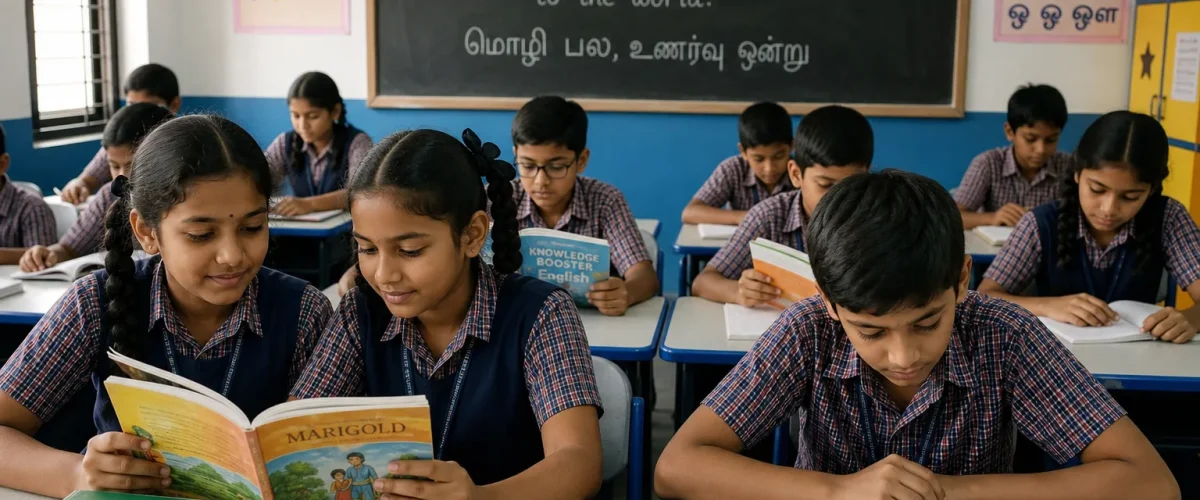
The Central Board of Secondary Education (CBSE) has announced that the study of three languages will be mandatory for all students in Class 9 and 10 from the 2026-27 academic session, which begins in July 2026. Under the new framework, designated as R1, R2 and R3, at least two of the three languages must be native Indian languages, implementing a key provision of the National Education Policy (NEP) 2020 that has been the subject of intense debate since its inception.
The announcement, made through an official circular dated 14 May 2026, specifies that R1 (the first language) must be a scheduled Indian language, R2 (the second language) can be either Hindi, English or another Indian language, and R3 (the third language) must also be an Indian language but should be different from R1 and R2. Schools have been given flexibility in choosing which languages to offer, but the curriculum must ensure that students achieve “functional communicative ability” in all three languages by the end of Class 10.
What Changes for Students
Under the current CBSE framework, students in Classes 9 and 10 study two languages — typically English and Hindi (or a regional language in non-Hindi states). The addition of a third mandatory language represents a significant increase in the academic workload, requiring approximately 4-5 additional periods per week in school timetables.
The NEP 2020 had originally proposed the three-language formula for Classes 6-8, with a gradual introduction from Class 3. However, the implementation has been phased, with CBSE first mandating three languages for Class 6 from April 2025, and now extending the requirement upward to Classes 9 and 10. The board has indicated that the three-language requirement will eventually be extended to Classes 11 and 12 as well, though no timeline has been specified for this.
Students who are already studying two languages will need to pick up a third Indian language, which could include Sanskrit, Tamil, Telugu, Bengali, Marathi, Gujarati, Kannada, Malayalam, Odia, Assamese, Urdu, Punjabi or any other language listed in the Eighth Schedule of the Indian Constitution. Schools in non-Hindi states will need to offer Hindi as one of the options, while schools in Hindi-speaking states will need to offer at least one non-Hindi Indian language.
The Three-Language Formula: History and Controversy
The three-language formula has been one of the most contentious aspects of Indian education policy since it was first proposed in the 1968 National Policy on Education. The formula was originally designed to promote national integration by ensuring that students in Hindi-speaking states learned a southern Indian language and vice versa, while all students learned English as a link language.
In practice, however, the formula was never fully implemented. In Hindi-speaking states, the third language was often Sanskrit (seen as easier to learn), while in southern states, resistance to mandatory Hindi led to the formula being effectively reduced to a two-language system. Tamil Nadu, in particular, has historically opposed any mandate to teach Hindi in schools, viewing it as an imposition on the state’s linguistic identity. Tamil Nadu’s new government under CM Vijay has already signalled that it may resist the CBSE directive if it is perceived as mandating Hindi.
The NEP 2020’s version of the three-language formula attempted to address these concerns by emphasising that “no language will be imposed on any state” and that the choice of languages would be flexible. The CBSE circular echoes this position, stating that “the spirit of the three-language formula is to promote multilingualism and linguistic diversity, not to impose any particular language.”
Supporters: Preserving Linguistic Heritage
Proponents of the three-language mandate argue that it is essential for preserving India’s extraordinary linguistic diversity. India has 22 scheduled languages, hundreds of tribal and regional languages, and is facing a gradual erosion of linguistic heritage as English and Hindi dominate urban education and professional life.
“This is a civilisational imperative,” said K. Kasturirangan, the former ISRO chairman who chaired the committee that drafted the NEP 2020. “India’s languages are repositories of centuries of knowledge, culture and identity. If we don’t teach our children these languages in school, we risk losing them within two or three generations.” He pointed to UNESCO data showing that over 190 Indian languages are classified as “endangered,” with several having fewer than 1,000 speakers remaining.
Research also supports the cognitive benefits of multilingualism. Studies by the National Council of Educational Research and Training (NCERT) and international bodies have found that students who learn multiple languages demonstrate improved cognitive flexibility, better problem-solving skills and enhanced empathy. “Multilingualism is not a burden — it is a competitive advantage,” said NCERT Director Dinesh Prasad Saklani.
Critics: Academic Burden and Implementation Challenges
Critics of the mandate, however, raise several concerns. The most immediate is the increased academic burden on students who are already under pressure from the existing curriculum, competitive exams and extracurricular expectations. With the NEET examination system already causing immense stress on students, adding another subject raises questions about whether the education system is asking too much of young learners.
“Students in Class 9 and 10 are preparing for board exams, competitive entrance exams and managing a heavy extracurricular schedule,” said Meera Srinivasan, principal of a leading CBSE school in Bengaluru. “Adding a third language will require schools to either extend the school day, cut into other subjects, or compromise on the depth of teaching in each language. None of these options is ideal.”
Teacher availability is another major concern. Many schools, particularly in rural and semi-urban areas, struggle to find qualified teachers for even two languages. The requirement for a third language teacher — potentially in a language that is not widely spoken in the school’s region — could prove extremely difficult to fulfil. The CBSE has acknowledged this challenge and said it is working with state governments and teacher training institutions to develop crash courses and online teaching modules.
Political Dimensions
The three-language mandate has predictable political dimensions. Southern states, particularly Tamil Nadu and Karnataka, have historically resisted any policy that they perceive as promoting Hindi at the expense of regional languages. While the CBSE circular is careful to avoid mandating Hindi specifically, the practical reality is that most CBSE schools in southern states are likely to offer Hindi as one of the three languages, which could reignite dormant linguistic controversies.
The BJP, which has championed the NEP and the three-language formula, sees the policy as a way to promote national unity and Hindi proficiency across the country. The opposition views it through a different lens, arguing that the policy disproportionately burdens students in non-Hindi states while allowing Hindi-speaking students to choose “easy” options like Sanskrit for their third language. India’s cultural policy debates continue to evolve at the intersection of education, identity and politics.
Schools have been given until 30 June 2026 to submit their three-language implementation plans to the CBSE, including details of the languages offered, teacher recruitment plans and timetable adjustments. The board has also announced that the Class 10 board examination from 2028 onward will include a third-language paper, though the weightage and assessment pattern are yet to be finalised. For millions of students and parents across India, the next few weeks will be spent navigating the practical implications of a policy change that will reshape the school experience for years to come.