Two US Navy EA-18G Growler Jets Collide Mid-Air at Idaho Air Show as All Four Crew Members Eject Safely in Dramatic Escape

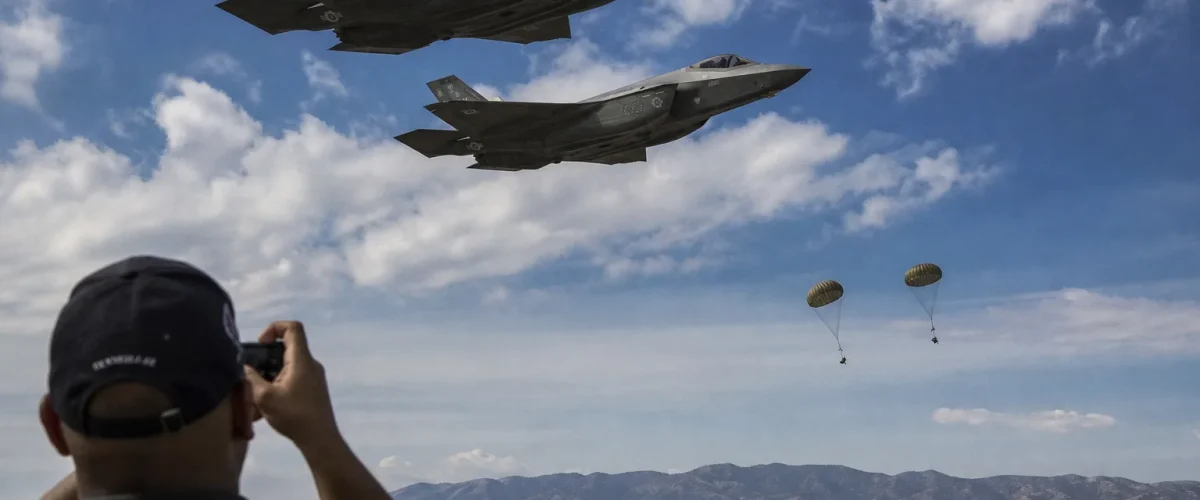
In a heart-stopping incident witnessed by thousands of spectators, two US Navy EA-18G Growler electronic warfare jets collided mid-air and crashed during the Gunfighter Skies Air Show at Mountain Home Air Force Base in Idaho on Saturday, May 17. In what aviation experts are calling a miracle, all four crew members — two pilots and two weapons systems officers — ejected safely and sustained no life-threatening injuries, with dramatic eyewitness footage capturing the collision, parachute deployment, and both aircraft plunging to the ground near the base — making it one of the most viral trending stories worldwide.
The Mid-Air Collision: What Happened
The accident occurred at approximately 2:15 PM local time during an aerial demonstration at the annual Gunfighter Skies Air Show, which is hosted by the 366th Fighter Wing at Mountain Home Air Force Base. The two EA-18G Growler jets, operated by the US Navy’s Electronic Attack Squadron VAQ-129, were performing a formation manoeuvre when they made contact in mid-air at an altitude estimated by witnesses to be between 500 and 1,000 feet.
Video footage captured by multiple spectators and immediately shared across social media shows the two jets flying in close formation before one aircraft appears to roll into the other. The moment of impact produced a visible shower of debris, followed by the deployment of four ejection seat parachutes as the crew members were propelled clear of the doomed aircraft. Both jets then tumbled to the ground and erupted in fireballs approximately half a mile from the spectator viewing area.
“Nothing like this has ever happened at this air show before. The planes were very close together, and then suddenly there was a bang and we saw pieces flying off. Then the parachutes came out, and everyone started cheering because we knew the pilots were alive,” said Mark Henderson, a spectator from Boise who filmed the collision on his phone.
All Four Crew Members Safe
The US Navy confirmed that all four crew members ejected successfully and were immediately attended to by medical personnel stationed at the air show. Two of the crew members were transported to a local hospital for observation as a precautionary measure but were reported to be in good condition with only minor bruises and abrasions from the ejection process.
The Martin-Baker ejection seats used in the EA-18G Growler are capable of propelling crew members clear of the aircraft at speeds of up to 600 miles per hour and altitudes as low as zero feet (on the ground). The seats deploy a parachute automatically and are equipped with survival kits including flotation devices, radio beacons, and first aid supplies.
“The safe ejection of all four aviators is a testament to the incredible engineering of modern ejection systems and the training our aviators undergo for emergency situations,” said Captain Thomas Marks, commanding officer of the Naval Air Facility at Mountain Home. “We are grateful that no lives were lost.”
Investigation Launched
The US Navy has launched a formal investigation into the collision, with a safety investigation board expected to examine flight data recorders, maintenance records, pilot communications, and video evidence from multiple angles. The investigation is expected to take several months to complete.
Preliminary reports suggest that the collision may have been caused by a misjudgement during a close formation pass, though investigators have not ruled out mechanical failure or communication errors. The EA-18G Growler is a two-seat carrier-based electronic warfare aircraft derived from the F/A-18F Super Hornet, and is considered one of the most advanced electronic attack platforms in the world.
Air show demonstrations are carefully choreographed and rehearsed, with strict safety protocols including minimum altitude and distance requirements. However, the inherently dangerous nature of close formation flying means that the margin for error is extremely slim, and even minor miscalculations can have catastrophic consequences.
Historical Context: Air Show Accidents
Mid-air collisions at air shows, while rare, are among the most feared scenarios in aviation. One of the deadliest air show disasters in history occurred in 2002 at the Sknyliv Air Show near Lviv, Ukraine, when a Sukhoi Su-27 fighter jet crashed into a crowd of spectators, killing 77 people including 28 children. The 1988 Ramstein Air Show disaster in Germany, where three Italian Air Force jets collided during an aerobatic display and one crashed into the crowd, killed 70 people.
In the United States, air show safety has improved significantly since the establishment of strict Federal Aviation Administration (FAA) and military safety protocols. The last fatal military air show accident in the US occurred in 2003, when a vintage aircraft crashed at an air show in Dayton, Ohio, killing the pilot. The fact that Saturday’s collision at Mountain Home resulted in no fatalities is being hailed as a remarkable outcome given the severity of the incident.
The EA-18G Growler: A Critical Military Asset
The EA-18G Growler is the US Navy’s primary airborne electronic attack aircraft, capable of jamming enemy radar systems, disrupting communications, and providing electronic warfare support to strike packages. Each aircraft costs approximately $68 million, meaning the loss of two Growlers in Saturday’s accident represents a financial impact of roughly $136 million to the US military.
The US Navy operates approximately 160 EA-18G Growlers across 15 squadrons, and the aircraft has been deployed extensively in operations across the Middle East and the Pacific. The loss of two airframes, while significant, is unlikely to materially impact the Navy’s electronic warfare capability. However, the incident may lead to a temporary grounding of Growler demonstration flights while the investigation is underway.
The collision has renewed debate about the risks associated with military demonstrations and whether the public relations benefits of air shows justify the inherent dangers. Supporters argue that air shows serve a vital role in military recruitment and public engagement, while critics contend that performing dangerous manoeuvres over or near populated areas creates unnecessary risk.
India’s Connection: Kaal Bhairava and Growing Air Power
The incident comes at an interesting time for global military aviation, with India recently announcing that its first AI-powered autonomous combat aircraft, the Kaal Bhairava developed by Flying Wedge Defence & Aerospace (FWDA), will be manufactured in Portugal for NATO countries. The contrast between manned fighter jet demonstrations and the emerging era of unmanned autonomous combat aircraft underscores the rapid evolution of military aviation technology.
This story has dominated global news coverage since Saturday. As investigators work to determine the exact cause of the Mountain Home collision, the overwhelming sentiment from the thousands who witnessed the incident is one of relief that all four crew members walked away alive — a testament to human engineering, pilot training, and the remarkable safety systems built into modern military aircraft.

- Indian Army Gets New Chief as General Dwivedi Hands Over Command Amid Push for Indigenous Defence Tech - July 1, 2026
- Ayodhya Ram Temple Donation Scandal Deepens as Trustees Resign and SIT Arrests Eight - June 29, 2026
- Bengal Seven Weeks On: Modi’s Historic Win and the Questions That Won’t Go Away - June 28, 2026