RBI Keeps Repo Rate Unchanged at 5.25 Percent as Monetary Policy Committee Projects GDP Growth at 6.9 Percent Amid Global Uncertainty

RBI Maintains Status Quo on Interest Rates
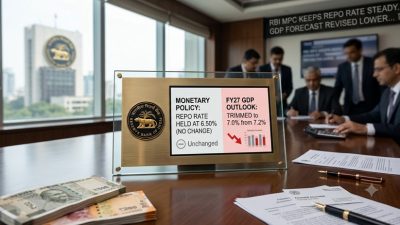
The Reserve Bank of India’s Monetary Policy Committee has unanimously decided to keep the policy repo rate unchanged at 5.25 per cent, opting for stability amid a complex mix of global uncertainty, domestic inflationary pressures and the ongoing West Asia energy crisis. The decision, announced by RBI Governor Sanjay Malhotra following the committee’s meeting, keeps the standing deposit facility rate at 5.00 per cent and the marginal standing facility rate and bank rate at 5.50 per cent. The MPC also retained its “neutral” stance, signalling that future policy decisions will be guided by evolving economic conditions.
The decision to hold rates was widely anticipated by markets and economists. With crude oil prices elevated above 100 dollars per barrel due to the West Asia crisis and Strait of Hormuz disruption, the RBI faces a delicate balancing act between supporting economic growth and containing inflationary pressures that threaten to erode consumer purchasing power.
GDP Growth Projected at 6.9 Per Cent
In a cautiously optimistic assessment, the MPC projected India’s real GDP growth for the current fiscal year 2026-27 at 6.9 per cent. This forecast takes into account the global economic resilience observed in 2025, supported by fiscal stimulus measures and accommodative monetary policies in several major economies. However, the RBI has flagged significant downside risks, including the protracted West Asia conflict, volatile commodity prices and tightening financial conditions in developed markets.
The growth projection represents a careful calibration. On one hand, India’s domestic consumption remains relatively robust, supported by a growing middle class, increasing urbanisation and government spending on infrastructure. On the other hand, the external environment has deteriorated significantly since the beginning of the Iran conflict, with elevated energy costs acting as a persistent drag on economic activity.
Quarter-wise, the RBI expects growth to be front-loaded, with stronger performance in the first half of the fiscal year supported by base effects and seasonal factors. The second half may see some moderation as the cumulative impact of higher energy costs works through the economy and as global demand potentially softens.
Inflation Outlook and the Energy Price Challenge
The inflation picture is arguably the most challenging aspect of the current monetary policy environment. The RBI has been grappling with the inflationary impact of the successive fuel price hikes implemented by the government in response to elevated global crude oil prices. Petrol and diesel prices have been raised multiple times in recent months, directly impacting transportation costs and, by extension, the prices of goods and services across the economy.
Consumer price inflation has remained within the RBI’s target band but has been trending towards the upper end. Food inflation, which disproportionately affects lower-income households, has been particularly persistent, driven by the combination of energy costs filtering into agricultural logistics and the impact of weather disruptions on crop yields. The Super El Niño conditions predicted for 2026 add another layer of uncertainty to the food inflation outlook.
Governor Malhotra addressed the inflation challenge directly in his post-decision statement, noting that while headline inflation remains manageable, the risks are clearly tilted to the upside. He emphasised that the MPC would not hesitate to act if inflationary pressures materialise beyond the committee’s tolerance, but that premature tightening could harm growth at a time when the economy is already absorbing significant energy price shocks.
Implications for Borrowers and the Housing Market
The decision to hold the repo rate at 5.25 per cent provides immediate relief to borrowers, particularly those with floating-rate home loans. Any increase in the repo rate would have been transmitted to lending rates by commercial banks, increasing equated monthly instalments for millions of homeowners. The status quo means that EMIs will remain unchanged for now, providing some breathing room for households already stretched by higher fuel and food costs.
The housing market, which has been one of the brighter spots in the Indian economy, stands to benefit from the rate stability. Developers have been launching new projects at a robust pace, supported by sustained buyer demand, and any rate hike could have dampened enthusiasm at a sensitive point in the cycle. The RBI Governor’s earlier warnings about the inevitability of fuel price hikes had already created some uncertainty in the real estate market, and the rate hold helps to stabilise sentiment.
Market Reaction
Financial markets reacted calmly to the RBI decision, which was in line with the consensus forecast of most economists and analysts. Bond yields edged slightly lower on the announcement, reflecting the market’s relief that the MPC did not signal an imminent rate hike. Equity markets, which had already factored in a rate hold, showed modest positive movement, with banking and real estate stocks performing well.
The Indian rupee, which has been under sustained pressure due to the trade deficit widening from elevated oil imports, showed limited reaction to the RBI decision. Currency traders are more focused on the trajectory of crude oil prices and the outcome of US-Iran negotiations than on domestic monetary policy, reflecting the dominant role that external factors are playing in determining the rupee’s direction.
What Comes Next
The RBI’s next monetary policy decision is scheduled for August, and the path forward will depend heavily on developments in the West Asia situation and the monsoon season. A successful diplomatic resolution of the Iran conflict could lead to a rapid decline in crude oil prices, easing inflationary pressures and potentially opening the door for a rate cut to support growth. Conversely, an escalation of the conflict or a failed monsoon could force the MPC’s hand toward tightening.
Governor Malhotra indicated that the RBI is closely monitoring multiple data points, including core inflation trends, rural and urban consumption patterns, export performance, and the fiscal position of both central and state governments. The neutral stance maintained by the MPC gives it maximum flexibility to move in either direction as the situation evolves.
For India’s 1.4 billion citizens, the RBI’s steady hand on interest rates provides a measure of stability in an otherwise turbulent economic environment. The challenge ahead lies in navigating the external headwinds while sustaining the domestic growth momentum that has made India one of the world’s fastest-growing major economies.
Explore more: Economy | Business & Economy