RBI Governor Sanjay Malhotra Warns Petrol and Diesel Price Hike Inevitable If West Asia Crisis Persists as Crude Oil Stays Above 100 Dollars Per Barrel

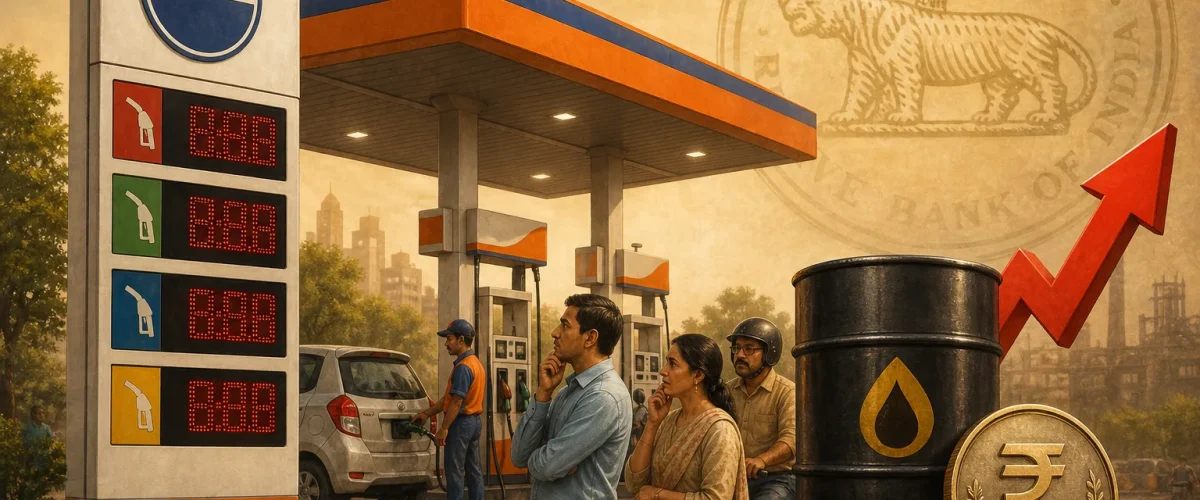
Reserve Bank of India Governor Sanjay Malhotra on Tuesday issued a stark warning that India may eventually have to raise petrol and diesel prices if elevated crude oil prices persist due to the ongoing conflict in West Asia, marking the first time a senior Indian monetary policy official has publicly acknowledged the growing inevitability of a fuel price hike that the government has resisted for over four years. Speaking at a conference hosted by the Swiss National Bank and the International Monetary Fund in Switzerland, Malhotra said the government and state-run fuel retailers were currently absorbing the increase in crude prices, but that this approach has limits.
“If this is to continue for a longer period of time, it is just a matter of time before the government will pass on some of the price increases,” the RBI Governor said, in remarks that sent a clear signal to both consumers and markets about the direction of fuel pricing policy in the coming weeks. At present, petrol and diesel prices in India remain at Rs 94.74 per litre and Rs 87.81 per litre respectively — unchanged since 2022, despite global oil prices having fluctuated dramatically in the intervening period and now trading well above $100 per barrel.
Why Fuel Prices Haven’t Been Raised Yet
India has not raised retail petrol and diesel prices since May 2022, when global crude oil prices spiked following Russia’s invasion of Ukraine. At the time, the government reduced excise duties on petrol by Rs 8 per litre and on diesel by Rs 6 per litre to cushion consumers from the price shock. Since then, oil marketing companies (OMCs) — Indian Oil Corporation, Bharat Petroleum and Hindustan Petroleum — have been absorbing the difference between the cost of imported crude and the retail selling price, resulting in significant under-recoveries that have eroded their profit margins.
The ongoing West Asia conflict has made this absorption increasingly unsustainable. With Brent crude trading consistently above $95-105 per barrel since March 2026 due to the US-Iran war and the disruption of the Strait of Hormuz, the gap between imported crude costs and domestic retail prices has widened sharply. Industry analysts estimate that OMCs are currently under-recovering between Rs 12-15 per litre on petrol and Rs 8-12 per litre on diesel — a financial burden that cannot be sustained indefinitely without either a retail price hike, additional government subsidy or further excise duty cuts.
Political Timing and Election Angle
Governor Malhotra also pushed back against suggestions that the government had delayed the fuel price hike due to the recently concluded state assembly elections in West Bengal, Tamil Nadu, Kerala, Assam and Bihar. “It’s not my case that prices should not go up. I’m saying the two are unrelated,” he said, noting that “several polls have been conducted since 2022, when the petrol and diesel rates were last hiked.” He emphasised that India was “the only country to keep fuel prices unchanged for the past four years,” a statement that simultaneously acknowledged the government’s restraint and hinted at its unsustainability.
The political sensitivity of fuel prices in India cannot be overstated. Any increase in petrol and diesel prices has a cascading effect on transportation costs, food prices and the overall cost of living — making it a politically toxic decision for any government. The BJP, which has positioned itself as a party committed to controlling inflation and providing relief to the common man, faces a delicate balancing act between fiscal reality and political messaging. With no major state elections on the immediate horizon, some analysts believe the government may use the current window to implement a phased price increase.
Impact on Inflation and Monetary Policy
The RBI Governor’s warning also has implications for India’s monetary policy trajectory. The central bank cut interest rates by 25 basis points in April 2026, bringing the repo rate to 5.75 per cent, in a move aimed at supporting economic growth amid the external shock. However, CPI inflation has already risen to 3.8 per cent in April, driven by higher fuel and food costs, and any retail fuel price increase would push it closer to the RBI’s 4 per cent target — potentially limiting the scope for further rate cuts.
Malhotra acknowledged this dilemma, saying the RBI would “consider data for further action” and would “look through the increase in oil prices if the shock from the conflict becomes deep-seated.” The phrase “look through” suggests that the central bank may tolerate a temporary spike in inflation caused by a fuel price hike, treating it as a supply-side shock rather than a structural shift — but this tolerance has limits. If headline inflation breaches 5 per cent, the RBI may be forced to pause or even reverse its rate-cutting cycle, with significant consequences for economic growth, investment and consumer spending.
What Consumers Should Expect
Based on the Governor’s comments and the current trajectory of global oil prices, economists and industry analysts are increasingly expecting a phased fuel price increase in the coming weeks. The most likely scenario, according to multiple estimates, involves a hike of Rs 5-8 per litre on petrol and Rs 4-6 per litre on diesel, implemented in two or three tranches over a period of four to six weeks to minimise the immediate inflationary impact.
For Indian consumers already grappling with the impact of the global crisis — including rising food prices, a weakening rupee, record gold prices, and stock market volatility — a fuel price hike would add another layer of financial pressure. The cascading effect on transportation costs alone could push up the prices of vegetables, fruits, milk and other essential commodities by 3-5 per cent within weeks of a fuel price increase.
The government, for its part, is exploring ways to cushion the blow. Options being discussed include targeted subsidies for LPG and kerosene for below-poverty-line households, an increase in the free fuel allocation for public transport operators, and a possible further cut in excise duty to offset part of the retail price increase. A final decision is expected from the Prime Minister’s Office in consultation with the Finance Ministry and petroleum ministry within the next two weeks.
The RBI Governor’s public warning serves as both a factual assessment and a political signal: the era of artificially suppressed fuel prices is drawing to a close, and India must prepare for a painful but necessary adjustment to the new reality of expensive energy in a world disrupted by geopolitical conflict.