India Successfully Tests Vayu Astra-1 Loitering Munition at Pokhran With 100 km Strike Range and 10 kg Warhead

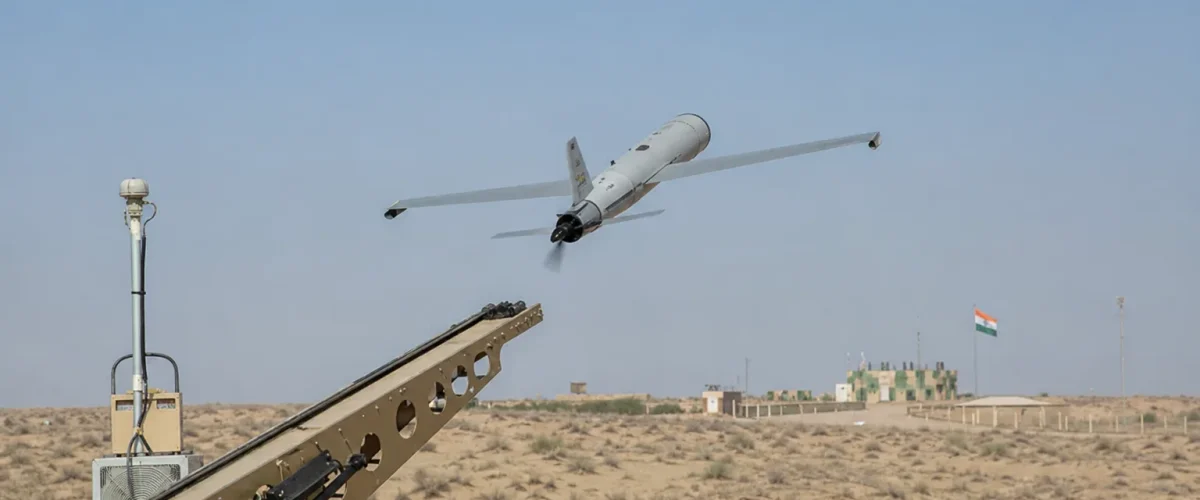
Nibe Limited Completes Successful Demonstration at Pokhran and Joshimath
In a significant step forward for India’s indigenous defence technology sector, Hyderabad-based Nibe Limited has completed a successful No Cost No Commitment demonstration of the Vayu Astra-1 loitering munition at the Pokhran firing range in Rajasthan’s Jaisalmer district. The demonstration, conducted on 21 May 2026, validated the system’s capability to carry a 10 kilogram warhead to targets up to 100 kilometres away, making it one of the most capable indigenous loitering munitions developed in India to date.
The Vayu Astra-1 has now completed successful trials in two distinct terrain environments: mountainous terrain at Malari in the Joshimath region of Uttarakhand, and desert terrain at Pokhran. This dual-environment validation is significant because Indian military planners need weapon systems that can perform reliably across the country’s diverse geography, from the high-altitude Himalayan frontiers to the arid western border regions. The system’s ability to operate effectively in both settings demonstrates its versatility and readiness for operational deployment scenarios.
The demonstration was witnessed by representatives from the Indian Army, which has been actively seeking loitering munition capabilities in response to the changing nature of modern warfare. The conflicts in Ukraine and West Asia have vividly demonstrated the transformative impact of drone warfare on conventional military operations, accelerating India’s own procurement and development efforts in this domain.
How the Vayu Astra-1 Works
Unlike conventional guided missiles that fly on a pre-programmed trajectory to a fixed target, a loitering munition occupies a fundamentally different category of weapon system. The Vayu Astra-1 is launched from a portable tube launcher and can fly to a designated area, where it then loiters or circles overhead for an extended period, connected to its operator via a two-way data link. This connection allows the operator to observe the battlefield in real time through the munition’s onboard camera and sensors.
Once a suitable target is identified, the operator commands the munition to dive into the target, detonating its 10 kilogram warhead on impact. This ability to loiter, observe, and then strike gives field commanders a level of tactical flexibility that is impossible with conventional artillery or pre-programmed missiles. The system can also be recovered safely via an inbuilt parachute if no suitable target is found during the mission, allowing it to be refurbished and reused.
The 10 kilogram warhead represents a significant capability. According to Nibe Limited, this warhead is larger than both the Nag anti-tank missile’s warhead and a standard 155mm artillery shell, giving operators and field commanders greater options when engaging targets. The system can carry both anti-tank and anti-personnel warhead variants, making it effective against armoured vehicles, bunkers, command posts, and personnel concentrations.
Lessons From Ukraine and West Asia Drive Indian Procurement
The urgency behind India’s loitering munition development programme is directly linked to the lessons emerging from contemporary conflicts. In Ukraine, relatively inexpensive loitering munitions and first-person-view drones have destroyed tanks, artillery positions, and supply lines worth hundreds of millions of dollars. The growing role of AI-powered autonomous systems in military operations worldwide has made it clear that nations without indigenous drone warfare capabilities will be at a severe disadvantage in any future conflict.
The West Asia crisis has provided additional evidence of the loitering munition’s battlefield effectiveness. Various parties to the conflict have employed these systems to devastating effect, targeting high-value assets including air defence systems, radar installations, and command infrastructure. The relatively low cost per unit compared to conventional missiles makes loitering munitions an attractive option for militaries seeking to deliver precision strikes without expending expensive guided munitions.
For India, which faces complex security challenges along its northern border with China and western border with Pakistan, the ability to deploy indigenous loitering munitions represents a critical capability gap that is now being addressed. The Vayu Astra-1, along with other systems under development by Indian companies and the Defence Research and Development Organisation, is part of a broader effort to build a comprehensive drone warfare ecosystem under the Make in India defence initiative.
India’s Growing Indigenous Defence Drone Ecosystem
The Vayu Astra-1 is not an isolated development but rather part of a rapidly expanding Indian defence drone ecosystem that includes companies like Nibe Limited, Adani Defence, Bharat Forge, and several startups backed by the iDEX innovation programme. The government’s decision to encourage private sector participation in defence manufacturing has created a competitive landscape where multiple companies are developing loitering munitions, surveillance drones, and unmanned combat aerial vehicles.
The Indian Army has already inducted several types of indigenous drones for surveillance and reconnaissance purposes, and the procurement of loitering munitions represents the next logical step in building a comprehensive unmanned warfare capability. The military has issued multiple requests for information and expressions of interest for loitering munition systems, signalling its intent to acquire these weapons in significant quantities.
Nibe Limited’s successful demonstration at Pokhran positions the company as a strong contender for future procurement contracts. However, the Vayu Astra-1 is still at a relatively early stage of the trials process. Full operational clearance will require additional testing, including integration with existing command and control networks, performance validation under adverse weather conditions, and reliability testing over extended operational periods.
Strategic Significance for India’s Border Defence
The 100 kilometre strike range of the Vayu Astra-1 is particularly significant in the context of India’s border defence requirements. Along the Line of Actual Control with China, the ability to strike targets deep within occupied territory from safe standoff distances would provide Indian forces with a valuable asymmetric capability. In the western sector, loitering munitions could be used to suppress enemy air defences, neutralise forward observation posts, and disrupt logistical supply lines.
The system’s portability is another crucial advantage. Unlike heavy artillery or guided missile systems that require substantial logistical support, loitering munitions can be carried and deployed by small infantry teams operating in remote areas. This makes them ideally suited for the kind of distributed, high-altitude operations that characterise India’s military posture along its northern frontiers.
As India continues to modernise its armed forces and build indigenous defence manufacturing capabilities, systems like the Vayu Astra-1 represent the convergence of technological innovation and strategic necessity. The successful Pokhran demonstration marks an important milestone, but the journey from demonstration to full-scale deployment will require sustained investment, rigorous testing, and close collaboration between the military and India’s growing defence technology sector.
Related Stories on DailyTips
- SRH Beat RCB by 55 Runs in IPL 2026 Match 67 but Joy for Bengaluru as They Seal First Place in Points Table
- Election Commission Announces Rajya Sabha Polls for 24 Seats Across 10 States on June 18 2026
- Venezuela Overtakes Saudi Arabia and US to Become India Third Largest Crude Oil Supplier in May 2026 Amid West Asia Crisis

- India’s Startup Funding Crosses $7.2 Billion in H1 2026 - July 1, 2026
- After Ireland Shock, India’s T20I Side Faces Bigger Test - July 1, 2026
- Ireland Stun World Champions India 2-0 in Belfast, Sooryavanshi Debate Rages On - June 29, 2026