Sensex Rallies Over 900 Points and Crosses 76,300 as Crude Oil Prices Plunge 5 Percent — Nifty50 Nears 24,000 Mark

Indian Markets Open Strong as Oil Prices Drop Sharply
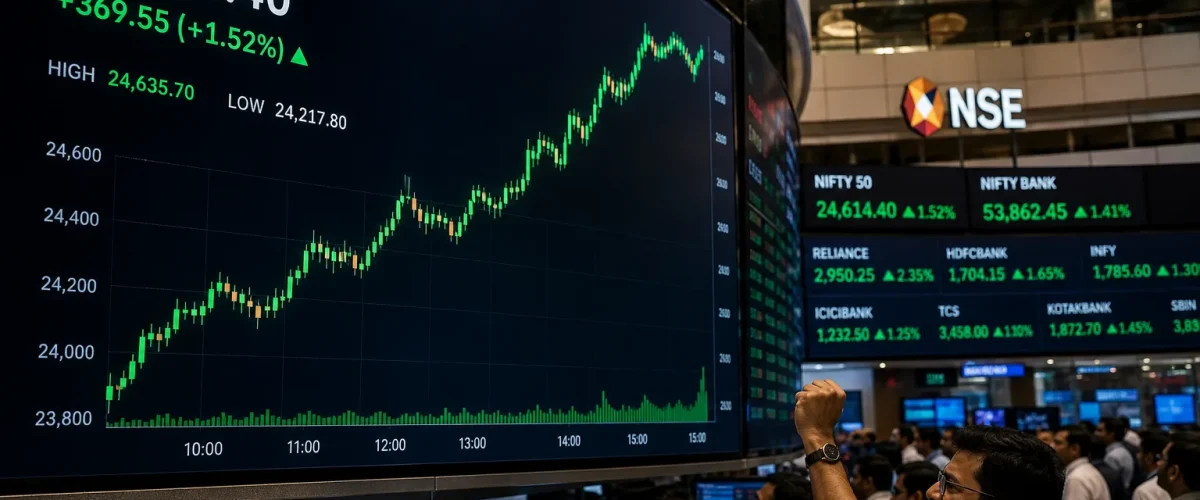
Indian equity markets began the week on a decisively bullish note on Monday, 25 May 2026, with the BSE Sensex surging over 900 points in early trade to cross the 76,300 level while the NSE Nifty50 climbed more than 245 points to approach the psychologically crucial 24,000 mark. The sharp rally was driven primarily by a dramatic overnight plunge in global crude oil prices, which fell more than 5 per cent to two-week lows amid growing expectations of a possible diplomatic resolution to the US-Iran standoff.
As of 10:30 am IST, the Sensex was trading at 76,290.21, up 874.86 points or 1.16 per cent from Friday’s close. The Nifty50 stood at 23,964.35, gaining 245.05 points or 1.03 per cent. Broad-based buying was visible across sectors, with oil-sensitive stocks, airlines, paints, and FMCG companies leading the advance. Market breadth was overwhelmingly positive, with advancing stocks outnumbering decliners by a ratio of approximately three to one on the BSE.
Why Did Oil Prices Fall So Sharply?
The proximate trigger for Monday’s market enthusiasm was a dramatic drop in crude oil prices over the weekend and into Asian trading hours on Monday morning. Brent crude fell more than 5 per cent to touch 73.40 dollars per barrel, its lowest level in two weeks, while West Texas Intermediate declined to 69.80 dollars per barrel. The sell-off in oil markets was driven by a combination of factors that collectively suggested a potential easing of the geopolitical premium that has kept crude elevated for much of 2026.
Most significantly, diplomatic channels between the United States and Iran showed signs of renewed activity. While US President Donald Trump publicly downplayed the likelihood of an immediate agreement, Secretary of State Marco Rubio, currently on a four-day visit to India, made positive remarks about the trajectory of behind-the-scenes negotiations. Market participants interpreted these signals as indicating that the risk of a full-scale military confrontation, which had been priced into oil markets, was diminishing.
Additionally, reports emerged that Saudi Arabia and the UAE had quietly signalled their willingness to increase production if prices remained above 80 dollars per barrel for a sustained period. This supply-side reassurance, combined with the diplomatic optimism, triggered aggressive short-covering in oil futures markets, amplifying the price decline.
Sector-Wise Market Performance
The fall in crude oil prices has outsized significance for India, the world’s third-largest oil importer, because it directly impacts the country’s current account deficit, inflation trajectory and the profitability of several key sectors. Monday’s rally reflected this through the sector-wise breakdown of gains.
Oil marketing companies, which had been under pressure due to under-recoveries from selling fuel below cost, saw sharp reversals. BPCL surged 4.2 per cent, HPCL gained 3.8 per cent and Indian Oil Corporation rose 3.1 per cent in early trade. These stocks had been among the worst performers in the broader market over the past month and the reversal suggested that traders were reassessing the outlook for the sector’s profitability.
Aviation stocks also soared, with InterGlobe Aviation (IndiGo) up 3.5 per cent and SpiceJet gaining 5.1 per cent. Jet fuel constitutes the single largest operating expense for airlines, and any sustained decline in crude oil prices translates directly into improved profit margins. Paint companies, which use petroleum-derived inputs, also advanced strongly, with Asian Paints up 2.8 per cent and Berger Paints up 2.4 per cent.
Banking stocks contributed significantly to the headline index gains, with HDFC Bank, ICICI Bank and State Bank of India all advancing between 1 and 2 per cent. The RBI’s record dividend of Rs 2.87 lakh crore to the government last week continued to support sentiment in the financial sector by reinforcing the perception of fiscal stability.
Technical Analysis and Key Levels
Market technicians noted that the Nifty50’s approach towards the 24,000 level was significant because the index had faced stiff resistance at this zone during recent attempts to break higher. The breakdown zone of 23,800 to 23,900 was being watched closely by traders, with analysts suggesting that a decisive close above 23,900 would confirm a short-term bullish reversal and open the path towards 24,100 to 24,120.
On the downside, the zone of 23,600 to 23,500 was identified as the next support level if the rally were to fade. Analysts from several brokerages cautioned that while the crude oil decline was supportive, the market needed sustained follow-through buying in the coming sessions to confirm that a durable bottom had been established.
The India VIX, which measures expected market volatility, declined sharply from 18.5 to 16.2, suggesting that fear levels had receded significantly from the elevated readings seen during the oil price spike in the preceding weeks. A falling VIX typically accompanies sustained rallies because it indicates that options traders are becoming less concerned about near-term downside risks.
Global Context and FII Flows
Asian markets broadly supported India’s rally, with Japan’s Nikkei 225 up 1.1 per cent, Hong Kong’s Hang Seng gaining 0.9 per cent and South Korea’s Kospi advancing 0.7 per cent. The positive global sentiment was reinforced by Wall Street’s strong close on Friday, where the S&P 500 rose 0.8 per cent and the Nasdaq Composite gained 1.2 per cent on technology sector strength.
Foreign institutional investors, who had been net sellers of Indian equities for much of May due to the oil-related macro concerns, showed signs of returning. Preliminary data indicated net FII buying of approximately Rs 1,200 crore in the cash segment during Monday’s session, the largest single-day inflow in over two weeks. If sustained, this reversal in FII flows could provide the foundational support needed for a meaningful market recovery.
The RBI’s accommodative monetary policy stance, combined with India’s relative economic resilience and now the prospect of lower energy costs, creates a favourable backdrop for domestic equities. However, analysts cautioned that the geopolitical situation remains fluid and that any reversal in diplomatic momentum could quickly reignite oil market fears.
Explore more: Markets | Business
Related Articles
- RBI Approves Record Rs 2.87 Lakh Crore Dividend to Government
- RBI Keeps Repo Rate Unchanged at 5.25 Percent
- India Electricity Demand Hits All-Time Record
- Petrol Diesel Prices Hiked for Fourth Time in 13 Days — Petrol Crosses Rs 102 in

- Fentanyl Vaccine Breakthrough: Scripps Research Develops Shot That Blocks Deadly Overdoses Before They Reach the Brain - June 13, 2026
- Nipah Virus Returns to Kerala — First Case of 2026 Confirmed, State Declares High Alert - June 12, 2026
- Jill Biden Reveals She Wanted to Keep PM Modi’s 7.5-Carat Diamond Gift but Returned It After State Department Valued It at $20,000 - June 8, 2026