Quad Foreign Ministers Meet in New Delhi — Jaishankar Hosts Rubio, Wong and Motegi for Indo-Pacific Security Talks

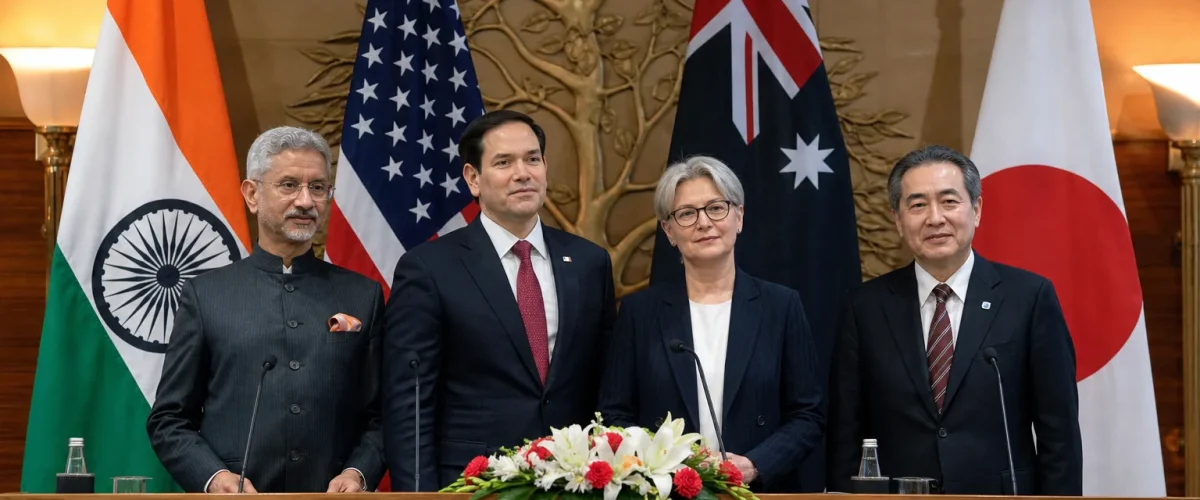
In what is being described as one of the most significant diplomatic gatherings of 2026, New Delhi today hosts the Quad Foreign Ministers’ Meeting, bringing together the top diplomats of four of the world’s most influential democracies. External Affairs Minister Dr. S. Jaishankar is chairing the high-level dialogue, with US Secretary of State Marco Rubio, Australian Foreign Minister Penny Wong, and Japanese Foreign Minister Toshimitsu Motegi converging on the Indian capital for a day of intensive discussions on Indo-Pacific security, technology cooperation, and regional stability.
The meeting, confirmed by India’s Ministry of External Affairs on May 22, builds directly on the framework established during the last Quad Ministerial in Washington, D.C. on July 1, 2025. It comes at a particularly charged moment in global geopolitics — with the US-Iran conflict still simmering, rising tensions in the South China Sea, and growing concerns over supply chain resilience in the wake of multiple overlapping crises.
Why This Meeting Matters Now
The Quadrilateral Security Dialogue — or Quad — comprising India, the United States, Australia, and Japan, has evolved from a loose diplomatic grouping into one of the most consequential strategic partnerships in the Indo-Pacific. What began as a response to the devastating 2004 Indian Ocean tsunami has transformed into a robust platform for addressing maritime security, critical technology development, climate resilience, and infrastructure connectivity.
This particular meeting carries added weight because it takes place against the backdrop of several simultaneous geopolitical flashpoints. The ongoing US-Iran war, which began in February 2026, has disrupted global energy markets, closed the Strait of Hormuz, and forced nations across Asia to scramble for alternative supply chains. Meanwhile, China’s increasing assertiveness in the South China Sea and Taiwan Strait continues to test the resolve of the existing rules-based international order.
“The Quad is no longer just a talking shop,” said Harsh V. Pant, Vice President of Studies at the Observer Research Foundation in New Delhi. “It has become the primary vehicle through which these four democracies coordinate their responses to the most pressing security challenges in the Indo-Pacific.”
Key Agenda Items
According to the MEA statement, the ministers will exchange views on advancing Quad cooperation across several priority areas:
- Maritime Security and Freedom of Navigation: With the Strait of Hormuz effectively blocked since the Iran conflict began, ensuring freedom of navigation in key waterways — including the Malacca Strait, South China Sea, and Indian Ocean — is expected to dominate discussions.
- Critical and Emerging Technologies: The Quad has been steadily building a framework for cooperation on semiconductors, quantum computing, and artificial intelligence. This meeting is expected to advance concrete deliverables on supply chain mapping and joint R&D initiatives.
- Climate Resilience and Clean Energy: With India facing one of its worst heatwaves in years and energy prices spiralling due to the Iran crisis, clean energy transition and climate adaptation are likely to feature prominently.
- Infrastructure and Connectivity: The Quad Infrastructure Fellowship and Partnership for Infrastructure have been positioning themselves as alternatives to China’s Belt and Road Initiative in the Indo-Pacific.
Bilateral Meetings on the Sidelines
Beyond the multilateral format, each visiting minister is scheduled to hold separate bilateral meetings with Dr. Jaishankar and call on Prime Minister Narendra Modi. These one-on-one consultations are expected to cover a range of issues specific to each bilateral relationship.
For US Secretary Rubio, who has been on a multi-day tour of India — visiting Kolkata and the Taj Mahal before arriving in Delhi — the bilateral with Jaishankar is expected to focus on the US-India defence partnership, energy cooperation, and coordination on the Iran situation. Rubio has publicly stated that Washington is “actively engaged in discussions with India to significantly broaden energy cooperation.”
Australian Foreign Minister Penny Wong’s agenda is likely to include discussions on the India-Australia Economic Cooperation and Trade Agreement (ECTA), critical minerals partnership, and education ties. Japan’s Motegi is expected to focus on infrastructure investment in India’s northeast, defence technology transfer, and the Japan-India Special Strategic and Global Partnership.
India’s Growing Centrality in Global Diplomacy
The fact that India is hosting this Quad Ministerial underscores New Delhi’s growing centrality in global diplomatic architecture. Under Prime Minister Modi, India has carefully positioned itself as a bridge between the Global South and the established Western-led order, maintaining strategic relationships with both Russia and the West while charting an independent foreign policy course.
This balancing act has become even more complex in the context of the Iran conflict. India, which relied heavily on Iranian crude oil, has had to rapidly diversify its energy sources — with Venezuela now becoming India’s third-largest oil supplier, overtaking both Saudi Arabia and the United States. The Quad meeting provides an opportunity for India to discuss collective approaches to energy security with its partners.
“India is hosting the Quad at a time when the world is looking for stable anchors of cooperation,” said Tanvi Madan, Director of The India Project at the Brookings Institution. “New Delhi’s ability to convene these four powers and drive a constructive agenda is a testament to its rising diplomatic stature.”
What to Expect from the Joint Statement
While a formal joint statement is expected after the meeting, diplomatic sources suggest it will reaffirm the Quad’s commitment to a “free and open Indo-Pacific” and include language on support for international law, including the United Nations Convention on the Law of the Sea (UNCLOS). The statement is also expected to reference ongoing Quad initiatives in areas such as vaccine delivery, maritime domain awareness, and cybersecurity.
Notably, the statement is unlikely to name China directly, consistent with past Quad communiqués that have preferred coded language about “challenges to the rules-based order.” However, the underlying message — that four of the world’s major democracies are aligned in their vision for the Indo-Pacific — will not be lost on Beijing.
Looking Ahead: The Road to the Quad Leaders’ Summit
Today’s Foreign Ministers’ Meeting is widely seen as a precursor to a potential Quad Leaders’ Summit later in 2026. The last such summit was held in Wilmington, Delaware in September 2024, where leaders announced initiatives on cancer research, maritime security, and semiconductor supply chains. With elections in multiple Quad countries behind them, the stage is set for a renewed push to deepen cooperation at the highest levels.
As the ministers gather in New Delhi today, the stakes could not be higher. In a world grappling with war, climate crisis, and technological disruption, the Quad represents one of the few multilateral groupings that has consistently delivered on its promises — and the world will be watching to see what emerges from today’s talks.
Related Articles
- Marco Rubio Visits Taj Mahal with Wife Jeanette During India Tour — Calls It True Treasure of the World Amid US-Iran Diplomatic Push
- Marco Rubio Calls India a Strategic Ally During Historic 4-Day Visit — Quad Meeting and Bilateral Talks on Agenda
- Russia Launches Largest Nuclear Military Exercises in Years Mobilizing 65000 Troops and 200 Missile Launchers as NATO Tensions Escalate
Explore more: Culture & Lifestyle

- Indian Army Gets New Chief as General Dwivedi Hands Over Command Amid Push for Indigenous Defence Tech - July 1, 2026
- Ayodhya Ram Temple Donation Scandal Deepens as Trustees Resign and SIT Arrests Eight - June 29, 2026
- Bengal Seven Weeks On: Modi’s Historic Win and the Questions That Won’t Go Away - June 28, 2026