Marco Rubio Visits Taj Mahal with Wife Jeanette During India Tour — Calls It True Treasure of the World Amid US-Iran Diplomatic Push

Rubio Makes Symbolic Stop at Taj Mahal Amid Packed Diplomatic Schedule
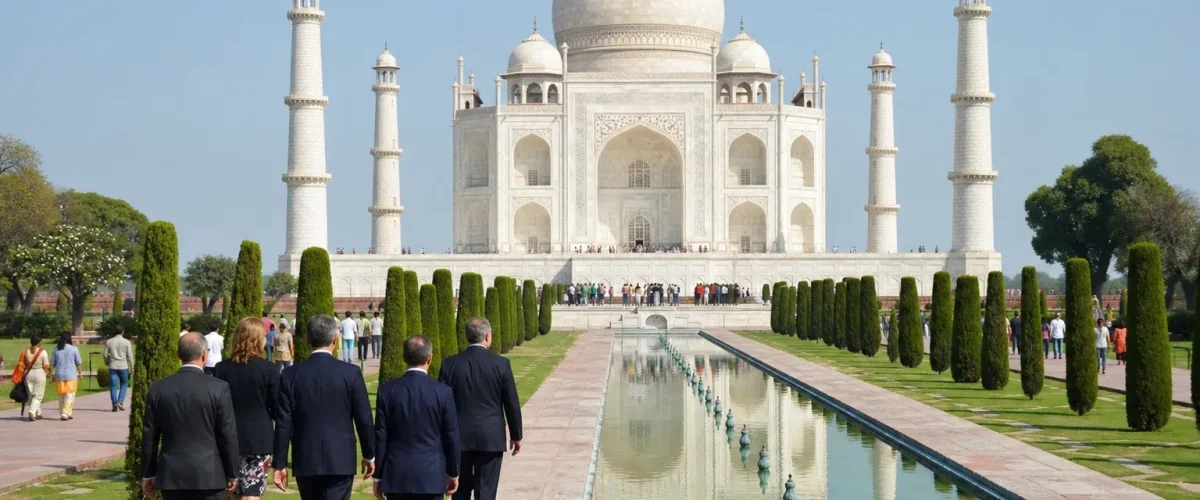
United States Secretary of State Marco Rubio took a one-day break from his packed diplomatic schedule in India on Sunday, 25 May 2026, to visit the Taj Mahal in Agra with his wife Jeanette, calling the 17th-century Mughal monument a “true treasure of the world.” The unusual cultural detour came between high-level meetings in Kolkata and the upcoming Quad foreign ministers’ summit in New Delhi on Tuesday, adding a personal and symbolic dimension to what has been a historically significant first visit to India by the US top diplomat.
Under a blazing 40-degree-Celsius sun, Rubio removed his tie from his navy-blue suit and put his arm around Jeanette, who wore a flowing dress with elegant heels, as the couple walked through the gardens of the UNESCO World Heritage site. They posed for photographs on the iconic bench where Princess Diana was memorably photographed alone in 1992, a spot that has since become a traditional photo opportunity for visiting dignitaries and world leaders.
Security arrangements were extensive but notably less restrictive than those deployed during Vice President JD Vance’s visit earlier this year. The main approach road to the Taj Mahal was cleared for Rubio’s motorcade, with other tourists kept approximately 100 metres away. However, the monument itself was only partially shut down, allowing regular visitors to continue their tours in sections away from the Secretary’s immediate vicinity.
A Cultural Interlude with Diplomatic Undertones
While the Taj Mahal visit was ostensibly a personal and cultural stop, diplomatic observers noted several layers of symbolism in the choice. The monument, built by Mughal emperor Shah Jahan in the 17th century, is heavily influenced by Persian architectural traditions, creating an ironic backdrop for a Secretary of State who has been deeply involved in navigating the delicate US-Iran standoff that has dominated global headlines for much of 2026.
Rubio himself acknowledged the connection with characteristic good humour. Speaking to a small pool of journalists allowed to cover the visit, he noted that the Taj Mahal’s beauty transcended the geopolitical tensions of the present moment. “When you stand in front of something like this, you’re reminded that the greatest achievements of civilisation endure long after the political dramas of any era fade away,” he said, carefully avoiding any direct reference to the ongoing negotiations with Tehran.
The visit also served as a powerful visual signal of the deepening personal and cultural bonds between the United States and India. Previous Secretaries of State have typically limited their India visits to official meetings in New Delhi, occasionally venturing to Mumbai for business-focused engagements. Rubio’s decision to visit Agra, a city not typically on the diplomatic circuit, was interpreted by Indian commentators as a gesture of genuine personal interest in Indian culture that went beyond the transactional nature of most high-level diplomatic exchanges.
Rubio’s India Tour So Far
The Taj Mahal visit came on the third day of Rubio’s historic four-day India tour, which began with meetings in Kolkata on Friday where he visited Mother Teresa’s mission, participated in a roundtable with Indian business leaders and held extensive bilateral discussions with External Affairs Minister S. Jaishankar. During the Kolkata leg, Rubio described India as “a strategic ally that shares America’s commitment to a free and open Indo-Pacific,” remarks that were warmly received by the Indian establishment.
The Secretary’s itinerary has been carefully designed to showcase the breadth of the India-US relationship beyond the traditional security and defence focus. The Kolkata stop highlighted the humanitarian, cultural and economic dimensions of bilateral ties, while the Agra visit emphasised the civilisational connection. The upcoming Quad meetings in New Delhi will return the focus to strategic affairs, with discussions expected to cover maritime security in the Indo-Pacific, technology cooperation, supply chain resilience and the coordinated response to China’s assertive posture in the region.
Jeanette Rubio’s Rare Public Appearance
Perhaps the most noteworthy aspect of the Taj Mahal visit was the presence of Jeanette Rubio, who has historically maintained an extremely low public profile and rarely accompanies her husband on official overseas trips. Her decision to join the India visit and participate in the Taj Mahal outing was viewed as significant by diplomatic protocol experts, who noted that the inclusion of spouses in high-profile cultural visits typically signals a desire to project warmth and personal investment in the bilateral relationship.
Jeanette appeared relaxed and engaged during the approximately 45-minute visit, asking the guide detailed questions about the architectural techniques used in the monument’s construction and the history of the Mughal dynasty. She was also spotted purchasing miniature marble replicas from an authorised vendor inside the complex, a personal touch that endeared the couple to Indian media covering the event.
What Comes Next in New Delhi
Rubio departs Agra on Monday morning for New Delhi, where the most consequential part of his India tour will unfold. The Quad foreign ministers’ meeting on Tuesday will bring together the top diplomats of the United States, India, Japan and Australia for discussions on a range of strategic issues. The meeting assumes particular significance against the backdrop of the evolving US-Iran diplomatic process and the need for a coordinated approach among like-minded democracies to the challenges posed by an increasingly assertive China.
Rubio is also expected to hold a separate bilateral meeting with Indian Prime Minister Narendra Modi, during which trade, defence procurement and technology transfer are likely to feature prominently on the agenda. The visit comes at a time when India-US relations are broadly positive but face emerging friction points around tariffs, immigration policy and India’s continued purchase of Russian energy.
For India, Rubio’s extended visit, the longest by a US Secretary of State in recent memory, is being viewed as a validation of the country’s growing strategic importance in Washington’s worldview. The Taj Mahal stop, beyond its cultural significance, reinforced the message that the relationship between the world’s largest and oldest democracies has matured beyond purely transactional exchanges into something more enduring and personal.
Explore more: International | Culture
Related Articles
- Marco Rubio Calls India a Strategic Ally During Historic 4-Day Visit
- US-Iran 60-Day Truce Draft Emerges
- India Heatwave Intensifies — Delhi Hits 43.4 Degrees

- Indian Army Gets New Chief as General Dwivedi Hands Over Command Amid Push for Indigenous Defence Tech - July 1, 2026
- Ayodhya Ram Temple Donation Scandal Deepens as Trustees Resign and SIT Arrests Eight - June 29, 2026
- Bengal Seven Weeks On: Modi’s Historic Win and the Questions That Won’t Go Away - June 28, 2026