India Heatwave Intensifies as Delhi Hits 43.4 Degrees Celsius Making It Hottest May Day in Two Years and Power Demand Touches Record

Delhi Records 43.4°C as Heatwave Blankets Northern India
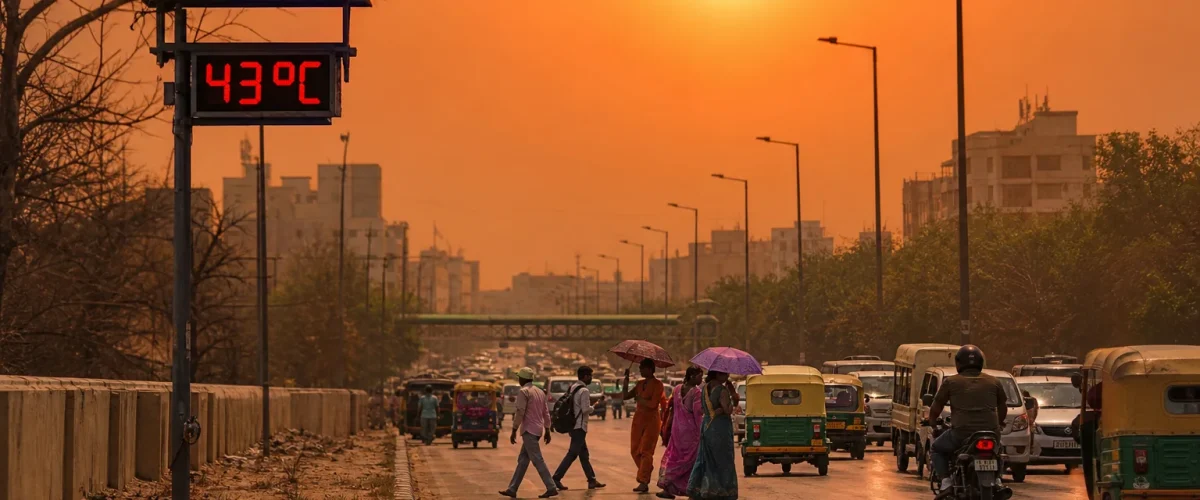
A punishing heatwave tightened its grip on northern and central India this week as the national capital Delhi recorded a maximum temperature of 43.4 degrees Celsius on 19 May 2026, marking the hottest May day in the city in two years. Several parts of Delhi exceeded 44 degrees Celsius on the same day, with the India Meteorological Department issuing yellow, orange, and red heat warnings across multiple states as temperatures climbed well above normal levels for this time of year.
The Safdarjung observatory, which serves as Delhi’s primary weather recording station, registered the 43.4 degree reading that officially confirmed the record. Other monitoring stations across the National Capital Region reported even higher readings, with parts of Najafgarh, Mungeshpur, and Narela approaching the 45-degree mark. The heat index, which combines temperature and humidity to indicate the perceived temperature, made conditions feel significantly worse than the raw thermometer readings suggest.
The heatwave extends far beyond Delhi. States across northern India including Uttar Pradesh, Rajasthan, Madhya Pradesh, Gujarat, Maharashtra, and Odisha are all experiencing prolonged periods of extreme heat. The highest maximum temperature recorded anywhere in the country last week was a staggering 46 degrees Celsius in Akola, Maharashtra, a reading that places the city among the hottest locations on the planet during that period. Reports indicate that all 22 of the world’s hottest cities during the peak of the heatwave were in India, an extraordinary statistic that underscores the severity of the crisis.
Power Demand Hits All-Time National Record
The scorching temperatures have driven India’s electricity demand to unprecedented levels as millions of air conditioners, coolers, and fans operate at maximum capacity. The national power grid recorded its highest-ever instantaneous demand, surpassing the previous record set during last year’s summer peak. The Power Ministry reported that all-India peak electricity demand crossed 250 gigawatts, a figure that would have been considered unimaginable just a decade ago.
The strain on the electricity grid has been particularly acute in Uttar Pradesh, Rajasthan, and Delhi, where the combination of large populations, limited local generation capacity, and extreme cooling demand has created supply-demand mismatches. While India has significantly expanded its generation capacity in recent years, including a massive build-out of solar and wind installations, the transmission infrastructure required to move power from surplus to deficit regions has not kept pace with demand growth.
Coal-fired power plants across the country are running at maximum capacity, and the government has directed Coal India Limited to prioritise supplies to thermal power stations. Several plants that were scheduled for maintenance shutdowns have been asked to postpone their outages until the heatwave subsides. The Power Ministry has also activated emergency procurement protocols that allow state distribution companies to purchase power on the spot market at higher-than-normal rates to prevent shortfalls from translating into blackouts.
Health Impact and Government Response
Health authorities across affected states have issued advisories urging people to stay indoors during peak afternoon hours, stay hydrated, and avoid strenuous outdoor activities. Hospitals in Delhi, Uttar Pradesh, and Maharashtra have reported increases in heat-related admissions, including cases of heat exhaustion, heatstroke, and dehydration. Vulnerable populations, including outdoor workers, the elderly, young children, and people with pre-existing health conditions, face the greatest risks.
State governments have implemented various emergency measures. Delhi has ordered schools to shift to online-only classes for the remainder of May and restricted construction work during afternoon hours. Uttar Pradesh has deployed additional medical teams to rural areas and set up heat relief camps with drinking water and oral rehydration solutions. Rajasthan has opened public buildings and temples as cooling centres for people without access to air conditioning.
The National Disaster Management Authority has been coordinating a multi-state response, sharing best practices from its Heat Action Plan framework that was developed after the devastating heatwaves of 2015 and 2023. The framework includes colour-coded warning systems, public awareness campaigns, and protocols for hospitals and emergency services. While these measures have helped reduce heat-related mortality compared to the catastrophic events of previous decades, the increasing frequency and intensity of heatwaves poses a growing challenge to public health infrastructure.
Climate Change and India’s Warming Trend
Climate scientists have noted that the current heatwave fits a broader pattern of increasing extreme heat events across South Asia that is consistent with climate change projections. The Indian Institute of Tropical Meteorology has documented a statistically significant increase in the frequency, duration, and intensity of heatwaves over the Indian subcontinent during the past three decades. Spring and early summer temperatures have been trending upward, and the onset of extreme heat has been occurring earlier in the year.
Research published by international climate agencies indicates that the probability of heatwaves as intense as the current event has approximately doubled compared to pre-industrial climate conditions. While natural variability plays a role in any individual weather event, the underlying warming trend driven by greenhouse gas emissions is making extreme heat events both more likely and more severe. India, as one of the world’s most climate-vulnerable nations with over 1.4 billion people and vast populations engaged in outdoor agricultural and industrial work, faces disproportionate risks.
The IMD has forecast that the heatwave conditions will persist across northern and central India through at least the end of May, with daily highs remaining in the 40 to 45 degree range across the worst-affected regions. Some relief may arrive with the advance of the southwest monsoon, which typically reaches the southern coast of Kerala by late May or early June and progressively covers the rest of the country through July. However, the monsoon’s arrival date varies year to year, and any delay would extend the heatwave’s duration.
Looking Ahead: Monsoon Relief and Long-Term Adaptation
The immediate focus for government agencies and public health authorities is managing the current crisis and preventing heat-related casualties. But the recurring nature of extreme heatwaves is driving longer-term discussions about urban planning, building standards, green infrastructure, and energy policy. Cities like Delhi, Ahmedabad, and Nagpur are developing urban heat island mitigation strategies that include increasing tree cover, using reflective building materials, and creating cool roof programmes for low-income housing.
Energy planners are also grappling with the implications of rising cooling demand for India’s grid and climate goals. Air conditioning penetration in India remains below 10 per cent, compared to over 90 per cent in countries like the United States and Japan. As incomes rise and heatwaves intensify, the demand for cooling is projected to grow exponentially, creating both an enormous energy challenge and a potential feedback loop where more cooling drives more emissions, which in turn drives more warming. Transitioning to energy-efficient cooling technologies and scaling up renewable energy generation are critical priorities for India’s climate and development agenda.
Related Stories on DailyTips
- SRH Beat RCB by 55 Runs in IPL 2026 Match 67 but Joy for Bengaluru as They Seal First Place in Points Table
- Election Commission Announces Rajya Sabha Polls for 24 Seats Across 10 States on June 18 2026
- Venezuela Overtakes Saudi Arabia and US to Become India Third Largest Crude Oil Supplier in May 2026 Amid West Asia Crisis
Explore more: Science & Space | India