Supreme Court Upholds 28% GST on Online Fantasy Gaming — Landmark Verdict Could Wipe Out India’s Rs 1 Lakh Crore Online Gaming Industry

Two Landmark Rulings Deliver Fatal Blow to Fantasy Gaming Sector
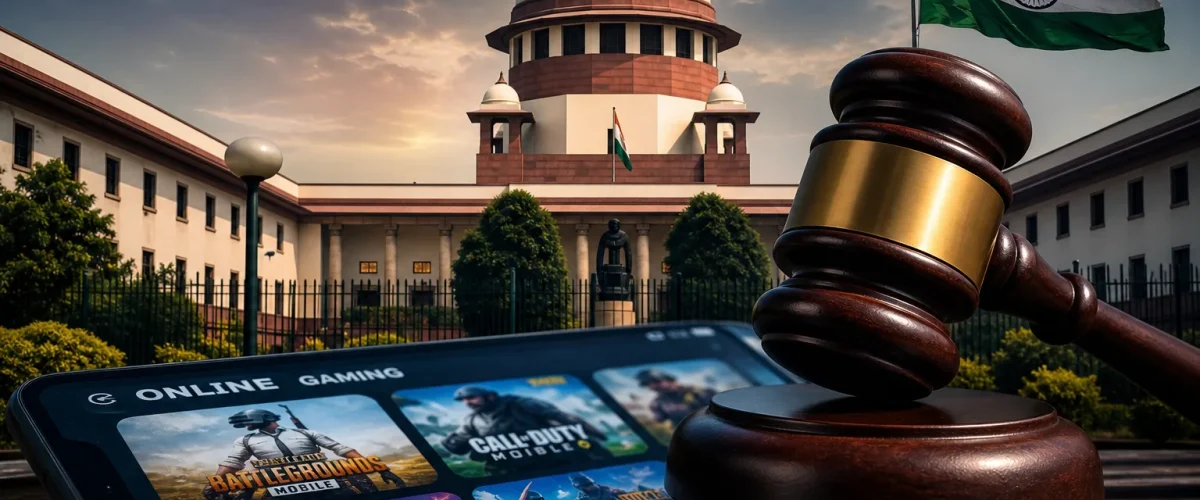
The Supreme Court of India delivered two landmark rulings on Wednesday that together could fundamentally alter — and potentially wipe out — what remains of the country’s online fantasy gaming and betting industry. In back-to-back decisions, the apex court upheld the retrospective application of the 28 per cent Goods and Services Tax on the full face value of bets placed on online gaming platforms, and separately ruled that fantasy sports involving monetary stakes do not qualify as games of skill exempt from the higher tax rate.
The combined impact of these verdicts is expected to validate tax evasion allegations of approximately Rs 1 lakh crore against around 80 companies, according to sources in the Directorate General of GST Intelligence. Legal and industry experts said the ruling effectively dismantles the legal framework that had allowed fantasy sports platforms like Dream11, MPL and others to operate under a lower tax regime by classifying their offerings as games of skill rather than games of chance.
What the Court Ruled — Breaking Down the Two Judgments
In the first ruling, a bench comprising Justices BV Nagarathna and Sanjay Kumar upheld the government’s October 2023 amendment to the GST law that imposed a uniform 28 per cent tax on the full face value of bets placed on online gaming, casinos and horse racing. The court rejected arguments from industry associations that the amendment amounted to retrospective taxation and was therefore unconstitutional, holding instead that the amendment was a clarificatory measure that merely formalised what the law had always intended.
The bench observed that the GST Council’s recommendation to levy 28 per cent GST on the total amount paid by participants was a legitimate exercise of its constitutional authority. “The distinction between games of skill and games of chance is irrelevant for the purpose of GST classification when monetary stakes are involved. The nature of the activity — whether it requires skill or not — does not alter the essential character of the supply, which is the provision of a platform for wagering,” the court held.
In the second ruling, delivered by a different bench, the court specifically addressed the classification of online fantasy sports, holding that platforms which charge entry fees and distribute prize pools based on the outcome of sporting events are essentially facilitating a form of betting. This ruling overturns the long-standing interpretation relied upon by the industry that fantasy sports are games of skill protected under Article 19(1)(g) of the Constitution.
Impact on the Rs 1 Lakh Crore Tax Demand
The verdict opens the floodgates for the DGGI to aggressively pursue tax recovery from online gaming companies. The tax intelligence agency had issued show-cause notices totalling approximately Rs 1.12 lakh crore to around 80 companies, including some of the biggest names in India’s gaming industry. The largest single demand of Rs 21,000 crore was served to Gameskraft Technologies, the Bengaluru-based company behind the popular Rummy Culture platform, followed by Dream11’s parent company Dream Sports facing a demand of approximately Rs 25,000 crore.
Industry insiders said the combined tax liability, if enforced in full, would far exceed the total revenues ever generated by most of these companies, effectively rendering them insolvent. Several companies had obtained interim relief from various High Courts, but Wednesday’s Supreme Court verdict removes the legal shield that had protected them from immediate recovery proceedings.
The business community has reacted with alarm, with multiple industry associations calling for an urgent dialogue with the government to discuss transitional relief measures that could prevent mass layoffs and business closures across the sector.
Industry Reacts with Shock and Dismay
The All India Gaming Federation, which represents over 100 gaming companies, said the verdict was “deeply disappointing” and would have “catastrophic consequences” for an industry that employs over 100,000 people directly and supports several hundred thousand more through ancillary services. AIGF CEO Roland Landers said the organisation would study the judgment carefully and explore all available legal remedies, including a review petition.
Dream11 co-founder Harsh Jain, whose platform has over 200 million registered users, issued a statement saying the company was “evaluating the implications of the judgment” and would “take all necessary steps to protect the interests of our users and stakeholders.” Market analysts noted that Dream Sports had been valued at over $8 billion in its last funding round and the ruling could effectively render that valuation worthless.
Shares of listed gaming and technology companies tumbled in after-hours trading on international exchanges, with Nazara Technologies and Delta Corp among the hardest hit. Market analysts said the ripple effects would extend beyond gaming to the broader technology startup ecosystem, as investors recalibrate the regulatory risk premium for Indian companies operating in grey areas of law.
Government Welcomes the Verdict
Finance Minister Nirmala Sitharaman welcomed the Supreme Court’s verdict, saying the ruling “upholds the principle that taxation must be equitable and that economic activities involving monetary stakes must contribute their fair share to the national exchequer.” The minister added that the government would work with the GST Council to establish a practical framework for the collection of outstanding dues, hinting at the possibility of instalment-based payment schemes for companies facing existential-level tax demands.
Revenue Secretary Sanjay Malhotra said the DGGI would now proceed with the adjudication of pending show-cause notices “in an orderly and time-bound manner,” and that the government was prepared to engage with companies willing to settle their dues voluntarily. Legal experts noted that the settlement route may be the only viable option for most companies, as contesting individual demands in tribunals and courts would involve years of litigation with uncertain outcomes.
What Happens Next — The Road Ahead
The immediate fallout of the ruling is expected to include a wave of restructuring, downsizing and potential shutdowns across the online gaming sector. Companies that had been operating on thin margins or burning investor capital in anticipation of a favourable judicial outcome now face the stark reality of backdated tax demands that dwarf their balance sheets.
Legal commentators said the ruling also has broader implications for the regulation of emerging digital industries in India. By holding that the skill-versus-chance distinction is irrelevant for GST purposes, the Supreme Court has effectively created a precedent that could be applied to other technology-driven activities where monetary stakes are involved, including cryptocurrency trading platforms and prediction markets.
For millions of fantasy sports users across India who had made platforms like Dream11, MPL and My11Circle a part of their daily entertainment, the ruling raises uncomfortable questions about the future availability and viability of these services. While the court’s decision does not ban online gaming per se, the economic reality of operating under a 28 per cent tax on the full bet value makes most existing business models commercially unviable.
Explore more: Business | Economy
Related Articles
- Supreme Court Upholds Election Commission’s Power to Conduct SIR — Rules Special Intensive Revision ‘Breathes Life Into Constitution’
- Sensex Drops Over 150 Points as US Renews Strikes on Iran — Brent Crude Rises and FIIs Pull Back
- Reliance’s Ambani Green Energy Giga Complex Ships First Batch of High-Efficiency Solar Modules from Jamnagar — India’s Clean Energy Push Gets Major Boost

- Indian Army Gets New Chief as General Dwivedi Hands Over Command Amid Push for Indigenous Defence Tech - July 1, 2026
- Ayodhya Ram Temple Donation Scandal Deepens as Trustees Resign and SIT Arrests Eight - June 29, 2026
- Bengal Seven Weeks On: Modi’s Historic Win and the Questions That Won’t Go Away - June 28, 2026