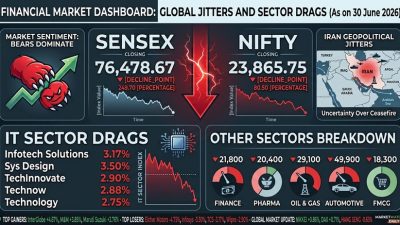
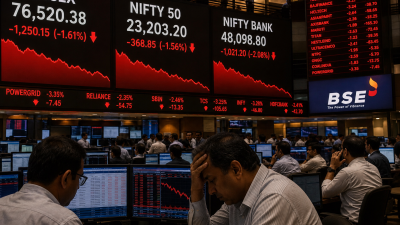
Sensex Drops Over 150 Points as US Renews Strikes on Iran — Brent Crude Rises and FIIs Pull Back

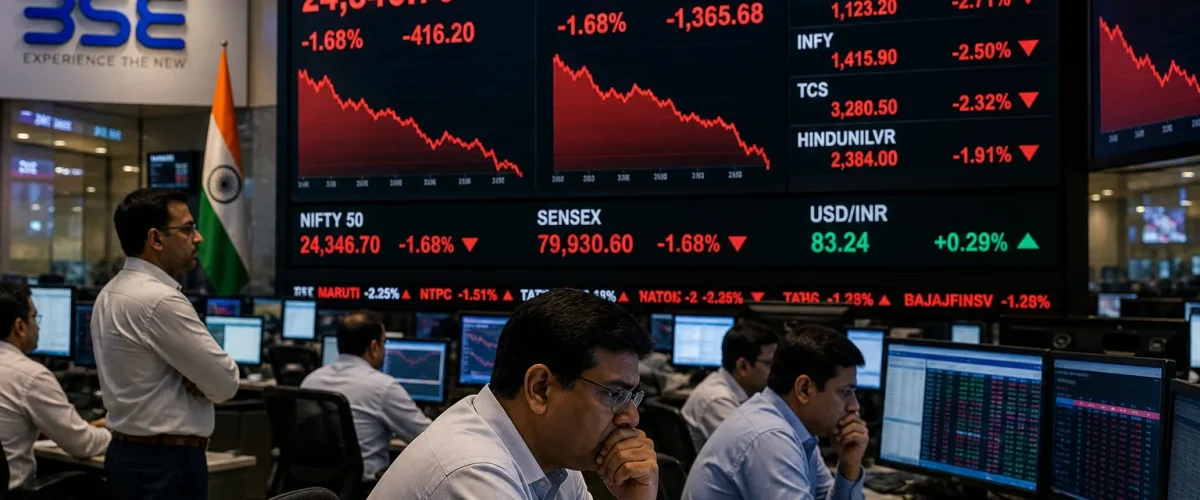
Indian equity markets opened on a negative note on Tuesday, May 26, 2026, with the BSE Sensex falling over 150 points and the NSE Nifty50 slipping below the psychologically important 24,000 mark. The sell-off came as fresh US military strikes on Iran over the weekend rattled global markets, pushing Brent crude prices higher and triggering risk-off sentiment among foreign institutional investors (FIIs). The Sensex was trading at 76,341.42, down 150 points from Monday’s close, while the Nifty50 slipped 0.2% to 23,983.95 in early trade.
The sharp reversal is particularly notable given that markets had rallied strongly in the previous session, with the Sensex gaining over 900 points on May 25 on hopes of de-escalation in the Iran conflict. However, the US announcement of renewed strikes on Sunday evening — which Washington described as “acting in self-defence” — dashed those hopes and sent Asian markets into a tailspin.
What Triggered the Sell-Off
The immediate catalyst was the US announcement on May 25 that it had renewed military strikes against Iranian targets, just days after Iranian President Masoud Pezeshkian had signalled willingness to assure the world that Iran is not pursuing nuclear weapons. The timing of the strikes — coming amid what appeared to be diplomatic progress — caught markets off guard and raised fears of a prolonged conflict.
“The market had priced in de-escalation after Pezeshkian’s conciliatory statements and the discussion around a 60-day truce,” said Ajay Menon, Head of Equities at Motilal Oswal Securities. “The renewed strikes have effectively reset expectations, and we’re likely to see continued volatility until there’s clarity on the diplomatic trajectory.”
Brent crude futures, which had fallen sharply in the previous session on hopes of a truce, reversed course and were trading up 2.3% at $87.45 per barrel in early Asian trade. The rise in crude prices has direct implications for India — the world’s third-largest oil importer — affecting everything from the current account deficit and fiscal math to retail fuel prices and inflation.
Sectoral Performance
The market reaction was uneven across sectors. In the broader market, both smallcap and midcap stocks showed resilience, trading in positive territory. The Nifty Smallcap 100 rose 0.5% to 18,301.85, while the Nifty Midcap 100 gained 0.1% to 62,035.50.
From a sectoral perspective, the trend was mixed:
- Gainers: Nifty Metal led the charge, rising 1.2% as steel and aluminium stocks benefited from expectations of supply disruptions. Nifty IT gained 0.8% on a favourable rupee-dollar dynamic, while Nifty Media also posted gains.
- Losers: Nifty Realty was the worst performer, falling 1.5% on concerns that rising interest rates and fuel costs would dampen housing demand. Nifty Consumer Durables dropped 0.9%, while Nifty Auto fell 0.7% amid worries about the impact of rising fuel prices on demand.
FII Flows: The Crucial Variable
Foreign institutional investors, who had turned net buyers in the previous session after weeks of relentless selling, are expected to resume their cautious stance following the renewed Iran tensions. FIIs have pulled out over Rs 25,000 crore from Indian equities in May alone, driven by a combination of geopolitical uncertainty, a strong US dollar, and attractive valuations in other emerging markets.
“FII flows are being driven by global risk appetite, and the Iran situation is the single biggest variable right now,” said Nilesh Shah, Managing Director of Kotak Mahindra AMC. “Until there’s a clear path to de-escalation, we should expect FII selling to continue, particularly in the large-cap space.”
Domestic institutional investors (DIIs), led by mutual funds flush with systematic investment plan (SIP) inflows, have been providing a counterbalance to FII selling. DII net purchases in May have exceeded Rs 20,000 crore, preventing a deeper correction. However, analysts warn that DII buying alone may not be sufficient to sustain markets if FII outflows accelerate.
Gift Nifty and Global Cues
The negative opening was signalled by Gift Nifty futures, which were trading around 24,030 — down 95 points — before the Indian market opened. Asian markets were broadly lower, with Japan’s Nikkei 225 falling 0.6%, Hong Kong’s Hang Seng dropping 0.8%, and South Korea’s KOSPI declining 0.4%.
European futures were also pointing to a weaker open, with EuroStoxx 50 futures down 0.3%. US markets had closed mixed on Friday, with the S&P 500 edging up 0.1% but the Nasdaq falling 0.3% as tech stocks came under pressure.
The Crude Oil Wild Card
For Indian markets, the trajectory of crude oil prices remains the single most important external variable. India imports approximately 85% of its crude oil requirements, and every $10 per barrel increase in Brent crude adds approximately 0.5% to the current account deficit and 30-40 basis points to headline inflation.
The closure of the Strait of Hormuz since the Iran conflict began has forced India to diversify its crude sources, with Venezuela recently overtaking both Saudi Arabia and the United States to become India’s third-largest crude supplier. However, the logistics of sourcing oil from more distant suppliers add to procurement costs.
“The equation is simple: if Brent stays above $85, Indian markets will struggle to hold current levels,” said Saurabh Mukherjea, Founder of Marcellus Investment Managers. “The Nifty needs crude at $75-80 to sustain the 24,000 level comfortably.”
Key Levels to Watch
Technical analysts are closely monitoring the Nifty50’s behaviour around the 23,900-24,000 zone, which has emerged as a critical support level. A sustained break below 23,900 could trigger further selling pressure, with the next major support at 23,500. On the upside, a recovery above 24,100 would signal that the dip is being bought into and could pave the way for a move towards 24,300.
The India VIX, the market’s fear gauge, rose 5.2% to 16.8, indicating elevated anxiety among traders. Options data showed significant put writing at the 23,800 strike, suggesting that traders expect this level to hold as a floor in the near term.
What Should Investors Do?
Market strategists are advising investors to maintain a cautious stance in the near term while using dips to accumulate quality stocks. “This is not the time for panic selling, but it’s also not the time for aggressive buying,” said Raamdeo Agrawal, co-founder of Motilal Oswal Financial Services. “Stay invested in fundamentally strong companies, use SIPs to average out volatility, and keep some powder dry for deeper corrections.”
As the Quad Foreign Ministers meet in New Delhi today — with the Iran situation likely to feature prominently in discussions — investors will be watching for any diplomatic signals that could move markets. Until then, the combination of geopolitical uncertainty, rising crude prices, and FII outflows suggests that volatility is here to stay.
Related Articles
- RBI Approves Record ₹2.87 Lakh Crore Dividend to Government for FY26 — 7% Jump Over Last Year
- Maharashtra’s Alphonso Mango Trade Devastated by Heatwave, El Niño and Iran War — King of Mangoes Faces Worst Season in Decades
- CNG Prices Hiked by Rs 2 Per Kg in Delhi — Third Increase in Under Two Weeks as Iran War Drives Energy Costs Higher
Explore more: Markets

- Fentanyl Vaccine Breakthrough: Scripps Research Develops Shot That Blocks Deadly Overdoses Before They Reach the Brain - June 13, 2026
- Nipah Virus Returns to Kerala — First Case of 2026 Confirmed, State Declares High Alert - June 12, 2026
- Jill Biden Reveals She Wanted to Keep PM Modi’s 7.5-Carat Diamond Gift but Returned It After State Department Valued It at $20,000 - June 8, 2026