6 Workers Killed, 3 Trapped as Under-Construction Bridge Collapses During Storm in UP’s Hamirpur — CM Yogi Orders Probe

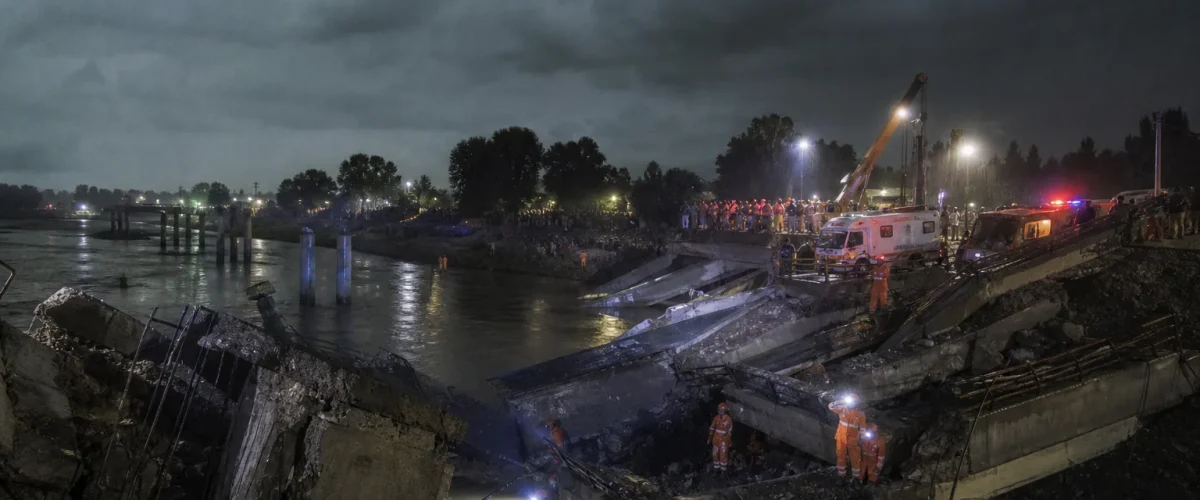
Six construction workers were killed and three others injured early on Thursday when a section of an under-construction bridge collapsed during a powerful storm over the Betwa River in Uttar Pradesh’s Hamirpur district. The tragedy, which occurred around 2-3 AM on May 29, has renewed questions about construction safety standards and the vulnerability of workers on India’s infrastructure projects.
The accident took place near Morakandar Parsani village in the Lalpura area, where a bridge linking the village with Naithi in the Kurara region was being built. Officials said strong winds and heavy rain swept through the area late on Wednesday night when a concrete slab of the bridge suddenly caved in. Several workers had been resting beneath and around the structure, using it as shelter from the storm, when the slab collapsed on them.
The Victims
The deceased have been identified as Lokendra Nishad, 22, and Kuldeep Nishad, 19, both from Chilla village in neighbouring Banda district; Sawant Yadav, 28, a resident of Bhuragarh; Sabhajeet, 30; Pushpendra Singh Chauhan, 34, from Swasa Khurd in Hamirpur; and Rajesh Pal, 42, from Achpura. The youngest victim, Kuldeep Nishad, was just 19 years old — a stark reminder that many of India’s infrastructure workers are young men from economically vulnerable backgrounds.
Three additional workers were stranded on one of the bridge pillars after the collapse and were later rescued by teams from the State Disaster Response Force (SDRF). Their injuries are reported to be non-life-threatening, though they have been hospitalised for observation.
Rescue Operations
Police, district administration officials, and SDRF teams reached the site shortly after the incident and launched rescue operations in extremely challenging conditions. Heavy rain continued through the early morning hours, hampering efforts to clear debris and locate victims. Five bodies were recovered from the rubble by dawn, with the sixth body found later in the morning as rescue teams used heavy machinery to lift collapsed concrete slabs.
The Betwa River, swollen by the overnight storm, added to the danger at the site. Rescuers had to contend with rising water levels as they worked to reach workers who may have been swept into the river. District Magistrate officials confirmed that the immediate area has been cordoned off and that a structural assessment of the remaining bridge sections is being conducted to prevent further collapses.
Government Response
Chief Minister Yogi Adityanath has ordered a detailed investigation into the incident and directed district officials to provide immediate relief to the families of the deceased. Each family is expected to receive ex-gratia compensation as per state government norms. The Chief Minister also instructed the Public Works Department to review the construction plans and safety protocols at the bridge site.
The bridge was being constructed under a state-funded infrastructure development project aimed at improving connectivity between rural areas in the Bundelkhand region. The contractor responsible for the project has not yet been identified publicly, though officials said they would be summoned for questioning as part of the investigation.
Questions About Construction Safety
The Hamirpur tragedy highlights persistent safety concerns in India’s construction sector, which employs an estimated 55 million workers — making it the country’s second-largest employer after agriculture. According to data from the International Labour Organization (ILO), India accounts for a disproportionately high share of global construction-related fatalities, with an estimated 38 deaths per 100,000 workers annually compared to fewer than 5 in developed nations.
Construction workers in rural areas are particularly vulnerable. Many are informal labourers without written contracts, safety equipment, or insurance coverage. The practice of workers sheltering under partially built structures during storms — as appears to have happened in Hamirpur — is common on Indian construction sites where worker accommodation is often inadequate or nonexistent.
Industry experts have long called for stricter enforcement of the Building and Other Construction Workers (Regulation of Employment and Conditions of Service) Act, 1996. While the law mandates safety equipment, proper working hours, and welfare measures, compliance remains low, particularly on smaller state-level projects far from the scrutiny of major urban centres.
A Pattern of Infrastructure Failures
The Hamirpur collapse is not an isolated incident. India has witnessed a troubling series of bridge and infrastructure failures in recent years. In 2022, the collapse of a suspension bridge in Gujarat’s Morbi killed 135 people. Multiple bridge collapses in Bihar during the monsoon seasons of 2023 and 2024 raised questions about the quality of construction in flood-prone areas.
Engineers note that bridges under construction are particularly vulnerable during storms because they lack the structural integrity of completed structures. Without the full complement of reinforcement, curing, and load distribution that comes with a finished bridge, partially constructed sections can fail under the combined stress of wind, rain, and the weight of freshly poured concrete.
The Bundelkhand Context
The Bundelkhand region, which spans parts of Uttar Pradesh and Madhya Pradesh, has historically been one of India’s most underdeveloped areas. Infrastructure development — including bridges, roads, and irrigation projects — has been a key government priority for the region. The Betwa River bridge was part of efforts to improve connectivity for remote villages that remain cut off during the monsoon season when the river swells.
The irony that an infrastructure project meant to protect communities from the monsoon’s fury itself became a victim of the same forces is not lost on local residents. Community leaders have demanded accountability and urged that the investigation examine not just the structural failure but also the decision-making that allowed workers to remain at an exposed construction site during a severe storm warning.
As rescue operations continue and the district administration processes compensation claims, the families of six men who went to work and never came home are left to reckon with a tragedy that, for all its scale, is depressingly familiar in the story of India’s infrastructure ambitions.
Related Articles
- Delhi Records Warmest May Night in 14 Years as Severe Heatwave Continues
- Cocaine Worth Rs 1,150 Crore Seized Off Gujarat’s Mundra Coast
- ED Raids Former Kerala CM Pinarayi Vijayan’s Premises in CMRL Case
- Punjab Municipal Election Results 2026 — AAP Sweeps Civic Polls with 131+ Seats

- Indian Army Gets New Chief as General Dwivedi Hands Over Command Amid Push for Indigenous Defence Tech - July 1, 2026
- Ayodhya Ram Temple Donation Scandal Deepens as Trustees Resign and SIT Arrests Eight - June 29, 2026
- Bengal Seven Weeks On: Modi’s Historic Win and the Questions That Won’t Go Away - June 28, 2026