Punjab Municipal Election Results 2026 — AAP Sweeps Civic Polls with 131+ Seats as Congress, SAD and BJP Trail Far Behind

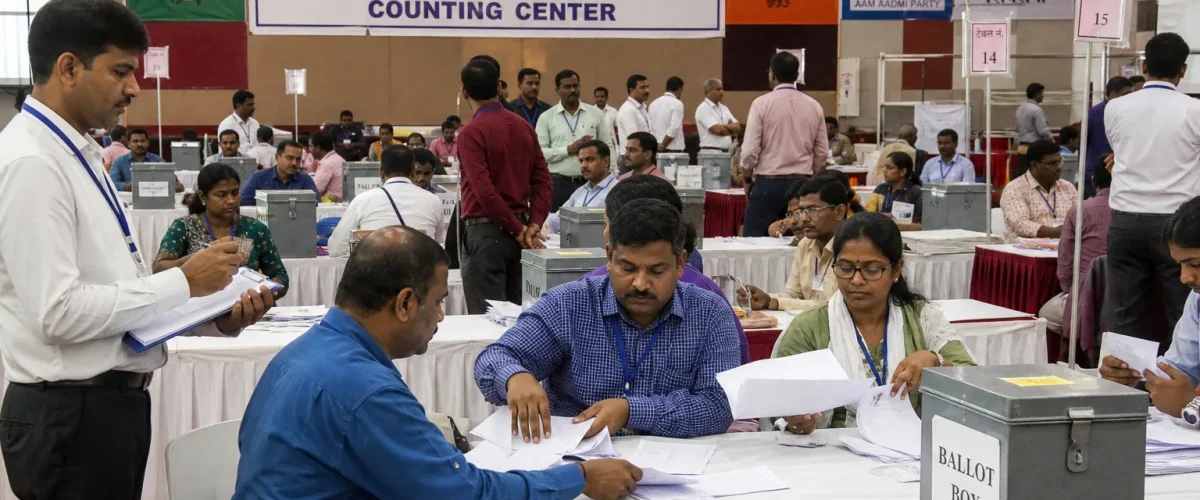
The Aam Aadmi Party has delivered a commanding performance in Punjab’s 2026 municipal elections, sweeping civic polls across the state with over 131 seats as counting progressed through May 29. The results represent a resounding vote of confidence in Chief Minister Bhagwant Mann’s governance and a stunning setback for opposition parties who had mounted an aggressive campaign alleging electoral irregularities.
As of the latest trends, AAP leads with 131 seats across 102 local bodies — comprising eight major municipal corporations, 75 municipal councils, and 20 nagar panchayats. The Shiromani Akali Dal (SAD) and Congress are locked in a distant battle for second place with approximately 28 seats each, while the Bharatiya Janata Party has managed just 2 seats in what appears to be a negligible showing.
Scale of AAP’s Victory
The scale of AAP’s dominance becomes clear when examining the numbers. A total of 22.38 lakh citizens cast their ballots across 3,833 polling booths to decide the governance of Punjab’s urban local bodies. AAP’s 131+ seats represent a majority in the vast majority of these bodies, giving the party near-complete control over urban governance in the state.
The party’s strength was evident even before counting began — 80 AAP candidates were elected unopposed across several municipalities, with 63 of these being AAP nominees. This “uncontested” dominance suggests a level of organisational strength and grassroots support that opposition parties were unable to match.
In the eight major municipal corporations — including Amritsar, Ludhiana, Jalandhar, and Patiala — AAP has established clear leads. Early trends from Bathinda, where at least 10 candidates were declared winners unopposed with 9 being AAP nominees, exemplify the party’s ground-level consolidation.
Opposition’s Dismal Performance
Congress, which governed Punjab from 2017 to 2022 under Captain Amarinder Singh and briefly under Charanjit Singh Channi, has been reduced to a marginal force in the state’s urban politics. With approximately 28 seats, the party’s showing is particularly disappointing given its historical strength in Punjab’s cities. The party managed an early lead only in the Kapurthala municipal corporation, with most other urban centres going decisively to AAP.
The Shiromani Akali Dal, once the dominant political force in Punjab, finds itself in a similar predicament. Tied with Congress at around 28 seats, the party’s inability to capitalise on anti-incumbency — if any — raises serious questions about its organisational health and leadership under Sukhbir Singh Badal.
The BJP’s showing is the most striking. With just 2 seats in a state where it once shared power as part of the SAD-BJP alliance, the party appears to have virtually no urban political base in Punjab. This result comes despite the BJP’s strong national position and suggests that Punjab’s political landscape remains fundamentally different from the rest of northern India.
Allegations and Controversies
The election was not without controversy. Leaders from Congress, SAD, and BJP had submitted formal grievances to the State Election Commission alleging systemic irregularities during the polling process. Accusations ranged from voter intimidation and disruption of ballot secrecy to what opposition leaders described as the “weaponisation of the police force” on polling day.
AAP dismissed these allegations as the “desperation of parties that know they’ve lost the people’s trust.” Party leaders pointed to the smooth conduct of polls at the vast majority of booths and the presence of election observers as evidence that the process was fair and transparent.
The State Election Commission has not yet formally responded to the opposition’s complaints, though officials indicated that all grievances would be examined as per standard protocol.
Significance for AAP’s National Ambitions
For AAP, the Punjab civic poll results carry significance far beyond local governance. The party, led nationally by Arvind Kejriwal, has been seeking to establish itself as a credible national alternative. Punjab remains its only state government, and a strong showing in civic elections validates the governance model that CM Bhagwant Mann has implemented — focused on education, healthcare, and urban infrastructure improvements.
The results also provide ammunition for AAP ahead of the 2027 Punjab Assembly elections, where the party will seek a second term. A dominant civic poll performance suggests that the urban voter base remains firmly with the party, though rural areas — which were not part of these elections — will tell their own story.
AAP’s sweep of the unopposed seats — 63 out of 80 candidates elected without contest — indicates that the party has built a cadre-based organisation in Punjab that can field credible candidates even at the ward level. This ground-level infrastructure has been a weakness for the party in other states and represents a genuine achievement in Punjab.
What This Means for Punjab
With control of both the state government and the vast majority of urban local bodies, AAP now has an unprecedented mandate to implement its vision for Punjab’s cities. Key challenges facing Punjab’s urban areas — including water supply, waste management, road infrastructure, and urban flooding — can now be addressed through coordinated state-local governance.
The party has promised an urban development blueprint that includes smart city initiatives, improved public transport, and the regularisation of colonies. Whether it can deliver on these promises while managing the state’s fiscal challenges — including the legacy of debt inherited from previous governments — will determine its political future in the state.
For now, May 29 belongs to AAP in Punjab. The question is whether this urban dominance can be sustained and extended to the rural heartland before the next assembly election.
Related Articles
- Siddaramaiah Steps Down as Karnataka Chief Minister — DK Shivakumar Set to Take Over
- Supreme Court Upholds Election Commission’s Power to Conduct SIR
- Tamil Nadu CM Vijay Announces Farm Loan Waiver Worth Rs 2,044 Crore
- Supreme Court Raps NTA Over NEET-UG 2026 Cancellation

- Indian Army Gets New Chief as General Dwivedi Hands Over Command Amid Push for Indigenous Defence Tech - July 1, 2026
- Ayodhya Ram Temple Donation Scandal Deepens as Trustees Resign and SIT Arrests Eight - June 29, 2026
- Bengal Seven Weeks On: Modi’s Historic Win and the Questions That Won’t Go Away - June 28, 2026