India Power Demand Shatters All Records at 265 GW as Deadly Heatwave Pushes Temperatures Past 48 Degrees Celsius Across Northern India

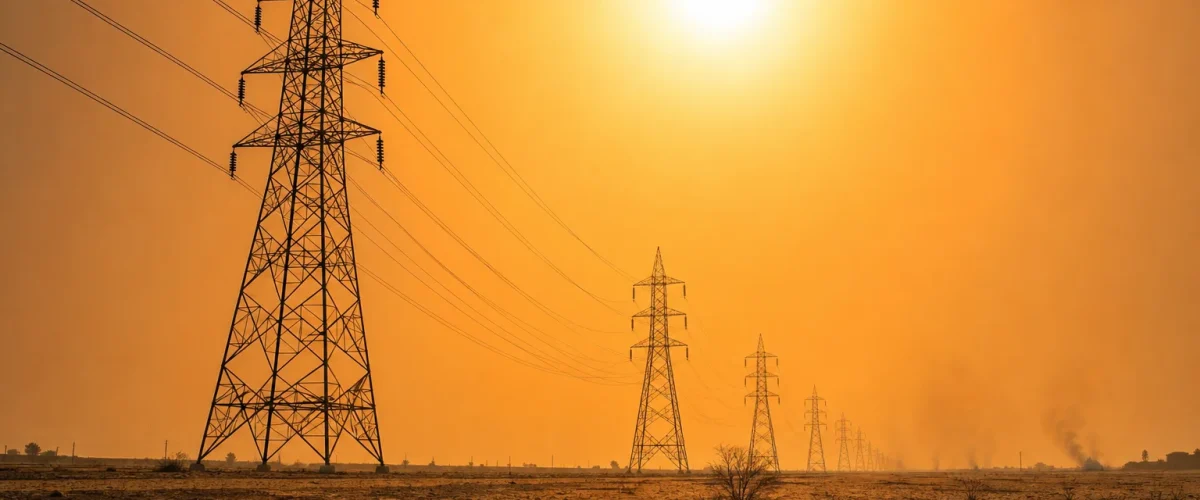
India’s peak electricity demand has reached an all-time record of 265.44 gigawatts, recorded at 3:45 PM on 20 May 2026 as severe heatwave conditions continued to grip northern and central India. The milestone came on the third consecutive day of record-breaking power demand, following 257.37 GW on Monday and 260.45 GW on Tuesday of the same week.
The Union power ministry confirmed that demand was “successfully met,” with thermal power plants contributing 165 GW and solar generation adding 57.86 GW. But the raw numbers disguise the strain on India’s electricity infrastructure — grid operators are running at near-capacity, and any significant equipment failure during peak hours could trigger cascading outages affecting tens of millions of people.
Simultaneously, temperatures have crossed 48 degrees Celsius in parts of Uttar Pradesh, with Delhi hovering around 46°C during the day and recording its warmest May night in nearly 14 years — a minimum temperature of 32.4°C that was 5.7 degrees above normal. The combination of extreme daytime heat and elevated nighttime temperatures has created conditions that health experts describe as genuinely life-threatening.
Why 265 GW Matters
India’s power grid was designed and built incrementally over decades, and until recently, peak demand rarely exceeded 200 GW. The jump from 200 GW to 265 GW has occurred in roughly three years, driven almost entirely by air conditioning adoption and industrial cooling requirements during increasingly severe heatwaves.
The power ministry projects that demand could touch 271 GW this year. That projection, made before the current heatwave intensified, may prove conservative. Each additional degree of temperature above 40°C adds approximately 3-5 GW of cooling demand to the grid as households, commercial buildings and industrial facilities run air conditioning at full capacity.
Coal remains the backbone of India’s power supply during peak demand periods, despite the country’s ambitious renewable energy targets. The ministry has projected coal demand of 906 million tonnes for the current fiscal year. The reliance on thermal generation during heatwaves creates a difficult tension with India’s climate commitments — the very fossil fuel infrastructure needed to keep people cool is contributing to the warming that makes heatwaves more severe.
The earlier record demand periods in May already strained the grid. The 265 GW figure represents a new frontier that India’s energy planners must now design for as the baseline, not the exception.
The Heat Is Not Normal
What India is experiencing in May 2026 is not a standard summer. The India Meteorological Department has issued severe heatwave warnings across Rajasthan, Delhi, Uttar Pradesh, Madhya Pradesh, Maharashtra and parts of Bihar. Temperatures have repeatedly crossed 47°C in multiple locations, with some stations in western Rajasthan recording readings approaching 50°C.
Scientists have linked the severity to El Niño conditions that have suppressed premonsoon moisture, combined with long-term warming trends that have raised baseline temperatures. The warmest May night in Delhi in 14 years is not just a temperature record — it represents a failure of the natural cooling cycle that normally gives urban populations relief after sunset.
When nighttime temperatures remain above 30°C, the human body cannot recover from daytime heat exposure. This is when heat-related mortality spikes — particularly among outdoor workers, the elderly and populations without access to air conditioning or adequate hydration. India’s public health system does not systematically track heat deaths, making the true mortality toll difficult to assess.
Delhi’s Power Grid Under Pressure
The national capital’s peak power demand hit 8,039 MW during the 265 GW national peak — approaching Delhi’s all-time record of 8,656 MW set in June 2024. Delhi’s position is precarious because it imports the vast majority of its electricity from neighbouring states. Any supply disruption in Uttar Pradesh, Haryana or Rajasthan — states that are themselves under severe heat stress — could trigger blackouts in the capital.
Delhi’s distribution companies have deployed additional mobile transformers and repair crews to manage the surge, but the ageing distribution infrastructure in many parts of the city is not designed for sustained demand at these levels. Transformer failures, which increase exponentially when equipment runs at high temperatures for extended periods, are the most common cause of localised power outages during heatwaves.
The Monsoon Cannot Come Soon Enough
The only natural relief from the heatwave is the southwest monsoon, which typically arrives on India’s Kerala coast in early June before advancing across the country through July. However, the IMD’s forecast of 90 per cent of normal rainfall — categorised as below-normal — suggests that even when the monsoon arrives, it may not deliver the temperature relief that northern India desperately needs.
The monsoon forecast has already rattled agricultural markets and water management planners. A delayed or weak monsoon would extend the heatwave season, pushing power demand even higher and increasing the risk of water shortages in states that rely on monsoon recharge for drinking water and irrigation.
The Human Cost
Behind every gigawatt of power demand and every temperature record is a human story. Construction workers labouring in 47-degree heat. Street vendors who cannot retreat to air-conditioned spaces. Farm labourers in Bihar and Uttar Pradesh working through conditions that the International Labour Organization classifies as hazardous. Children in schools without cooling, many of which have been forced to shift to morning-only schedules or close entirely.
India’s economic productivity takes a measurable hit during severe heatwaves. The Reserve Bank of India has estimated that heat stress reduces GDP growth by 0.3 to 0.5 percentage points during peak heatwave years. The 2026 summer may test the upper bound of that estimate.
The 265 GW record is a number that will be surpassed — perhaps within days, certainly within the next heatwave cycle. What it represents is a country at the intersection of its development trajectory and its climate vulnerability, generating and consuming more energy than ever before to cope with temperatures that are, year by year, becoming more extreme.
The environmental implications extend in every direction: more coal burned to power air conditioners, more carbon emitted to cool a warming country, more strain on water systems that are simultaneously depleted by heat and needed for thermal power plant cooling. The cycle is self-reinforcing, and breaking it will require systemic changes in energy policy, urban planning and public health infrastructure that India has not yet implemented at the scale required.