TMC Crisis Deepens as 60 of 80 MLAs Skip Mamata Banerjee Meeting After Alleged Attack on Nephew Abhishek in South 24 Parganas

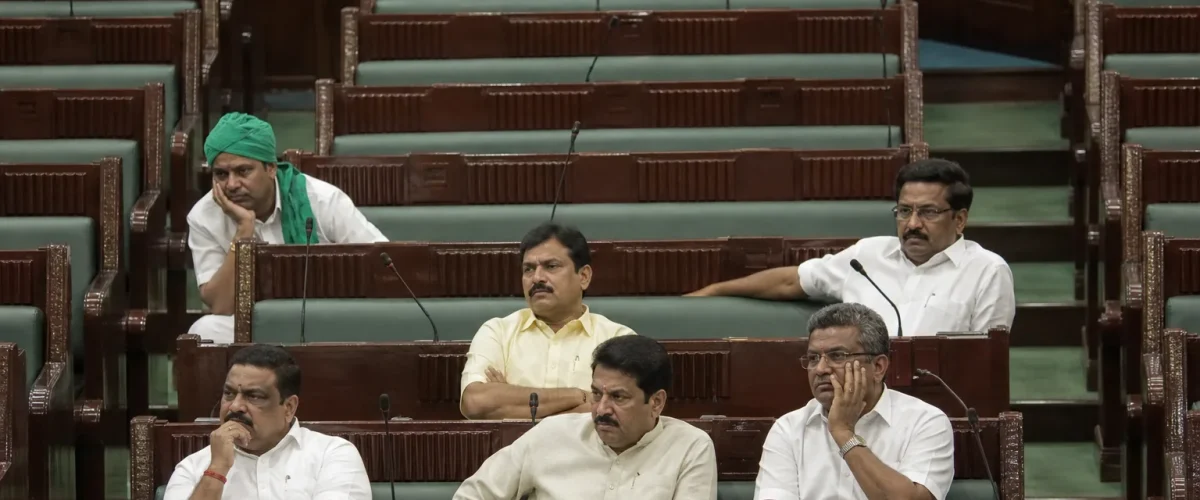
A scheduled meeting of newly elected Trinamool Congress legislators, to be chaired by party supremo and Chief Minister Mamata Banerjee at her Kalighat residence on Sunday, was called off after nearly three-quarters of the party’s 80 MLAs failed to attend. Only about 20 legislators showed up, forcing the TMC leadership to defer the meeting indefinitely — a remarkable display of internal disarray in a party that just won a commanding majority in the West Bengal assembly elections.
The mass absence comes in the aftermath of an alleged attack on TMC general secretary Abhishek Banerjee — Mamata’s nephew and the party’s most prominent younger leader — in South 24 Parganas district on Saturday, which the party claims was orchestrated by “BJP-backed miscreants” in the context of escalating post-poll violence across Bengal.
What Happened — The Attack on Abhishek Banerjee
According to TMC accounts, Abhishek Banerjee was visiting the family of Sanju Karmakar, a party worker whom the TMC claims was killed during post-election violence, when his convoy was attacked by a group of armed individuals in the Baruipur area of South 24 Parganas. The nature and severity of the attack have been disputed — TMC leaders describe it as a “planned assassination attempt,” while BJP leaders and local police have characterised it as a “minor scuffle” during a politically charged visit.
TMC MP Kalyan Banerjee was also reportedly attacked during a separate incident on the same day, adding to the party’s narrative of a coordinated campaign against its leaders. The double attack set off a chain of events — protests by TMC workers across multiple districts, police action including the arrest of several party cadres, and ultimately the mass no-show at Mamata’s legislative party meeting.
The Official Explanation — And What It Really Means
TMC spokesperson Kunal Ghosh, speaking outside Mamata’s Kalighat residence where the meeting was scheduled, offered a carefully worded explanation: “The meeting was pre-scheduled. However, in the aftermath of the attacks on our leaders, our MLAs are organising protest programmes at the ground level, following which severe police action has been unleashed on our workers.”
Ghosh added that the absentee MLAs “had informed the legislative party of the developments and requested if the meeting could be temporarily postponed,” and that the party had agreed to defer after receiving what he described as a “legitimate request.”
Political analysts in Bengal, however, read the situation differently. The 75 percent absence rate at a meeting called by the Chief Minister herself — barely days after a historic election victory — suggests something deeper than logistical inconvenience. Three possible explanations are being discussed in Bengal’s political circles.
First, a genuine fear factor: some MLAs may be reluctant to travel to Kolkata amid ongoing post-poll violence in their constituencies, concerned that their absence could embolden opponents to target their supporters. Second, factional tensions: the TMC has long been divided between those aligned with Abhishek Banerjee’s “younger generation” faction and those loyal to the old guard around Mamata. A meeting called in the immediate aftermath of an attack on Abhishek could have forced uncomfortable positioning. Third, and most prosaically, some MLAs may be occupied with the messy business of managing post-poll violence at the grassroots — distributing relief, managing local tensions, and negotiating with police and administration.
Post-Poll Violence — Bengal’s Recurring Nightmare
West Bengal has a grim history of post-election violence that cuts across party lines. After the 2021 assembly elections, which saw the TMC return to power with an increased majority, widespread violence was reported in multiple districts, with both TMC and BJP workers claiming to be victims. The Calcutta High Court eventually ordered a CBI investigation into the most serious cases, and the National Human Rights Commission published a damning report documenting killings, sexual assaults, and property destruction.
The 2026 post-election period appears to be following a similar, if somewhat less severe, trajectory. Reports of violence have emerged from Cooch Behar, North 24 Parganas, Purba Medinipur, and parts of South 24 Parganas, with both TMC and BJP trading accusations of initiating the attacks. The Governor has written to the Chief Minister demanding a report on the violence, while the BJP has called for President’s Rule — a demand that the TMC has dismissed as “anti-democratic posturing.”
The Larger Political Picture
The TMC’s internal dynamics are being watched closely because they carry implications beyond Bengal. Mamata Banerjee has positioned herself as a key figure in national opposition politics, and Abhishek Banerjee is widely seen as her political heir. Any perception of organisational weakness — whether through factional divisions, inability to control post-poll violence, or the spectacle of MLAs defying a summons from the Chief Minister — undermines both the state and national narratives.
The political landscape across Indian states has been volatile in recent months. AAP’s sweep in Punjab municipal elections demonstrated that regional parties with organisational discipline can consolidate power effectively. The Supreme Court’s verdict on Election Commission powers and the political tension in Kerala over ED raids on former CM Vijayan add layers of complexity to an already charged national political environment.
For Mamata Banerjee, the immediate priority will be restoring order — both on Bengal’s streets and within her party’s ranks. A rescheduled legislators’ meeting, whenever it occurs, will need to demonstrate unity rather than expose fault lines. The TMC’s election victory was emphatic; its post-victory management, so far, has been anything but.