India’s 5G Subscriber Base Races Toward One Billion: How Jio, Airtel, and Network APIs Are Reshaping Telecom

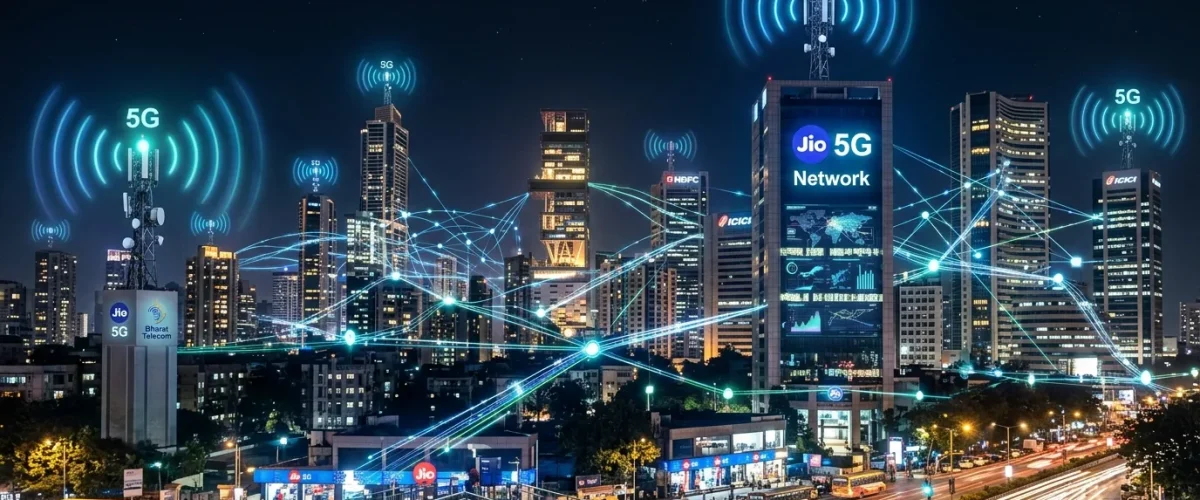
India’s telecommunications sector is witnessing a transformation of historic proportions. According to Ericsson’s latest mobility projections, India’s 5G subscriber base—which reached approximately 394 million by the end of 2025—is on a trajectory to surpass one billion by 2031, representing a staggering 79 percent penetration rate. This expansion, driven by fierce competition between Reliance Jio and Bharti Airtel, aggressive infrastructure deployment, and the emergence of network Application Programming Interfaces (APIs) as a new monetisation frontier, is reshaping not just how Indians communicate but how the nation’s digital economy operates at its most fundamental level.
The Duopoly That Drives Everything
India’s 5G story is, at its core, a tale of two companies. Reliance Jio and Bharti Airtel have collectively invested tens of thousands of crores in 5G spectrum acquisition and network deployment, creating a competitive dynamic that has accelerated rollout timelines far beyond initial projections. Jio, leveraging its standalone 5G architecture and its parent company Reliance Industries’ deep pockets, has pursued an aggressive coverage-first strategy, aiming to blanket India’s major urban centres with 5G before expanding to tier-two and tier-three cities.
Airtel has adopted a complementary approach, focusing on network quality and enterprise solutions alongside consumer coverage. Its non-standalone 5G deployment, which layers 5G capabilities atop existing 4G infrastructure, has enabled faster initial rollout in many markets, though the long-term performance advantages of standalone architecture remain a subject of industry debate.
The competitive intensity between these two operators has delivered tangible benefits to Indian consumers. Average revenue per user (ARPU) for 5G services remains among the lowest globally, while data consumption per user continues to climb. India’s mobile data consumption per smartphone—already among the highest in the world—has been further amplified by 5G’s enhanced speeds, creating a virtuous cycle of usage growth, network investment, and service innovation.
Fixed Wireless Access: Broadband Without the Wire
One of the most commercially significant applications of India’s 5G infrastructure is Fixed Wireless Access (FWA)—the delivery of home broadband services through 5G radio connections rather than physical fibre-to-the-home installations. Both Jio and Airtel have aggressively promoted their FWA offerings through 2025 and into 2026, targeting the vast underserved home broadband market.
India’s fixed broadband penetration remains remarkably low for a major economy—estimated at under 10 percent of households—creating an addressable market of over 200 million potential connections. Traditional fibre-to-the-home deployment in India faces enormous logistical challenges: the sheer scale of the country, the density and complexity of urban environments, and the absence of existing duct infrastructure in many areas make fibre rollout prohibitively slow and expensive for mass-market coverage.
5G FWA elegantly sidesteps these constraints. By utilising existing 5G tower infrastructure to deliver broadband-equivalent speeds to homes and small businesses, operators can offer high-speed internet access without the last-mile construction challenges that have historically constrained broadband expansion. The resulting competition between FWA and fibre broadband is driving down prices and expanding access in a market that desperately needs both.
Network APIs: The Next Monetisation Frontier
Perhaps the most transformative development in India’s telecom landscape in 2026 is the emergence of network APIs as a viable monetisation strategy. Network APIs expose 5G network capabilities—quality of service controls, device location awareness, network slicing parameters, and bandwidth-on-demand functions—to application developers through standardised software interfaces.
This concept, championed globally by organisations such as the GSMA’s Open Gateway initiative, has found particularly fertile ground in India. Airtel has been an early mover in the network API space, partnering with global technology companies to develop API marketplaces that allow application developers to request specific network behaviours for their services. A gaming application, for instance, could request guaranteed low-latency connectivity for its users during gameplay sessions, while a telemedicine platform could prioritise bandwidth allocation for video consultations.
The commercial implications are significant. Network APIs create an entirely new revenue stream for operators—one that is decoupled from traditional subscription-based models and instead tied to the value delivered to specific application use cases. For India’s vibrant startup ecosystem, network APIs represent an opportunity to build differentiated services that leverage network capabilities as a competitive advantage. As India’s UPI revolution and 11-fold payments surge demonstrates in the financial sector, India’s digital infrastructure increasingly enables innovative service layers that create compounding economic value.
Enterprise 5G: Private Networks and Industry 4.0
While consumer 5G has captured public attention, the enterprise segment represents the most promising revenue opportunity for India’s telecom operators. Private 5G networks—dedicated wireless networks deployed within factory floors, logistics hubs, ports, and mining operations—offer performance guarantees and security isolation that public networks cannot match. Both Jio and Airtel have established dedicated enterprise units focused on private 5G deployments.
India’s manufacturing sector, which the government is actively promoting through the Production-Linked Incentive (PLI) scheme, is a natural early adopter of private 5G technology. Smart manufacturing applications—automated quality inspection, digital twin monitoring, autonomous guided vehicles, and real-time supply chain visibility—require the combination of high bandwidth, ultra-low latency, and massive device connectivity that only 5G can deliver reliably.
The convergence of 5G with artificial intelligence and edge computing is creating industrial applications that were previously impossible. Factory floor cameras connected via 5G can stream high-resolution video to edge-based AI systems for real-time defect detection. Connected sensors can feed predictive maintenance algorithms with continuous equipment telemetry. These applications, while still nascent in India, represent the industrial transformation that 5G was ultimately designed to enable—aligning with the broader AI governance evolution tracked by India’s 2026 AI content regulation and deepfake governance.
BSNL’s 4G Ambition and the Third Operator Question
India’s telecom market structure has been a persistent concern for policymakers. The effective duopoly between Jio and Airtel, following Vodafone Idea’s financial challenges, has prompted the government to invest heavily in reviving state-owned Bharat Sanchar Nigam Limited (BSNL) as a viable third operator. BSNL’s long-delayed 4G network rollout, based on domestically developed technology from the Centre for Development of Telematics (C-DoT) and Tata Consultancy Services (TCS), has progressed through 2025 and into 2026.
The strategic rationale for a government-backed third operator extends beyond market competition. BSNL’s network, built on indigenous technology, aligns with India’s broader self-reliance (Atmanirbhar Bharat) objectives in telecommunications infrastructure. The use of open radio access network (Open RAN) architecture and domestically developed core network technology positions BSNL as a proof-of-concept for India’s telecom manufacturing ambitions.
However, BSNL faces formidable challenges. Competing against well-funded private operators with established subscriber bases and mature 5G networks using a newly deployed 4G infrastructure requires exceptional execution and sustained government support. The operator’s ability to attract and retain subscribers in an intensely competitive market will depend on its service quality, pricing strategy, and the successful deployment of value-added services that differentiate it from private alternatives.
The Road to Universal Connectivity
As India’s 5G expansion accelerates, the ultimate measure of success will be the extent to which advanced connectivity reaches beyond affluent urban centres into semi-urban and rural India. The BharatNet programme, which aims to connect all gram panchayats with broadband infrastructure, provides the backbone connectivity that telecom operators need to extend their networks into underserved areas.
The combination of 5G FWA for last-mile delivery, BharatNet for middle-mile connectivity, and satellite internet services for the most remote areas creates a multi-technology pathway toward universal broadband coverage. Achieving this vision—a connected India where geography no longer determines digital access—would represent a transformation as consequential as the mobile revolution that Jio ignited in 2016. As India builds its digital future across sectors from RBI’s digital lending framework for 2026 to space exploration, the telecom infrastructure underpinning it all has never been more critical.