NEET 2026 Paper Leak: Cockroach Janta Party Protests at Jantar Mantar Demanding Education Minister Dharmendra Pradhan Resignation

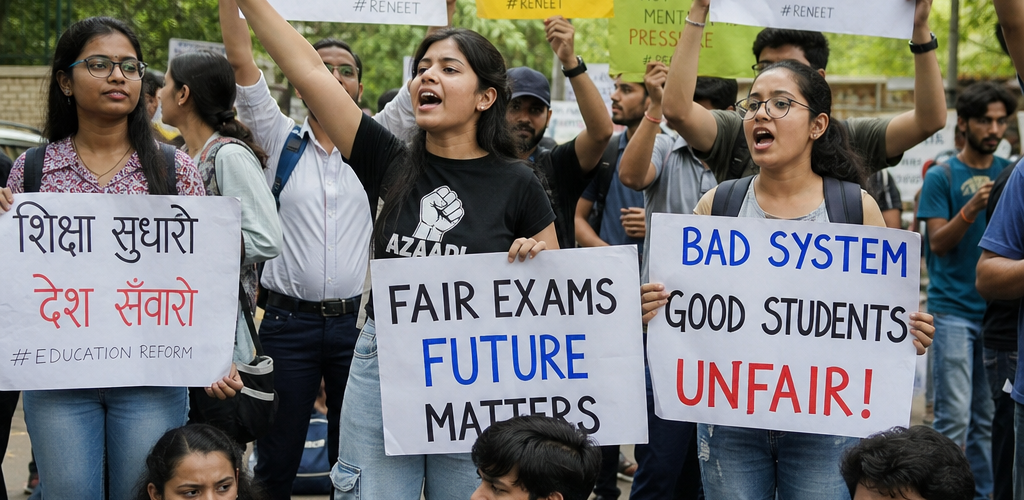
The Cockroach Janta Party (CJP) held a protest at Jantar Mantar in New Delhi on Saturday, demanding the resignation of Union Education Minister Dharmendra Pradhan over the NEET 2026 paper leak and alleged irregularities in the Central Board of Secondary Education’s (CBSE) On-Screen Marking (OSM) system. Protesters gathered at the iconic protest site with placards and slogans, including “Dharmendra Pradhan Istifa Do” and “We asked for ‘Make in India’, you gave us ‘Leak in India’.”
The demonstration was led by CJP founder Abhijeet Dipke, who flew from Boston, Massachusetts, specifically to participate in the protest. Dipke arrived in New Delhi carrying a copy of Dr. B.R. Ambedkar’s autobiography — a symbolic gesture linking the education accountability movement to broader constitutional values of equality and justice.
The NEET 2026 Paper Leak Controversy
The protest comes in the wake of fresh allegations that the NEET-UG 2026 examination paper was compromised before the test date. While the National Testing Agency (NTA), which administers NEET, has denied any breach in its security protocols, multiple reports from coaching centres and student forums have alleged that specific questions from the paper were circulating on messaging platforms hours before the exam began.
This is not the first time NEET has been hit by paper leak allegations. The NEET-UG 2024 controversy, which saw widespread protests and a Supreme Court intervention, led to a complete overhaul of the NTA’s examination processes. The fact that similar allegations have resurfaced in 2026, despite the reforms, has fuelled public anger and eroded whatever trust students had in the examination system.
“Two years ago, they promised reforms. They promised foolproof systems. And here we are again, with the same allegations, the same denials, and the same students whose futures are being played with,” Dipke said, addressing the protesters at Jantar Mantar. “If the minister cannot ensure the integrity of a single examination, he has no business holding that portfolio.”
The CBSE On-Screen Marking Issue
Alongside the NEET controversy, the CJP has raised questions about the CBSE’s On-Screen Marking system, which is used to evaluate board examination answer sheets digitally. Critics allege that the OSM system has technical vulnerabilities that could be exploited to manipulate marks, and that the lack of transparency in the marking process makes it impossible for students to verify whether their papers were evaluated fairly.
Also read: the Supreme Court’s scathing criticism of the NTA over the NEET paper leak
The CBSE has defended its OSM system as robust and tamper-proof, pointing to multiple layers of quality checks including random re-evaluation and statistical moderation. However, students and parents have demanded greater transparency, including the right to view their scanned answer sheets alongside the examiner’s markings — a facility that the CBSE currently provides only through a cumbersome application process.
The Cockroach Janta Party: An Unusual Political Force
The CJP, founded by Dipke — an IIT graduate and former technology professional based in the United States — represents a new breed of political activism in India. The party, whose unusual name is designed to attract attention and signal its grassroots, anti-establishment identity, has focused almost exclusively on education reform and examination integrity as its core political agenda.
Delhi Police granted permission for the protest at Jantar Mantar after the CJP applied through proper channels. The peaceful nature of the demonstration, combined with its focused demands, drew coverage from national media outlets — a significant achievement for a party that operates without the organisational infrastructure of India’s established political parties.
“The name gets people’s attention, but the substance is what matters,” Dipke told reporters. “We are not here to play politics. We are here because millions of students take NEET every year, and their trust in the system has been shattered repeatedly. Someone has to be held accountable.”
Government Response
The Education Ministry has not issued a formal response to the CJP’s demands. Minister Dharmendra Pradhan, speaking at an unrelated event earlier in the week, said the government was committed to ensuring examination integrity and that any credible allegations of malpractice would be investigated thoroughly by law enforcement agencies.
The NTA, for its part, has reiterated that NEET-UG 2026 was conducted with enhanced security protocols, including encrypted question papers, CCTV surveillance at all centres, and biometric verification of candidates. The agency said it was investigating the alleged leak claims but had found no evidence of a systemic breach so far.
Also read: CJP founder Abhijeet Dipke’s return to India for the Jantar Mantar protest
A Broader Crisis of Trust
The NEET controversy reflects a deeper crisis in India’s examination system — one that affects not just medical aspirants but the millions of students who appear for competitive examinations every year. From the SSC to the UPSC, allegations of paper leaks, evaluation irregularities, and question paper recycling have become a recurring feature of India’s examination landscape.
For the estimated 24 lakh students who took NEET-UG 2026, the protests at Jantar Mantar represent their frustration with a system that demands years of preparation but cannot guarantee a level playing field. Whether the government responds with structural reforms or dismisses the protests as politically motivated noise will determine how much longer India’s students are willing to trust the process.
The Path Forward
Education reform advocates argue that the solution to India’s examination crisis requires structural changes that go beyond punishing individual instances of malpractice. Proposals include decentralising high-stakes examinations to reduce the incentive for large-scale paper leaks, implementing computer-based adaptive testing that eliminates a single question paper, and establishing an independent examination regulator with the authority and resources to enforce security standards.
The NTA, established in 2017 specifically to address these issues, has faced criticism for failing to prevent repeated controversies. Its defenders argue that the sheer scale of Indian examinations — NEET alone draws over 24 lakh candidates across thousands of centres — makes perfect security almost impossible, and that the number of successful leaks represents a tiny fraction of total examinations conducted.
Also read: the JEE Advanced 2026 data breach that exposed 1.7 lakh student records
That argument holds little comfort for the students whose lives are affected when leaks do occur. For a medical aspirant who has spent three to four years in intensive preparation, the possibility that someone else gained an unfair advantage through a leaked paper undermines the entire premise of merit-based selection.
As the CJP protesters packed up their placards at Jantar Mantar on Saturday evening, the question they left behind was one that India’s political establishment has yet to answer convincingly: in a country that produces some of the world’s most accomplished doctors, engineers, and civil servants, why can’t we conduct an examination that everyone trusts?