CBI Raids 6 Premises in Haryana and Chandigarh Over Rs 661 Crore Government Fund Siphoning Through Banks

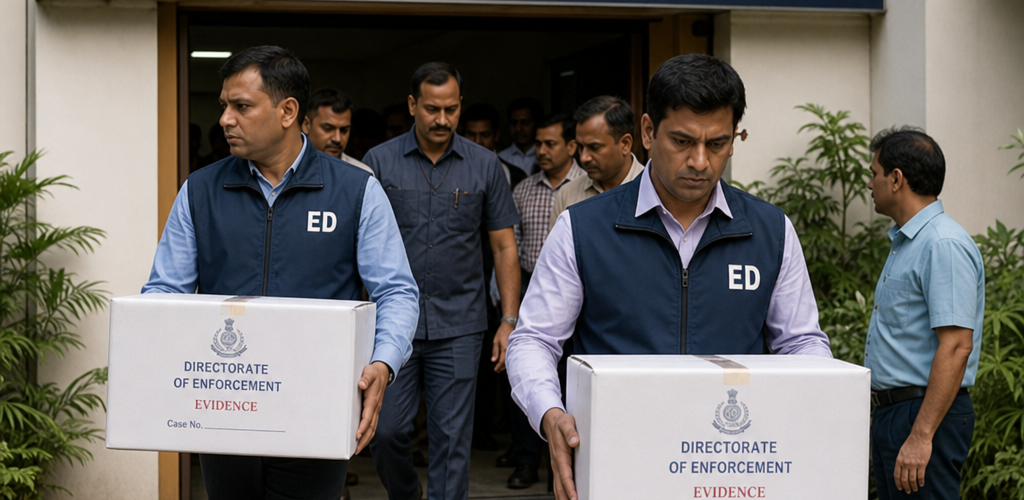
The Central Bureau of Investigation on Sunday conducted searches at six locations across Chandigarh, Panchkula, and Delhi-NCR in connection with a massive Rs 661 crore case involving the alleged siphoning of government funds through IDFC First Bank and AU Finance Bank. The raids targeted the residential premises of senior Haryana government officials as well as the offices and home of the director of Noida-based Vipam Consultancy Private Limited.
How the Alleged Fraud Worked
According to the CBI’s investigation, the fraud impacted eight departments of the Haryana state government and two entities of the Chandigarh Union Territory — specifically, the Municipal Corporation Chandigarh and the Chandigarh Renewable Energy and Science & Technology Promotion Society (CREST).
The alleged mechanism was systematic. Bank officials, in collusion with government servants, allegedly opened unauthorised bank accounts, transferred state funds into these accounts, and then diverted the money for personal enrichment. The agency described it as “a well-planned conspiracy orchestrated by bank officials and public servants” — language that suggests prosecutors believe they can demonstrate premeditation and coordination rather than opportunistic skimming.
Evidence recovered during the searches indicates that Vipam Consultancy received direct proceeds of the crime, which were subsequently transferred into the personal bank account of its director. This suggests the consultancy may have been used as a pass-through entity to launder government funds into private accounts — a common but effective structure in public finance fraud cases.
Scale of the Investigation
The Rs 661 crore figure represents a significant escalation from earlier reports. When the CBI took over the probe from Haryana police on April 8, the estimated misappropriation was pegged at around Rs 550 crore. The increase to Rs 661 crore suggests investigators have uncovered additional fraudulent transactions as the probe has deepened.
This is not the CBI’s first round of action. In May, the agency conducted raids at seven locations, targeting suspected beneficiaries and jewellery showrooms in Chandigarh and Panchkula. Sixteen people have been arrested so far in the broader case. A first chargesheet has already been filed before the Special CBI Court in Panchkula, detailing the alleged roles of officials from the Haryana Power Generation Corporation Limited and the Haryana School Shiksha Pariyojna Parishad.
The Banking Angle
The involvement of two private sector banks — IDFC First Bank and AU Small Finance Bank — raises questions about internal controls and compliance frameworks. Government funds are typically deposited in designated accounts with specific withdrawal authorisation protocols. For Rs 661 crore to be diverted without triggering alerts, there would need to be failures at multiple levels: account opening verification, transaction monitoring, reconciliation, and audit.
Neither IDFC First Bank nor AU Finance Bank has issued a public statement on the CBI’s latest action. Both banks have cooperated with the investigation, according to sources, and it remains to be determined whether the alleged collusion involved isolated branch-level officials or reflected broader institutional failures.
Political Context
The case has political dimensions in a state where government fund management is a perennial controversy. The alleged fraud spans multiple departments, suggesting it was not confined to a single bureaucratic silo but operated across the Haryana government apparatus. As further chargesheets are expected, the investigation could implicate officials at progressively senior levels.
During Sunday’s searches, CBI operatives seized incriminating documents, digital devices, and property-related records. The property records are significant — in cases of this nature, investigators often find that proceeds of financial fraud are converted into real estate, which is both difficult to trace and easy to rationalise as legitimate investment.
The CBI has indicated that more arrests and chargesheets will follow as the investigation progresses. For the residents of Haryana and Chandigarh, the case raises a fundamental question about how Rs 661 crore in public money — funds intended for government programmes, infrastructure, and services — could be siphoned through the banking system without detection for an extended period.
The IDFC First Bank and AU Finance Connection
The involvement of IDFC First Bank and AU Small Finance Bank in a government fund misappropriation case raises broader questions about the vulnerability of India’s banking system to insider-driven fraud. Both institutions are private sector banks that have grown rapidly in recent years, expanding their government banking business as part of their strategy to diversify revenue streams and deposit bases.
Government funds typically flow through designated accounts with multi-level authorisation requirements. For Rs 661 crore to be diverted without timely detection, multiple controls would need to have failed simultaneously — account opening KYC, transaction authorisation, reconciliation with government treasuries, concurrent audit, and regulatory reporting. The CBI’s characterisation of the fraud as “a well-planned conspiracy” implies that these controls were deliberately circumvented rather than passively ineffective.
The Reserve Bank of India has tightened compliance requirements for banks handling government accounts following several high-profile fraud cases in recent years. However, enforcement depends on individual banks’ internal governance, the quality of their compliance officers, and the independence of their audit functions. When bank officials themselves are allegedly part of the conspiracy, these internal safeguards lose their effectiveness.
Implications for Government Banking
The case has implications beyond Haryana. State governments across India maintain accounts with both public and private sector banks, and the mechanisms alleged in this case — collusive account opening, unauthorised fund transfers, and use of pass-through entities — are not unique to any single institution or geography. The CBI’s investigation may prompt the RBI and state governments to review their own banking arrangements and strengthen reconciliation protocols.
For IDFC First Bank and AU Finance Bank, the investigation creates reputational risk at a time when both institutions are seeking to grow their institutional and government banking portfolios. The outcome of the CBI’s probe — and the degree to which systemic failures versus individual misconduct are identified — will determine the long-term regulatory and reputational impact on both banks. Neither institution has publicly commented on the latest round of raids.