India’s Monsoon Deficit Deepens as El Niño Tightens Its Grip on the Farm Belt

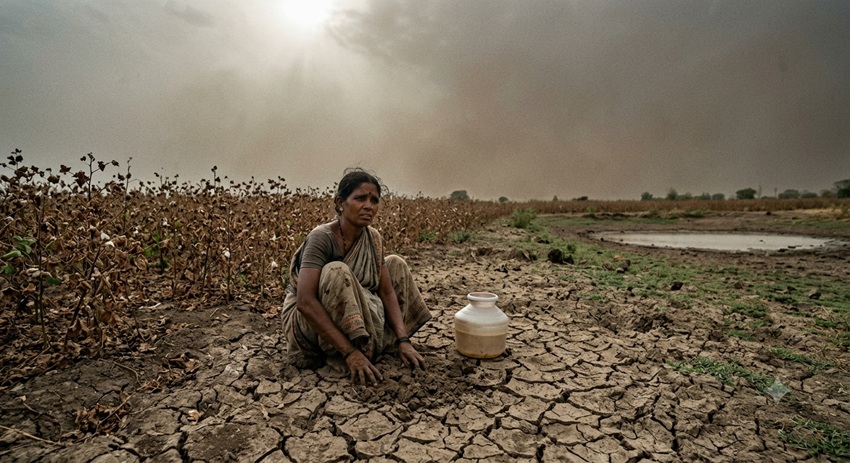
With cumulative rainfall running 43% below average and El Niño conditions strengthening, policymakers are racing to contain what could become the worst agricultural season in over a decade.
There is an old saying in Indian economics: as the rain goes, so goes the village; and as the village goes, so goes the country. This monsoon season, that warning is carrying unusual weight.
India’s cumulative rainfall stood at 43% below normal as of the third week of June — a deficit that has set off alarm bells across government ministries, the Reserve Bank of India, and agricultural commodity markets simultaneously. The southwest monsoon, which delivers roughly 70% of the country’s annual precipitation and underpins a $300 billion farm economy, arrived three days late in Kerala this year and has struggled to gather momentum ever since.
The culprit is well understood, if still deeply inconvenient. El Niño conditions — the periodic warming of Pacific Ocean surface temperatures that disrupts monsoon-carrying atmospheric circulation — are expected to persist through the end of 2026, according to NOAA’s latest climate models. The India Meteorological Department issued its formal below-normal forecast back in April, projecting the season at 92% of the Long Period Average, the first such warning in 11 years. Independent agency Skymet arrived at an almost identical figure. Both assessments carry an error margin of plus or minus five percentage points, meaning the downside scenario would place actual rainfall closer to the deficient category.
What Below-Normal Rainfall Actually Means on the Ground
Official statistics rarely capture the texture of a struggling monsoon season quickly. The signals show up first in rural commerce — smaller fertiliser purchases at district outlets, tractor bookings deferred until September, motorcycle dealerships in market towns that report a sudden slackening in enquiries. In 2023, the last comparable El Niño season, tractor registrations fell from 84,473 in July to 49,007 by September. Demand under the MGNREGA rural employment guarantee scheme surged 28 to 31% as crop income dried up. There is no reason to expect the pattern to be significantly different this time around.
Yuvika Singhal, an economist at QuantEco Research, has estimated that a 10% rainfall deficit can add as much as a full percentage point to headline consumer price inflation through food prices. Headline CPI was already at 3.9% in May 2026, its highest reading since January of the previous year, driven partly by food inflation running at 4.8% — a 16-month high shaped in part by fertiliser cost pressures from the Middle East conflict.
The government has moved to get ahead of the problem. The Agriculture Ministry has identified 315 districts vulnerable to below-normal rainfall this season, including 111 high-priority areas with limited irrigation. Contingency crop plans, covering alternative seed varieties and adjusted sowing calendars, have been circulated to state governments. Coordination mechanisms with major agricultural states have been tightened to enable faster response if dry conditions persist into August.
The RBI’s Uncomfortable Position
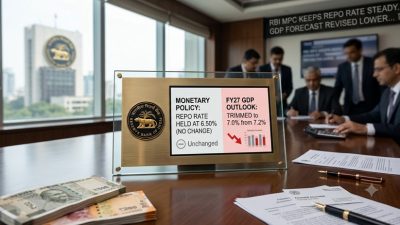
The Reserve Bank of India, which held its benchmark rate at 5.25% at its June meeting, has already revised its inflation projection for FY2026-27 upward by 50 basis points to 5.1%. Governor Sanjay Malhotra acknowledged in his policy statement that the central bank has turned “more cautious,” citing both geopolitical supply disruptions and the very real possibility that a failed monsoon accelerates domestic food inflation toward the upper ceiling of its 4% target band.
One analyst, Madan Sabnavis at Bank of Baroda, has projected that headline CPI could breach 5.5% by October if the monsoon continues to disappoint — a reading that would box the RBI into a deeply uncomfortable corner. Cutting rates to support slowing growth while inflation is climbing is not a formula any central banker chooses willingly.
Nagesh Kumar, an external member of the RBI’s Monetary Policy Committee, offered partial reassurance in a recent interview, noting that agriculture has become less weather-dependent over time and that India’s ample grain inventories provide a meaningful buffer against acute shortages. The government has been careful to draw attention to these stocks in public communications, and they are not irrelevant — in 2023, rice export curbs kept domestic supply tight enough to prevent a price spiral.
A Season to Watch
The risk arithmetic is layered. A late monsoon that extends into October disrupts not just the kharif sowing season — the summer crop of rice, cotton, soybean and sugarcane — but also interferes with the rabi harvest cycle that follows. Add elevated fertiliser costs driven by Strait of Hormuz supply disruptions, and the margin pressures on farming households this year could be considerably steeper than in 2023.
For now, the government’s contingency framework offers a credible first line of response. But with El Niño unlikely to release its grip before year-end, the monsoon story is far from over. Every week of the next eight will matter.