India’s Economy Navigates Headwinds as RBI Holds Rates at 5.25%, Trims Growth Outlook

With inflation creeping back toward the 4% target and Middle East conflict adding uncertainty, the central bank is managing a delicate balancing act going into the second half of 2026
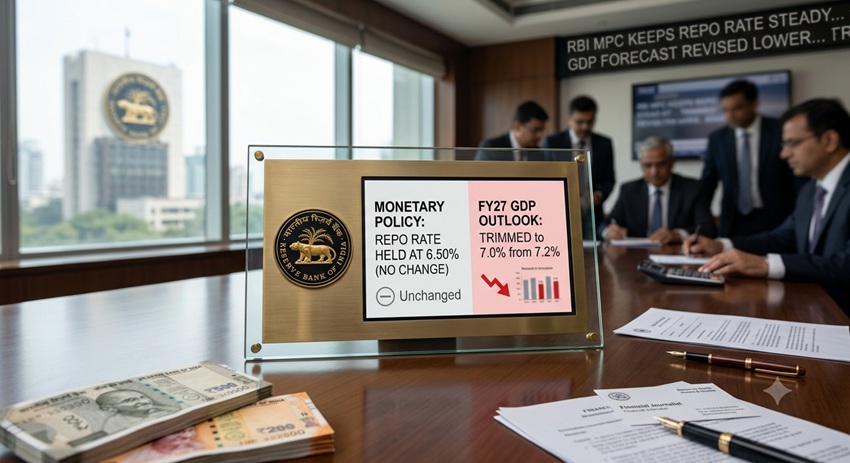
There was a time, not long ago, when the biggest challenge for the Reserve Bank of India was deciding how many times it could cut interest rates without spooking markets. That era, for now, is over. The RBI held its benchmark repo rate steady at 5.25 per cent for the third consecutive meeting in June 2026, maintaining its neutral stance as a set of external and domestic pressures made further easing politically and economically difficult.
The June decision was broadly anticipated. Markets had not been pricing in a cut, and the central bank’s communication over recent months has signalled caution rather than accommodation. What was less expected was the downward revision to the GDP growth forecast for FY2026-27 — trimmed to 6.6 per cent from the earlier projection of 6.9 per cent. It is still strong growth by any global standard, but the direction of the revision matters.
Why the Outlook Has Shifted
The RBI’s revised forecast reflects two converging pressures. The first is external. Ongoing conflict in the Middle East has added uncertainty to global energy markets, threatening to push crude oil prices higher — a significant concern for a country that imports the bulk of its petroleum needs. A weakening rupee compounds the problem, making imports more expensive and importing inflationary pressure from global commodity markets. Inflation, which had fallen to extraordinarily low levels in late 2025 — the Consumer Price Index touching 0.25 per cent year-on-year in October 2025 — is projected to average around 5.1 per cent through FY27, with the RBI now forecasting 4.2 per cent in Q1 and 5.9 per cent in both Q3 and Q4.
The second pressure is the sequencing of past policy. The RBI cut rates by 125 basis points last year in a concerted effort to ease financial conditions and stimulate consumption. Goldman Sachs Research, in its most recent India outlook, noted that those cuts have had a visible effect on consumer credit and urban consumption — but also concluded that there is now “limited scope for further policy rate easing.” The accommodative cycle appears to have run its course for the foreseeable future.
What the Numbers Actually Look Like
Strip away the central bank caution and India’s economic picture still looks broadly healthy. Goldman Sachs forecasts real GDP growth of 6.9 per cent for calendar year 2026 and 6.8 per cent in 2027 — both above consensus estimates and ahead of most peer emerging markets. Real consumption growth is projected to rise to 7.7 per cent in 2026, supported by a strong winter harvest, continued rural welfare spending by state governments heading into election cycles, and the Rs 6.3 trillion in liquidity injections that the RBI has pushed into the banking system over the past year.
The US-India trade deal struck in February — which reduced reciprocal tariffs on Indian goods from 25 per cent to 18 per cent, broadly in line with other Asian nations — is expected to provide a modest but meaningful growth tailwind, estimated at around 0.2 percentage points of GDP on an annualised basis. Analysts expect private capital expenditure to pick up in the second half of 2026 as the uncertainty that had been depressing investment decisions begins to lift.
The Rupee and the Current Account
One area of genuine concern for policymakers is the current account deficit, which widened sharply to around 2.8 per cent of GDP in the fourth quarter of 2025 — more than double the 1.3 per cent recorded the previous quarter — as exports to the United States dipped and gold imports surged. The RBI expects the deficit to widen further in 2026, driven primarily by higher non-oil and non-gold imports as domestic consumption improves. Services exports — where India remains one of the world’s most competitive suppliers, from IT services to financial outsourcing — are expected to provide a partial offset.
For households and businesses, the practical implication of a rate hold is straightforward: borrowing costs are unlikely to come down further in the near term. EMIs on home loans, auto finance, and MSME credit will remain at current levels. The RBI has signalled that any further rate decisions will be data-dependent, with the next monetary policy committee meeting scheduled for August.
For an economy that has, by most measures, handled a difficult global environment with considerable resilience, the message from the central bank is essentially one of holding steady — neither pressing the accelerator nor reaching for the brakes, waiting to see which way the headwinds blow.