The Rupee at 95: How the Iran War Turned India’s Currency Into a Pressure Point

A weakening rupee, record FPI outflows, and a central bank spending billions to defend the currency — India’s financial system is navigating a crisis that began in the Strait of Hormuz.
When the Strait of Hormuz — the narrow waterway through which roughly a quarter of global oil and a third of global fertiliser shipments pass — came under effective closure in early March 2026 following the escalation of the US-Iran conflict, the consequences arrived in New Delhi’s financial system with almost no delay.
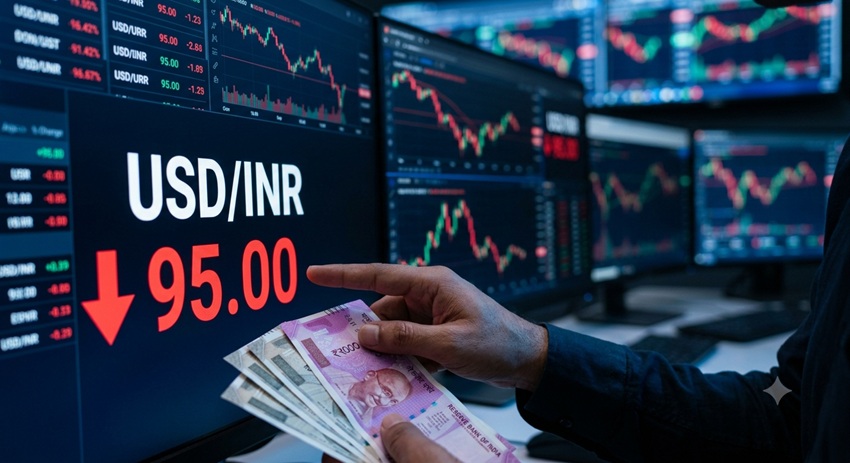
The Indian rupee had already been Asia’s weakest major currency through 2025, sliding 5% over that year. In the months since the Hormuz disruption began, it has shed a further 5.5%. By late March, it touched a record low of 93.94 against the US dollar — and as of mid-June, it continues to trade in the 95-to-96 range, according to data tracked by Business Standard and the RBI’s own published interventions.
The currency’s vulnerability is not incidental to India’s economic position — it is structural. India is among the world’s largest net importers of crude oil and petroleum products, which means every sustained rise in global energy prices directly widens its trade deficit and increases demand for dollars among importers. Combined with the geopolitical risk premium that sends foreign portfolio investors toward dollar assets in periods of global uncertainty, the rupee faces simultaneous pressure from two directions.
The RBI’s Firepower — and Its Limits
The Reserve Bank of India has not stood aside. Governor Sanjay Malhotra’s team has deployed an estimated $12 to $15 billion from India’s foreign exchange reserves — which stood at $723 billion before the crisis — to defend the currency through spot, forward, and offshore non-deliverable forward markets. In 2025, the RBI sold a record $51.7 billion to support the rupee.
The interventions have prevented a disorderly fall, but they have not stopped the depreciation. Anindya Banerjee, head of commodity and currency research at Kotak Securities, put the arithmetic plainly: as long as the Hormuz disruption persists, elevated energy prices will continue widening India’s trade deficit, driving importer demand for dollars, and attracting speculative positioning against the rupee. “At the same time, exporter hedging remains subdued, creating a demand-supply imbalance in the FX market,” he noted.
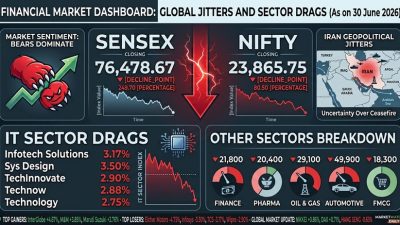
Foreign portfolio investors have sold Indian equities worth approximately 1.07 trillion rupees so far in calendar year 2026, according to NSDL data — a sustained outflow that reinforces downward pressure on the currency. India’s ten-year government bond yield climbed to 6.84% in the aftermath of the conflict’s initial escalation, up from around 6.6% before it.
The Worst-Case Scenario Debate
Analysts at Wells Fargo and Van Eck Associates have put a 100-rupee-to-the-dollar scenario explicitly on the table if the conflict drags on. Most India-based analysts consider it an extreme tail risk — Anindya Banerjee of Kotak Securities cited 96 to 97 as a more plausible stress scenario — but the fact that it is being modelled at all reflects how seriously markets are taking the duration risk in the Middle East.
Ahmed Aizan at Equiti Group told Bloomberg that “100 per dollar is no longer a tail risk — it is a credible stress scenario if current conditions persist.”
The government has attempted to reduce the external deficit pressure at the margins: Prime Minister Modi urged citizens to pause gold purchases, conserve fuel, and reduce overseas travel. Customs duties on gold imports have been raised. State-run banks have been directed to provide their own dollar liquidity rather than relying entirely on the central bank.
Broader Economic Damage
The currency’s weakness is not a purely financial story. A weaker rupee makes every dollar-denominated import more expensive — oil, LPG, fertilisers, edible oils, electronics — feeding directly into the consumer price index that the RBI is already watching anxiously. Imported dal is estimated to have become 10 to 15% more expensive for Indian households this year as a consequence of the exchange rate alone.
The RBI, which held its benchmark rate at 5.25% in June, has revised its FY2026-27 inflation forecast to 5.1% and trimmed its growth projection to 6.6%, down from 6.9% earlier in the year. Its language in the June policy statement — “monetary policy has turned more cautious” — is the kind of phrasing central banks use when they have more bad options than good ones.
The Iran conflict will eventually resolve. Whether that happens in weeks or in years is a question beyond any monetary policymaker’s control. Until it does, the rupee will remain, as one analyst put it, “a hostage to developments around the Strait of Hormuz.”