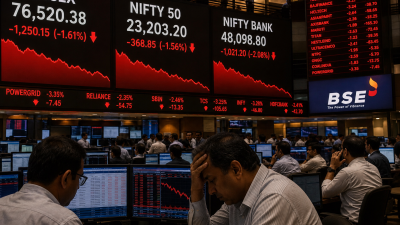
Sensex, Nifty Close Lower as IT Stocks Slump on Iran Ceasefire Jitters

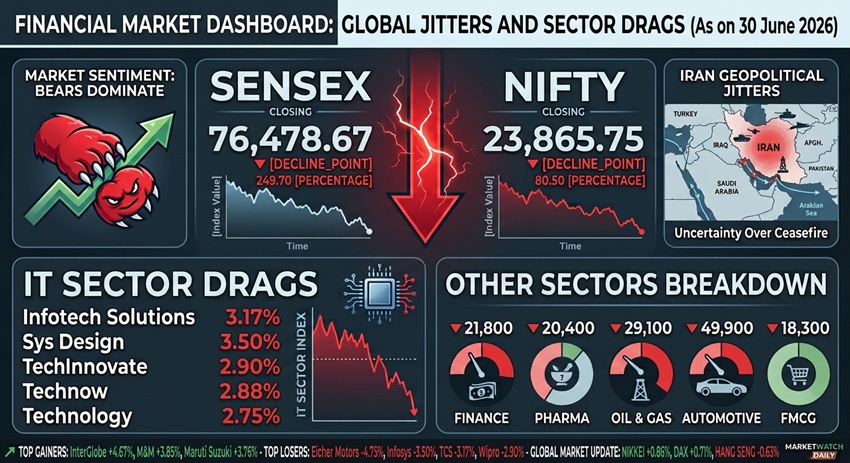
A volatile session on the last trading day of June saw heavyweight tech stocks drag benchmark indices down, even as broader markets held firm.
Dalal Street wrapped up June on a shaky note. The BSE Sensex fell 249.70 points, or 0.33%, to close at 76,478.67 on Tuesday, while the NSE Nifty 50 slipped 80.50 points, or 0.34%, to settle at 23,865.75 — sliding below the psychologically significant 23,900 mark. It was a volatile session from start to finish, one that began with sharper losses, recovered to near-flat by midday, and then drifted lower again into the close.
The trigger for the morning’s selloff was geopolitical. Iran accused the United States of violating the fragile ceasefire that has held in West Asia since 17 June, reviving fears of renewed escalation just as both sides were expected to send negotiating teams to Doha for fresh talks. Markets across Asia wobbled in sympathy, with Hong Kong’s Hang Seng down over 1% and Indonesia’s Jakarta Composite also under pressure, though Japan’s Nikkei 225 managed to buck the trend.
IT stocks bear the brunt
By the closing bell, it was the technology sector doing the real damage. The Nifty IT index plunged roughly 2.7% as investors trimmed exposure to export-oriented stocks ahead of key US economic data due later in the week. Sector heavyweights Tata Consultancy Services, Infosys and Wipro all featured among the day’s biggest losers on the Nifty 50, reflecting persistent worries about discretionary technology spending in the US and the broader interest-rate outlook there.
Eicher Motors had an especially rough day, falling close to 4.8% after analysts flagged that Delhi’s newly outlined electric vehicle policy — which charts a phased shift away from internal combustion two-wheelers — could weigh on demand for the company’s Royal Enfield motorcycles. Tata Consumer Products also featured among the laggards.
It wasn’t all bad news, though. Market breadth actually stayed positive through the session, with roughly 2,250 stocks advancing against 1,805 declining — a sign that the pain was concentrated in large-cap technology and auto names rather than spread evenly across the market. Domestic-focused sectors fared considerably better: the Nifty Realty and Nifty Consumer Durables indices both gained more than 1%, buoyed by optimism around domestic consumption and softer crude oil prices, which eased through the day as hopes grew for de-escalation in the Gulf.
What analysts are watching next
Market strategists say the coming sessions will likely continue to take their cue from developments in West Asia rather than domestic fundamentals. Siddhartha Khemka, Head of Research for Wealth Management at Motilal Oswal Financial Services, said equities are likely to stay “cautiously optimistic” while investors watch the progress of US-Iran negotiations, particularly around guarantees for safe navigation through the Strait of Hormuz.
Brokerages including Bajaj Broking Research maintain that the broader market structure remains constructive despite the short-term wobble, projecting the Nifty could gradually work its way toward the 24,500–24,600 zone in the coming weeks if the geopolitical overhang clears. Bank Nifty, meanwhile, has been consolidating around the 57,000 support zone, with the brokerage flagging 59,200 as a potential target on a sustained move higher.
For now, investors are also keeping an eye on foreign institutional investor flows, the rupee’s movement against the dollar, and crude oil prices — all of which have become more sensitive than usual given the uncertainty over whether the West Asia ceasefire will hold through the week.