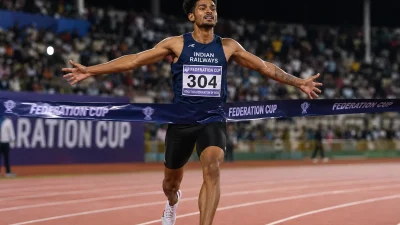
AFI Targets 4x100m Relay Medals at 2026 Asian Games: India’s Sprint Revolution Gains Momentum

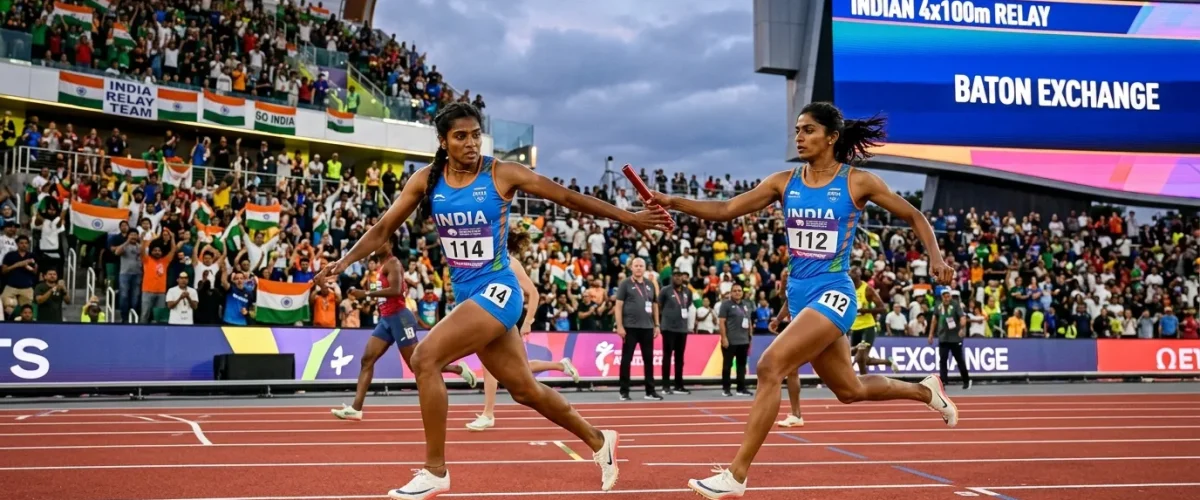
The Athletics Federation of India (AFI) has made a bold and significant declaration of intent: the men’s and women’s 4x100m relay events have been included as priority medal targets for the 2026 Asian Games in Aichi-Nagoya, Japan. The decision, announced in the context of the AFI’s strategic planning for the multi-sport event, reflects the remarkable progress that Indian relay sprinting has made in recent years and signals the federation’s confidence that medals are a realistic goal rather than aspirational fantasy.
For a nation whose athletic identity has been historically defined by middle-distance running and, more recently, by Neeraj Chopra’s javelin heroics, the emergence of a competitive relay programme represents a paradigm shift. Indian sprinting, long considered the weakest link in the country’s athletics chain, is experiencing a renaissance driven by improved coaching, sports science, and a generation of young athletes who refuse to accept that speed is not in India’s DNA.
The Evidence Base: Why the AFI Is Optimistic
The AFI’s optimism is grounded in recent performances that have shattered long-standing perceptions about Indian sprinting capabilities. The men’s 4x100m relay team has produced a series of impressive results in international competitions, with relay times that place India within medal contention at the Asian level. The women’s team, while further behind in its development curve, has also shown marked improvement and demonstrated that a competitive relay unit is being built.
The men’s relay quartet has benefited from the emergence of several individual sprinters who are running consistently below the 10.3-second barrier over 100 metres — a standard that was almost unimaginable for Indian sprinters even a decade ago. The combined speed of India’s top four sprinters, when harnessed through efficient baton exchanges, produces relay times that are competitive with the best in Asia outside of China and Japan.
The improvement is not solely attributable to individual speed. The technical aspect of relay running — the baton exchanges, the acceleration zones, the precise timing of handoffs — has been a focus of dedicated training sessions. The AFI has engaged specialist relay coaches, studied the techniques of world-leading relay nations, and invested in practice time that treats relay running as a distinct discipline rather than an afterthought to individual sprinting.
Men’s 4x100m Relay: The Medal Equation
India’s men’s 4x100m relay prospects at the Asian Games rest on a combination of individual talent and collective execution. The quartet likely to represent India features sprinters who have been training together extensively, building the understanding and trust that is essential for smooth baton exchanges at full speed.
The lead-off runner’s explosive start, the second and third runners’ ability to maintain and build speed through the acceleration zones, and the anchor leg’s finishing speed all contribute to the overall time. India’s current relay training programme has focused on optimising each of these elements, with video analysis and biomechanical data informing adjustments to technique and positioning.
The competitive landscape at the Asian Games features familiar challenges. China and Japan have historically been Asia’s relay superpowers, with both nations capable of producing times that compete at the global level. However, India’s recent improvements have narrowed the gap significantly, and on any given day — with clean baton exchanges and individual performances at personal-best levels — an Indian medal is achievable.
Thailand, the Philippines, and Kazakhstan represent additional competition, with each nation investing in their sprint programmes and producing relay teams of increasing quality. The Asian relay landscape is more competitive than ever, which makes India’s progress all the more noteworthy.
Women’s 4x100m Relay: Building for the Future
The women’s 4x100m relay programme is at an earlier stage of development than the men’s, but the trajectory is encouraging. Indian women’s sprinting has produced several athletes who are running competitive times by Asian standards, and the combination of these individual talents into a cohesive relay unit is a process that the AFI has begun with intent.
The challenges facing the women’s programme are primarily ones of depth and consistency. Producing four sprinters who are simultaneously in peak form, injury-free, and available for relay duty is a logistical challenge that requires a broad talent pool. The AFI’s investment in grassroots women’s athletics, including the identification and nurturing of young sprinting talent across India’s states, is designed to build this depth over time.
The women’s relay team has shown flashes of its potential in recent competitions, with improved baton work and individual split times suggesting that a breakthrough result is within reach. The Asian Games, with its multi-sport environment and the motivation of representing India, could provide the stage for a performance that announces Indian women’s sprinting to the continental audience.
The Science Behind India’s Sprint Improvement
India’s sprint revolution has been underpinned by advances in sports science that have transformed how athletes train, recover, and prepare for competition. The AFI’s partnership with sports science institutions has provided Indian sprinters with access to biomechanical analysis, nutrition counselling, sleep optimisation, and mental conditioning that was previously unavailable.
GPS tracking and video analysis of training sessions allow coaches to monitor workload, identify technical inefficiencies, and make data-driven decisions about training intensity. The result is a more scientific approach to sprint development that maximises the return on training investment while minimising injury risk — a critical consideration for sprinters whose event places extreme demands on muscles, tendons, and joints.
The influence of foreign coaching expertise has also been significant. Coaches with experience in world-leading sprint programmes have brought methodologies and perspectives that have challenged and enhanced Indian coaching practices. The cross-pollination of ideas — combining international best practices with knowledge of Indian athletes’ specific physiological and cultural contexts — has created a training environment that is uniquely effective.
Grassroots Development: The Foundation of Future Success
The AFI’s relay ambitions at the 2026 Asian Games are supported by a grassroots development programme that aims to create a sustainable pipeline of sprinting talent. School-level athletics programmes, state-level development centres, and the Khelo India initiative all contribute to the identification and nurturing of young sprinters across India’s diverse population.
The demographic advantage that India possesses — a young population with an enormous untapped athletic potential — is gradually being harnessed through these development initiatives. As more young Indians are exposed to athletics through structured programmes, the probability of identifying and developing exceptional sprinting talent increases exponentially.
The success of this grassroots approach is already visible in the quality of athletes emerging from state-level competitions and making the transition to national and international levels. The depth of competition at national championships has improved markedly, with personal bests being set at an unprecedented rate across all sprinting events.
The 2026 Asian Games: India’s Wider Athletics Ambitions
The relay medal targets exist within a broader AFI strategy for the 2026 Asian Games that includes medal ambitions across multiple athletics disciplines. From Lakshya Sen’s heartbreaking All England 2026 runner-up finish to the emerging wrestling stars competing at the FIH Hockey World Cup 2026 schedule and India’s qualification campaign, Indian sport in 2026 is characterised by ambition across disciplines.
The javelin throw, race walking, middle-distance events, and long jump all feature Indian athletes who are capable of podium finishes at the Asian level. The AFI’s comprehensive approach — investing across events rather than relying on a single star performer — reflects a maturation of India’s athletics administration that bodes well for sustained success.
A Sprint Revolution in the Making
India’s inclusion of the 4x100m relay events as priority medal targets at the 2026 Asian Games is more than a strategic decision — it is a statement about the changing nature of Indian athletics. The days when Indian sprinting was an afterthought are numbered, replaced by a confident, scientifically supported programme that believes in its ability to compete with Asia’s best. The 2026 Asian Games in Aichi-Nagoya will provide the ultimate test of this belief.

- India’s Startup Funding Crosses $7.2 Billion in H1 2026 - July 1, 2026
- After Ireland Shock, India’s T20I Side Faces Bigger Test - July 1, 2026
- Ireland Stun World Champions India 2-0 in Belfast, Sooryavanshi Debate Rages On - June 29, 2026