Yashasvi Jaiswal and Shafali Verma Receive NADA Notices for Missed Dope Tests as Cricket Faces Anti-Doping Compliance Challenge

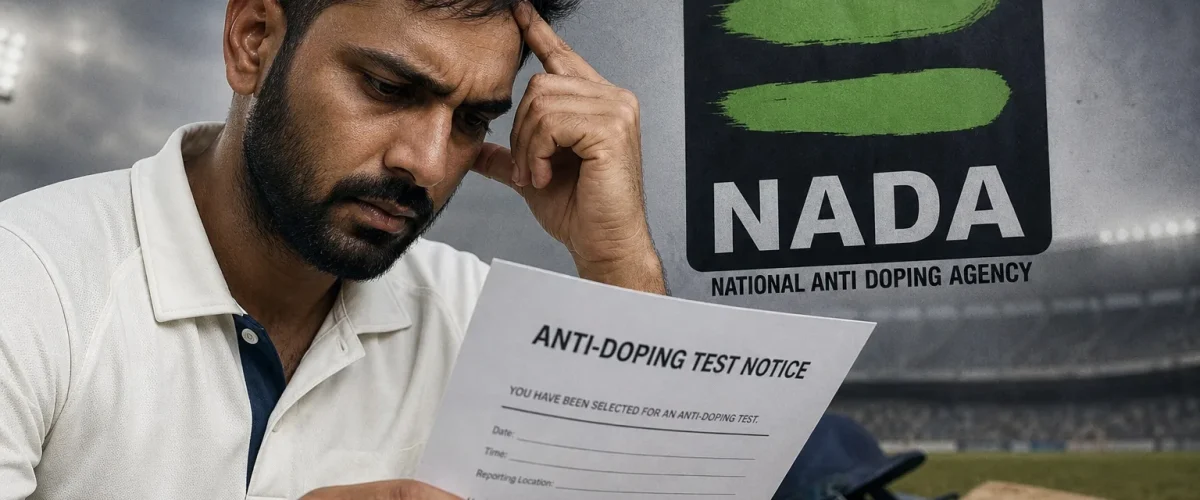
Indian cricket stars Yashasvi Jaiswal and Shafali Verma have been served their first “missed test” notices by the National Anti-Doping Agency (NADA) after failing to make themselves available for scheduled out-of-competition dope tests, sources confirmed on Friday, 09 May 2026. The notices fall under the whereabouts failure rule — a provision in the World Anti-Doping Code that requires elite athletes to provide precise location details for testing purposes — and carry potentially severe consequences if further failures occur.
According to sources familiar with the matter, Jaiswal missed a scheduled test on 17 December 2025, while Shafali was unavailable for testing on 07 November 2025. Both players are part of NADA’s Registered Testing Pool (RTP), which mandates that selected athletes provide a daily one-hour time slot and specific location where they can be found for unannounced testing. Three whereabouts failures within a rolling 12-month period constitute an anti-doping rule violation and can result in a ban of up to two years.
What Are Whereabouts Failures?
The whereabouts system is a cornerstone of modern anti-doping enforcement. Athletes in the Registered Testing Pool must update their location information quarterly through the ADAMS (Anti-Doping Administration and Management System) platform, specifying their overnight address, training schedule, competition calendar, and a daily one-hour testing window where they guarantee availability. If a doping control officer arrives at the declared location during the specified window and the athlete is not present, it counts as a “missed test.”
A missed test is one of three types of whereabouts failures — the others being a “filing failure” (not providing required information) and an “unsuccessful attempt” (being unreachable despite having provided information). Any combination of three such failures within 12 months triggers a formal anti-doping violation proceeding.
The system is designed to ensure that athletes can be tested at any time, including outside competition periods when some performance-enhancing substances are most commonly used. Without it, athletes could theoretically use banned substances during training and clear them from their systems before competition-day testing.
Jaiswal and Shafali: What Happened?
The specifics of why Jaiswal and Shafali missed their respective tests have not been publicly disclosed. However, the demanding schedule of elite Indian cricketers — who juggle international tours, IPL commitments, domestic cricket, and personal time — creates logistical challenges in maintaining accurate whereabouts information.
Jaiswal, 24, is one of India’s most exciting young batsmen and a key member of the Test and ODI squads. He has been a standout performer in the IPL 2026 season, where his explosive batting has been central to his franchise’s playoff push. Shafali, 22, is the explosive opener for the Indian women’s team, known for her fearless strokeplay and match-winning ability.
It is important to note that a missed test does not imply any use of banned substances. It is an administrative failure related to availability for testing. However, the notice serves as a formal warning that future failures could have serious consequences. The BCCI has been informed of both notices and is expected to work with the players to ensure full compliance going forward.
BCCI’s Response and Compliance Challenges
The BCCI confirmed the development and stated that it would “ensure stricter compliance” with anti-doping protocols, “especially with cricket returning to the Olympics in 2028.” Cricket’s inclusion in the 2028 Los Angeles Olympics has raised the stakes for anti-doping compliance, as the International Olympic Committee requires sports to demonstrate robust testing regimes as a condition of participation.
Indian cricket has historically had a mixed record with anti-doping compliance. While no major Indian cricketer has ever tested positive for a serious performance-enhancing substance, several players have received warnings or minor sanctions for whereabouts failures or procedural issues. The BCCI has been investing in education programmes to help players understand their obligations, but the sheer volume of cricket played by Indian athletes — who often participate in over 300 days of organised cricket annually — makes perfect compliance challenging.
Global Context: Cricket and Anti-Doping
Cricket globally has seen a growing focus on anti-doping enforcement. The International Cricket Council (ICC) has strengthened its testing programme in recent years, conducting over 3,000 tests annually across formats and competitions. The ICC’s Anti-Doping Code, aligned with the World Anti-Doping Code, applies to all international cricket and ICC-sanctioned events.
Recent high-profile anti-doping cases in other sports — including tennis, athletics, and swimming — have heightened public awareness of the issue. The case of several prominent athletes receiving bans for whereabouts failures (rather than positive tests) has also raised questions about whether the current system is overly punitive for what is essentially an administrative error.
However, anti-doping experts argue that the whereabouts system is essential for maintaining the integrity of sport. Without it, the entire out-of-competition testing programme — which is the most effective tool for detecting sophisticated doping — would collapse. “Missed tests may seem like minor issues, but they undermine the entire anti-doping framework,” said a former WADA official. “Athletes have a responsibility to make themselves available for testing, period.”
What’s Next for Jaiswal and Shafali?
For both players, the immediate priority is ensuring that no further whereabouts failures occur within the next 12 months. A second failure would place them one step away from a formal anti-doping violation, and a third would trigger proceedings that could result in suspension. Given the packed Indian cricket calendar — which includes IPL matches, international tours, and domestic tournaments — the players will need to be meticulous about updating their ADAMS profiles.
The BCCI is expected to assign dedicated anti-doping compliance officers to assist RTP athletes with their whereabouts submissions, a practice already common in other major sporting nations. Additionally, the board may introduce automated reminders and GPS-based location updates to reduce the risk of administrative errors.
As cricket prepares for its Olympic return in 2028, the sport’s commitment to clean competition will be under intense scrutiny. The NADA notices to Jaiswal and Shafali — while not indicative of any doping violation — serve as a timely reminder that India’s cricketers must be as disciplined off the field as they are on it. The integrity of the sport, and India’s proud cricketing legacy, depends on it.

- India’s Startup Funding Crosses $7.2 Billion in H1 2026 - July 1, 2026
- After Ireland Shock, India’s T20I Side Faces Bigger Test - July 1, 2026
- Ireland Stun World Champions India 2-0 in Belfast, Sooryavanshi Debate Rages On - June 29, 2026