India’s Biomedical Research Renaissance: From JIPMER’s Annual Research Day to the National Push for Clinical Innovation

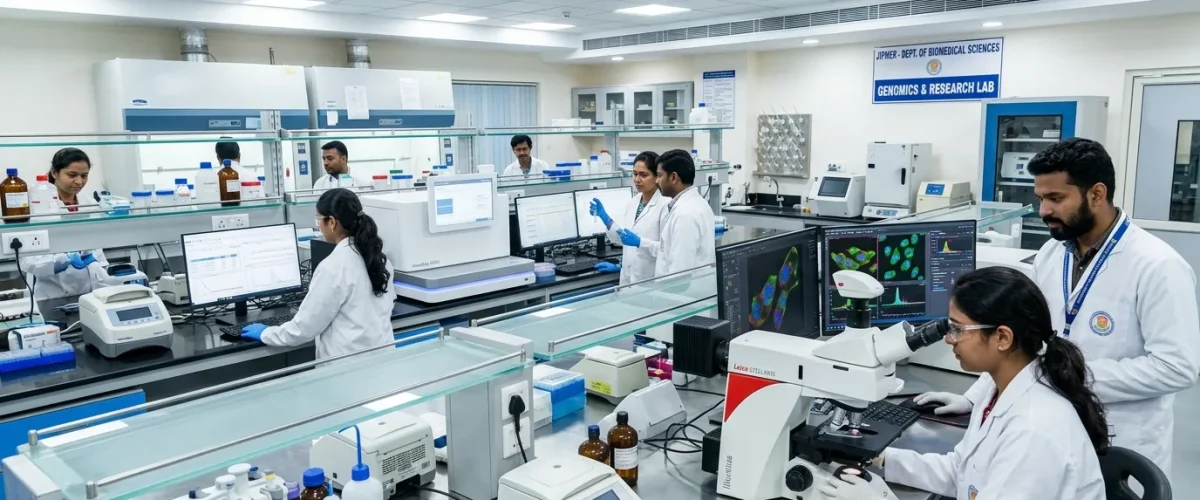
The Jawaharlal Institute of Postgraduate Medical Education and Research (JIPMER), Puducherry, celebrated its 11th Annual Research Day on March 7, 2026, with a programme that showcased the breadth and ambition of biomedical investigation at one of India’s premier medical research institutions. Yet the event signified something larger than institutional achievement—it reflected the accelerating momentum of India’s biomedical research ecosystem, which is transitioning from a predominantly clinical teaching enterprise to a research-intensive system capable of generating globally significant scientific contributions. Across India’s network of All India Institutes of Medical Sciences (AIIMS), Indian Institutes of Technology, national research laboratories, and an increasingly capable private research sector, the landscape of biological and medical research is undergoing a transformation that promises to reshape India’s contribution to global health science.
JIPMER’s Research Evolution
JIPMER’s trajectory from primarily a teaching hospital to a research-active institution mirrors the broader evolution of India’s medical education system. The institute, which has been designated as an Institution of National Importance by an Act of Parliament, has progressively built research infrastructure, recruited faculty with research training, and established collaborative networks that connect its investigators with national and international research communities.
The Annual Research Day programme highlighted investigations across clinical medicine, public health, basic sciences, and translational research—reflecting the multidisciplinary approach that characterises contemporary biomedical science. Presentations spanned areas from infectious disease epidemiology and antimicrobial resistance surveillance to cancer biology, genetic medicine, and health systems research, demonstrating the breadth of scientific inquiry at an institution that serves simultaneously as a clinical care provider, educational establishment, and research enterprise.
The institute’s research output has grown substantially over the past decade, with annual publication counts in peer-reviewed journals increasing significantly and the impact factor of target journals progressively rising. This quantitative improvement in research productivity, while important, tells only part of the story—the qualitative evolution toward more ambitious, collaborative, and translational research programmes represents a deeper institutional transformation that positions JIPMER as a model for other medical institutions seeking to enhance their research contributions.
Genomic Medicine: India’s Unique Opportunity
One of the most consequential frontiers in Indian biomedical research is genomic medicine—the application of genetic and genomic information to clinical diagnosis, treatment selection, and disease prevention. India’s genetic diversity, which reflects thousands of years of population structure shaped by endogamy, migration, and genetic drift, creates both challenges and opportunities for genomic medicine that are unique to the subcontinent.
The IndiGen programme and its successors have begun building the genomic reference databases necessary for clinical genomic medicine in India. These databases capture the spectrum of genetic variation present in Indian populations—variation that differs significantly from the European populations that dominate existing genomic databases and that therefore cannot be accurately represented by international reference datasets. Without India-specific genomic references, clinical genetic testing for Indian patients produces higher rates of variants of uncertain significance—a technical limitation that directly affects diagnostic accuracy and clinical decision-making.
Indian research institutions are developing precision medicine programmes that leverage this growing genomic knowledge base. Pharmacogenomics—the study of how genetic variation affects drug response—is particularly relevant in a country where adverse drug reactions remain a significant source of morbidity and where dosing guidelines developed for other populations may not be optimal for Indian patients. Institutions including AIIMS Delhi, CMC Vellore, and JIPMER are building clinical pharmacogenomics programmes that integrate genetic testing into treatment protocols for cancer, cardiovascular disease, and other conditions. As India’s technology sector advances from AI-powered wearables in India to sophisticated AI systems, the convergence of genomic data with digital health platforms creates opportunities for personalised medicine at population scale.
Antimicrobial Resistance: India’s Most Urgent Biological Crisis
Among the biological challenges confronting India, antimicrobial resistance (AMR) ranks among the most urgent and potentially catastrophic. India bears a disproportionate burden of AMR globally, driven by a combination of factors: high infectious disease prevalence creating widespread antibiotic use, over-the-counter availability of antibiotics without prescription, inadequate sanitation infrastructure facilitating the environmental spread of resistant organisms, and a large antibiotic manufacturing sector whose effluent can contribute to environmental resistance selection.
Indian researchers are at the forefront of AMR surveillance and response, with programmes at institutions including the Indian Council of Medical Research (ICMR), the National Centre for Disease Control, and multiple medical colleges generating data on resistance patterns across bacterial pathogens of clinical importance. This surveillance data informs treatment guidelines, identifies emerging resistance threats, and provides the epidemiological foundation for intervention programmes.
The research challenge extends beyond surveillance to understanding the biological mechanisms of resistance transmission. Indian laboratories are contributing to global understanding of how resistance genes spread between bacterial species, how resistant organisms survive and proliferate in environmental reservoirs, and how resistance patterns evolve under different selection pressures. This fundamental research, conducted at institutions including the Centre for Cellular and Molecular Biology (CCMB) and the Institute of Microbial Technology (IMTECH), provides the scientific basis for more effective resistance containment strategies.
Cancer Biology and the Indian Cancer Genome Atlas
Cancer research in India is undergoing a transformation driven by the convergence of genomic technologies, computational biology, and expanding clinical trial infrastructure. Indian researchers are building cancer genomic databases that capture the molecular profiles of tumours prevalent in Indian populations—profiles that differ significantly from those documented in Western populations due to differences in genetic background, environmental exposures, and cancer etiology.
The Indian Cancer Genome Atlas initiative, modelled on the landmark international Cancer Genome Atlas (TCGA) project, aims to generate comprehensive molecular portraits of cancers affecting Indian patients. This effort addresses a critical gap: clinical oncology guidelines developed primarily from data on Western patient populations may not optimally serve Indian patients whose tumours exhibit different molecular characteristics. Indian-specific genomic data enables the development of treatment protocols and diagnostic tools optimised for the population they serve.
India’s clinical trial infrastructure for cancer research has also expanded significantly, with an increasing number of Indian centres participating in global clinical trials and, importantly, designing and conducting investigator-initiated studies that address research questions specific to Indian cancer epidemiology. The development of India-specific clinical trial networks—connecting major cancer centres including Tata Memorial Hospital, AIIMS, JIPMER, and others—creates collaborative research platforms that can conduct studies at the scale necessary for statistically meaningful results.
Infectious Disease Research: Beyond COVID-19
The COVID-19 pandemic, while devastating, catalysed a transformation in India’s infectious disease research infrastructure that is now being applied to endemic threats including tuberculosis, malaria, dengue, and emerging viral diseases. The surveillance networks, diagnostic capabilities, genomic sequencing capacity, and vaccine development platforms developed or scaled during the pandemic represent durable assets for India’s infectious disease research enterprise.
India’s tuberculosis research programmes are of particular global significance. The country bears the world’s highest burden of tuberculosis disease, and Indian researchers are contributing to every dimension of the TB research agenda: diagnostic development, drug discovery, vaccine research, and implementation science. The Indian Council of Medical Research’s national TB research programme coordinates investigations across multiple institutions, creating a collaborative research architecture that matches the scale of the disease challenge. The intersection of infectious disease research with India’s growing digital health infrastructure—from AI-driven diagnostics to the connected health ecosystem enabled by India’s 5G expansion toward one billion subscribers—offers pathways to more effective surveillance and treatment delivery.
The Anusandhan National Research Foundation: A New Funding Paradigm
The establishment of the Anusandhan National Research Foundation (NRF), with a five-year outlay of approximately Rs 50,000 crore and a mandate to transform India’s research funding landscape, represents the most significant structural reform in Indian science funding in decades. The NRF aims to consolidate fragmented government research funding schemes, mobilise private sector co-investment in research, and create merit-based competitive funding mechanisms accessible to researchers across India’s diverse institutional landscape.
For biomedical research, the NRF’s significance lies in its potential to address several persistent structural weaknesses. The fragmentation of research funding across multiple government departments and agencies has historically created administrative complexity, duplication of effort, and gaps in coverage. The NRF’s consolidated funding model promises streamlined application processes, coordinated funding decisions, and strategic allocation of resources to priority research areas including those at the frontier of biological science.
The NRF’s emphasis on private sector co-funding is particularly relevant for biomedical research, where industry partnerships can accelerate the translation of laboratory discoveries into clinical applications. India’s pharmaceutical and biotechnology industries, which collectively represent one of the country’s most globally competitive technology sectors, are natural partners for NRF-supported biomedical research. As India’s broader research ecosystem expands—from India’s quantum computing mission to space biology experiments planned for India’s Bharatiya Antariksh Station programme—the NRF’s role in coordinating and funding this increasingly ambitious research enterprise will be essential for maintaining momentum and ensuring that scientific discoveries translate into societal benefit.
India’s biomedical research landscape in 2026 is characterised by growing ambition, expanding infrastructure, and increasing global integration. The transition from a system that primarily trained clinicians to one that produces both clinicians and researchers capable of contributing to the global knowledge frontier represents a generational shift—one that events like JIPMER’s Annual Research Day celebrate and that the broader institutional reforms underway aim to accelerate and sustain.