Union Budget 2026 Stimulus Takes Effect: How Record Capital Expenditure Is Reshaping India’s Infrastructure and Growth Story

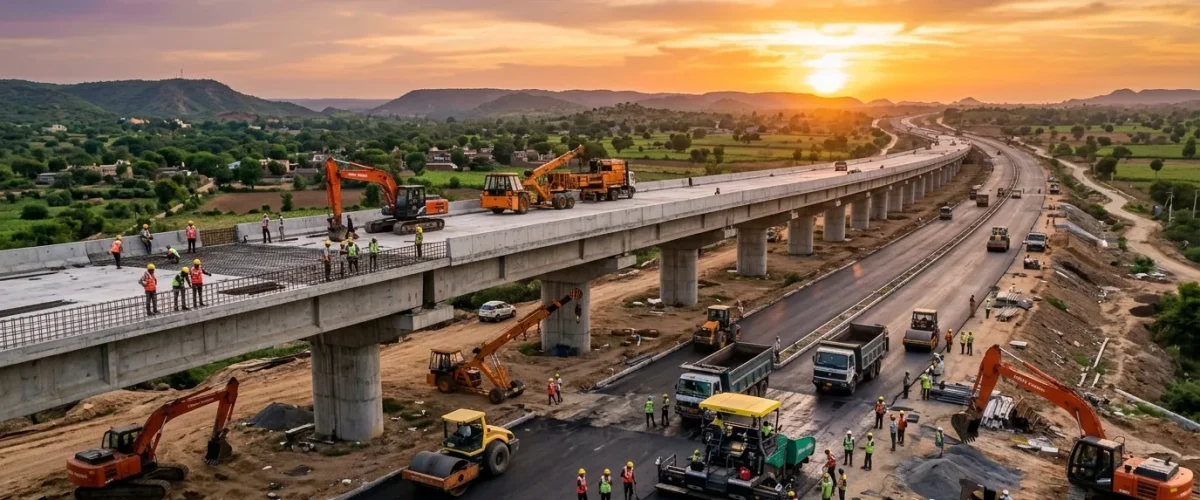
Three months into the fiscal year following Union Budget 2026’s announcement of a record ₹12.5 lakh crore capital expenditure allocation—a 17 per cent increase over FY2025-26—the impact of India’s most ambitious infrastructure spending programme is becoming visible across the economy. From the expressways crisscrossing the Gangetic plains to the metro corridors taking shape in Tier 2 cities, from the green energy installations dotting Rajasthan’s desert landscape to the semiconductor fabrication facilities rising in Gujarat, the fiscal stimulus is not merely supporting GDP growth but fundamentally reshaping the physical and economic geography of the nation.
The Capex Push: Magnitude and Allocation
Union Budget 2026, presented by Finance Minister Nirmala Sitharaman in February, marked the continuation of a deliberate strategy to use government capital expenditure as the primary engine of economic growth. The ₹12.5 lakh crore allocation for FY2026-27 builds upon several years of consistently rising capex commitments, with cumulative government capital spending over the last five years exceeding ₹50 lakh crore—an unprecedented figure in Indian fiscal history.
The allocation priorities reflect the government’s multi-dimensional development strategy. Transport infrastructure—roads, railways, airports, and ports—commands the largest share at approximately 35 per cent. Energy infrastructure, including green energy capacity addition, grid modernisation, and petroleum refining, accounts for 20 per cent. Urban development, including smart city projects, metro rail expansion, and water supply infrastructure, receives 15 per cent. The remaining allocations are distributed across defence manufacturing, digital infrastructure, healthcare facilities, and education institutions.
The economic multiplier effect of this spending is substantial. Research by the National Institute of Public Finance and Policy estimates that every rupee of government capital expenditure generates ₹2.5-3 of economic output over a three-year period through direct demand creation, supply chain activation, and induced consumption spending by workers employed in infrastructure projects.
Roads and Railways: Connecting India’s Economic Arteries
The National Highways Authority of India (NHAI) has maintained a construction pace of approximately 35-40 kilometres per day, adding over 12,000 kilometres of national highways annually. The completion of flagship projects—the Delhi-Mumbai Expressway, the Bengaluru-Chennai Expressway, and several sections of the Bharatmala Pariyojana—has dramatically reduced freight transportation times between major economic centres, with measurable impacts on logistics costs and supply chain efficiency.
Indian Railways’ transformation under the Gati Shakti framework has been equally significant. The dedicated freight corridors—the Eastern and Western DFCs—have freed up capacity on the existing rail network, enabling both faster freight movement and improved passenger services. The Vande Bharat network has expanded to over 100 routes, providing semi-high-speed connectivity that is changing travel patterns and economic linkages between cities.
Green Energy: Building the Infrastructure for Net Zero
A significant portion of capex is flowing into India’s clean energy transition. The country’s installed renewable energy capacity has crossed 200 GW, with solar alone contributing over 100 GW. Government spending on green energy infrastructure—transmission lines connecting renewable generation sites to demand centres, battery storage facilities, and green hydrogen production—is creating the backbone for India’s energy transition.
The production-linked incentive schemes for solar module manufacturing, battery cell production, and electrolyser manufacturing are catalysing private investment alongside government capex. India’s clean energy investment is projected to reach $40 billion annually by 2027, positioning the country as one of the world’s largest clean energy markets and a significant manufacturing hub for renewable energy equipment.
The Employment Dividend: Jobs Beyond the Construction Site
Infrastructure spending’s impact on employment extends far beyond the direct construction workforce. The cement, steel, heavy engineering, construction equipment, and building materials industries all experience sustained demand growth that supports manufacturing employment. The logistics and transportation sectors benefit from improved infrastructure that enables higher economic activity. Services industries—from hospitality to retail—grow as improved connectivity brings more economic activity to previously underserved regions.
The government estimates that its capex programme directly and indirectly supports over 5 crore jobs, making it the single largest employment generator outside agriculture. For a country where creating sufficient employment for its growing working-age population remains a critical challenge, the employment intensity of infrastructure spending is a key policy consideration. This growth narrative connects to the broader economic framework detailed in our analysis of how India’s ultra-low inflation is enhancing household purchasing power and economic participation.
Fiscal Discipline: Balancing Investment With Responsibility
A critical aspect of India’s capex strategy has been its execution within a framework of fiscal consolidation. The fiscal deficit for FY2026-27 has been targeted at 4.4 per cent of GDP, continuing the glide path toward the government’s medium-term target of below 4 per cent. This discipline has been achieved through improved tax collection efficiency (GST collections have consistently exceeded ₹1.8 lakh crore monthly), strategic asset monetisation, and restraint on revenue expenditure growth.
The markets have responded positively to this combination of growth-oriented spending and fiscal responsibility. India’s sovereign credit ratings, while still at the lower end of investment grade, are on positive outlook. Government bond yields have remained manageable despite large borrowing programmes, supported by the RBI’s liquidity management and strong domestic demand for government securities from banks, insurance companies, and pension funds.
State-Level Capex: The Multiplier Effect
The central government’s capex allocation is complemented by significant state-level capital spending. The central government provides interest-free loans to states—₹1.5 lakh crore in FY2026-27—specifically for capital expenditure on identified infrastructure projects. This mechanism ensures that infrastructure development extends beyond national highways and central projects to state roads, urban infrastructure, irrigation systems, and social infrastructure including schools and hospitals.
The competitive dynamic among states to attract investment through infrastructure development has intensified. States such as Uttar Pradesh, Gujarat, Maharashtra, Tamil Nadu, and Karnataka have each announced multi-lakh-crore infrastructure development plans, creating a virtuous cycle where improved infrastructure attracts private investment, which generates economic activity that provides tax revenue for further infrastructure development.
Private Sector Response: The Investment Cycle Revival
The most encouraging development for India’s growth outlook is the nascent revival of private sector capital expenditure. After nearly a decade of subdued private investment, corporate India is showing increasing willingness to invest in capacity expansion, driven by improved balance sheets, strong demand signals, and the enabling infrastructure being created by government spending.
Sectors witnessing significant private capex include steel and cement (capacity additions to meet infrastructure demand), renewable energy (both generation and manufacturing), electric vehicles and auto components, electronics manufacturing (particularly smartphones and IT hardware), and data centres. The combination of government infrastructure spending creating demand and enabling conditions, alongside private sector investment in productive capacity, has the potential to create a self-sustaining investment cycle that supports 7+ per cent GDP growth through the remainder of the decade.
The capex-driven growth strategy has drawn both praise and criticism. Supporters point to the visible transformation of India’s physical infrastructure, the employment generation, and the crowd-in effect on private investment. Critics argue that the focus on large infrastructure projects may not adequately address the needs of India’s informal economy, that cost overruns and execution delays diminish the efficiency of spending, and that the opportunity cost—in terms of social sector spending that could more directly benefit the poor—deserves greater consideration. This infrastructure-led growth model is closely connected to the commercial real estate boom that is seeing India’s office market cross 1 billion square feet in 2026.
What is beyond debate is the scale and ambition of India’s infrastructure programme. As the world’s fastest-growing major economy invests in the physical foundations for its next phase of development, the capex push of 2026 may well be remembered as the tipping point where India’s infrastructure began catching up with its aspirations, creating the conditions for the corporate dealmaking surge and broader economic transformation that define India’s growth narrative.