India’s National Quantum Mission 2026: Building the Infrastructure for a Quantum-Ready Future

India’s National Quantum Mission (NQM), approved by the Union Cabinet in April 2023 with a total outlay of ₹6,003.65 crore over eight years, has emerged as one of the country’s most strategically significant scientific programmes. By March 2026, the mission has crossed several critical milestones — from establishing state-of-the-art fabrication facilities to demonstrating early-stage quantum communication protocols — positioning India as a serious contender in the global quantum technology race. Yet formidable challenges remain, and the gap between India’s ambitions and its current capabilities provides both a roadmap and a reality check.
The Strategic Imperative
Quantum technology is not a single technology but a family of capabilities rooted in the counterintuitive principles of quantum mechanics — superposition, entanglement, and interference. These principles enable computing systems exponentially more powerful than classical computers for certain problems, communication channels that are theoretically unhackable, and sensors of unprecedented precision. The nations and companies that master these technologies first will enjoy decisive advantages in fields ranging from drug discovery and materials science to cryptography and national security.
This is why India’s NQM matters. The global quantum race is intensifying rapidly: the United States has invested over $3 billion through the National Quantum Initiative Act, China has spent an estimated $15 billion on quantum research including its operational quantum satellite, and the European Union’s Quantum Flagship programme commands €1 billion. India’s investment, while more modest, targets specific areas where the country has existing strengths — including theoretical physics, software, and a large pool of STEM graduates.
Progress Under the Mission
The Department of Science and Technology (DST), which oversees the NQM, reported significant progress in its November 2025 parliamentary update. The mission is structured around four verticals: quantum computing, quantum communication, quantum sensing and metrology, and quantum materials and devices. Each vertical has designated lead institutions and clear milestones.
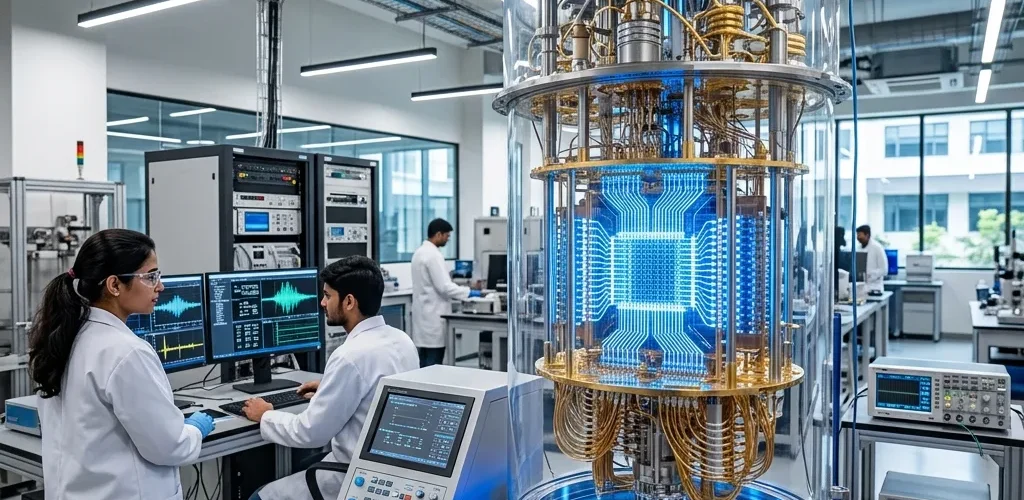
In quantum computing, the mission has established two central fabrication facilities — at IIT Bombay and IIT Madras — equipped with cleanroom infrastructure for fabricating superconducting qubits and photonic quantum processors. These facilities, while still in their early operational stages, represent a fundamental capability that India previously lacked: the ability to design and build quantum hardware domestically rather than relying entirely on imported systems. Indian researchers at IISc Bengaluru have also demonstrated a 5-qubit superconducting processor, a modest but symbolically important achievement that validates the indigenous fabrication pipeline.
Quantum communication has seen perhaps the most tangible progress. A quantum key distribution (QKD) link has been demonstrated over a 150-kilometre optical fibre connection between two cities, using an indigenously developed single-photon detection system. The National Informatics Centre (NIC), which manages the government’s IT infrastructure, is exploring the integration of QKD into sensitive governmental communication channels — a potential application with immediate national security implications.
Quantum sensing, the least publicised but potentially most near-term commercial application, has also advanced. Teams at the Inter-University Accelerator Centre (IUAC) in Delhi have developed prototype atomic clocks with precision approaching international standards, while researchers at DRDO have explored quantum magnetometers for submarine detection. These applications, unlike quantum computing, do not require large-scale quantum processors and could see deployment within the current decade.
The Talent Pipeline Challenge
Perhaps the most significant long-term challenge facing the NQM is human capital. Quantum technology sits at the intersection of physics, computer science, materials science, and engineering — a combination that requires researchers with deep interdisciplinary expertise. India produces large numbers of engineers and scientists, but the specialised quantum talent pool remains thin.
To address this, the NQM includes provisions for establishing quantum technology hubs at four major academic institutions, each focused on a specific research vertical. These hubs are intended to serve as training centres that produce not just researchers but also the technicians, engineers, and managers needed to translate laboratory results into commercial products. Additionally, the mission funds approximately 300 doctoral fellowships per year in quantum-related fields — a number that critics argue should be significantly higher given the scale of the global competition.
India’s broader educational infrastructure presents both an opportunity and a constraint. The IIT and IISc system produces world-class researchers, many of whom have contributed to quantum research programmes abroad. The mission’s challenge is to create conditions — competitive salaries, state-of-the-art facilities, and a supportive research culture — that encourage these scientists to build their careers in India rather than emigrating to laboratories in the United States, Europe, or Singapore. This brain drain concern is directly connected to India’s broader challenges in retaining AI and deep tech talent, as highlighted at the recent AI Summit.
The Industry Dimension
The NQM recognises that quantum technology must eventually move from laboratories to industry if India is to capture economic value from its investments. The mission includes provisions for public-private partnerships, startup incubation, and technology transfer mechanisms. Several Indian startups — including QNu Labs (Bengaluru), BosonQ Psi (Bhilai), and QPiAI (Bengaluru) — are already working on quantum software, communication, and simulation platforms.
However, the ecosystem remains nascent. India’s quantum startups face challenges common to deep tech ventures in the country: limited access to patient capital, difficulty attracting specialised talent, and a domestic market that is still learning to understand quantum technology’s value proposition. The government’s KPMG-World Economic Forum report from January 2026, which highlighted India’s semiconductor and AI surge, noted that quantum technology is a natural extension of the deep tech ecosystem but requires differentiated support mechanisms.
International Cooperation and Competition
India’s quantum ambitions exist within a complex international landscape of both cooperation and competition. The country has signed bilateral quantum research agreements with France, the United States, and Australia, and participates in multilateral forums through the Quad (alongside the US, Japan, and Australia) that include quantum technology cooperation.
At the same time, quantum technology has become a domain of strategic competition, particularly between the United States and China. Export controls on quantum computing components, restrictions on research collaboration, and concerns about quantum-enabled cryptanalysis — the ability of quantum computers to break current encryption standards — create a geopolitical environment in which India must carefully balance its partnerships and protect its own technological sovereignty.
The Road to 2031
The NQM’s stated targets for its completion in 2031 are ambitious: a 50-qubit quantum computer, a 2,000-kilometre quantum communication network, and commercially viable quantum sensors. Meeting these targets will require sustained funding, continued talent development, and effective coordination between dozens of academic and industrial partners.
The mission has made genuine progress in its first three years, establishing infrastructure that did not previously exist and building a community of researchers and entrepreneurs focused on quantum technology. Whether this foundation can support the superstructure of India’s quantum ambitions will depend on the quality of execution in the critical years ahead — and on whether the country can maintain the political and financial commitment needed to compete in what is arguably the most consequential technology race of the 21st century.