ICMR’s 2026 Clinical Trials Initiative: India Expands Its Role in Global Medical Research

The Indian Council of Medical Research (ICMR), India’s apex body for biomedical research, has announced an ambitious expansion of its clinical trials programme for 2026, signalling the country’s determination to move from being a participant in global medical research to a leader in shaping it. The initiative, which encompasses multi-centre trials addressing non-communicable diseases, joint research programmes with Switzerland and other nations, and the establishment of a Clinical Care Excellence network, represents a strategic pivot that could have far-reaching consequences for both Indian healthcare and the global pharmaceutical industry.
The Scale of Ambition
ICMR’s 2026 clinical trials initiative is notable for both its breadth and its focus. Unlike previous cycles, which were heavily weighted towards infectious diseases — a legacy of the COVID-19 pandemic — the current programme places non-communicable diseases (NCDs) at the centre. This reflects a demographic and epidemiological reality: NCDs, including cardiovascular disease, diabetes, cancer, and chronic respiratory disease, now account for approximately 65 per cent of all deaths in India, a proportion that is rising as the population ages and lifestyles change.
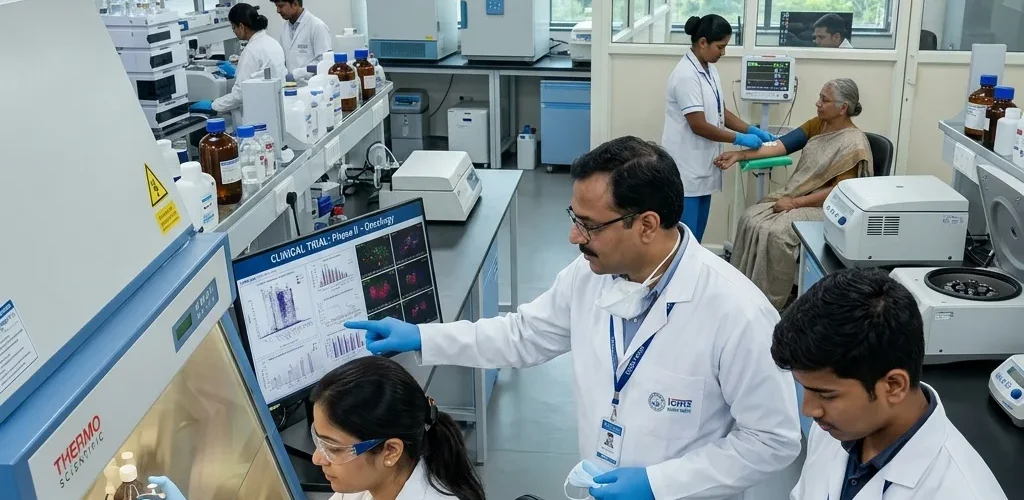
The initiative includes multi-centre trials across at least 15 ICMR-affiliated institutions, covering conditions ranging from type 2 diabetes and hypertension to specific cancers prevalent in the Indian population. These trials are designed not merely to test existing treatments but to generate evidence specific to Indian populations — data that has historically been scarce, leading to treatment protocols often extrapolated from studies conducted primarily in Western populations with different genetic backgrounds, diets, and environmental exposures.
A particularly significant component is the Indo-Swiss Joint Research Programme (ISJRP) 2026, conducted in collaboration with the Swiss National Science Foundation (SNSF) and the Department of Biotechnology (DBT). This programme, with a deadline for proposals in May 2026, targets collaborative research in areas including antimicrobial resistance, genomics-based diagnostics, and digital health — fields where both countries bring complementary strengths.
India’s Clinical Trial Landscape
India’s relationship with clinical trials has been complex and, at times, controversial. The country’s large and genetically diverse population, relatively lower costs, and growing pool of trained investigators make it an attractive destination for clinical research. The Clinical Trials Registry of India (CTRI), managed by ICMR, has registered over 50,000 trials since its inception, making it one of the largest national registries globally.
However, the sector has also faced challenges. Regulatory uncertainties in the early 2010s, triggered by reports of inadequate informed consent and insufficient compensation for trial-related injuries, led to a significant decline in trial activity. The New Drugs and Clinical Trials Rules, notified in 2019, addressed many of these concerns by establishing clearer timelines for regulatory approval, mandatory compensation frameworks, and enhanced ethics committee oversight. The result has been a gradual recovery in trial activity, with India now hosting approximately 5,000 active trials — a number that ICMR’s 2026 initiative aims to increase significantly.
The Genomic Dimension
A distinguishing feature of ICMR’s current programme is its emphasis on genomics-informed clinical research. The IndiGen project, which sequenced 1,000 Indian genomes to create a reference database of genetic variation in the Indian population, has provided a foundation for precision medicine approaches. The 2026 trials will incorporate pharmacogenomic analysis — studying how genetic variations affect drug metabolism — to develop treatment protocols tailored to Indian population subgroups.
This is particularly important because India’s population encompasses extraordinary genetic diversity, with over 4,600 population groups that have been shaped by millennia of endogamy and geographic isolation. Drug doses, efficacy, and side effect profiles that are appropriate for one population may be suboptimal for another. By generating India-specific pharmacogenomic data, ICMR’s programme aims to improve treatment outcomes while reducing adverse drug reactions — a goal with both clinical and economic significance, given that adverse drug reactions are estimated to account for 3-5 per cent of all hospital admissions in India.
Capacity Building and Infrastructure
A significant portion of ICMR’s investment is directed at building the institutional capacity needed to support a larger and more sophisticated clinical research ecosystem. The Clinical Care Excellence Initiative, announced alongside the trials programme, establishes a network of centres of excellence across ICMR’s 26 permanent institutes and regional centres. These centres will serve as model sites for Good Clinical Practice (GCP) compliance, data management, and bioethics — standards that are essential for the international recognition of Indian trial data.
The PhD admissions programme through AcSIR-ICMR’s Faculty of Medical Research, with applications open for the August 2026 batch, is another capacity-building measure. By creating a dedicated pathway for doctoral research in clinical and translational medicine, ICMR aims to address the critical shortage of clinical researchers — professionals who bridge the gap between laboratory discoveries and patient care. India currently has approximately 1.2 clinical researchers per million population, compared to 5-10 per million in developed nations.
ICMR’s infrastructure push aligns with the broader trend of Indian institutions climbing global research rankings. As documented in our coverage of top research breakthroughs from Indian universities, the country’s academic institutions are producing increasingly impactful research that is attracting international attention and collaboration.
Digital Health Integration
The 2026 initiative is also notable for its integration of digital health technologies. Trial designs incorporate remote monitoring through wearable devices, digital biomarkers, and AI-powered data analysis — approaches that were accelerated by the COVID-19 pandemic and are now becoming standard in clinical research globally.
India’s digital health infrastructure, including the Ayushman Bharat Digital Mission and the electronic health records systems being deployed across public hospitals, provides a foundation that few other developing countries possess. The ability to track patient outcomes longitudinally through digital systems, combined with India’s scale, creates opportunities for real-world evidence studies that can complement controlled clinical trials. The intersection with India’s rapidly developing AI capabilities offers further potential for innovation in trial design and data analysis.
Ethical Frameworks and Community Trust
ICMR has been particularly attentive to the ethical dimensions of its expanded programme, recognising that public trust is the foundation upon which clinical research rests. The Indian Council of Medical Research’s National Ethical Guidelines for Biomedical and Health Research Involving Human Participants, updated in 2017, provide a comprehensive framework for informed consent, confidentiality, and participant protection.
The 2026 initiative adds additional safeguards, including mandatory community advisory boards for trials conducted in rural or tribal areas, real-time reporting of serious adverse events to an independent data safety monitoring board, and a compensation framework that accounts for both direct and indirect costs borne by trial participants. These measures reflect lessons learned from past controversies and a recognition that India’s clinical research enterprise can only grow sustainably if it maintains the highest ethical standards.
Global Implications
ICMR’s 2026 expansion has implications that extend well beyond India’s borders. The global pharmaceutical industry, facing rising costs and declining returns on R&D investment, has been seeking more efficient models for clinical development. India offers a combination of scale, diversity, and cost-effectiveness that is unmatched — a single multi-centre trial in India can recruit patients from populations with genetic backgrounds spanning South Asian, Tibeto-Burman, Dravidian, and Indo-European lineages, providing diversity that would otherwise require trials across multiple countries.
Moreover, the diseases being targeted — diabetes, cardiovascular disease, and cancers with high prevalence in Indian populations — are also major health burdens in Southeast Asia, Africa, and other regions of the Global South. Evidence generated in Indian trials has direct relevance to treatment decisions in these countries, where local clinical data is even scarcer than in India.
As ICMR moves to implement its ambitious 2026 programme, the stakes are clear: success would establish India as an indispensable node in the global clinical research network, generating evidence that improves health outcomes for millions while building an industry worth tens of billions of dollars. The foundation has been laid; the execution will determine the outcome.