AI Tutors and Personalised Learning: How Indian Edtech Startups Are Rebuilding for Outcomes in 2026

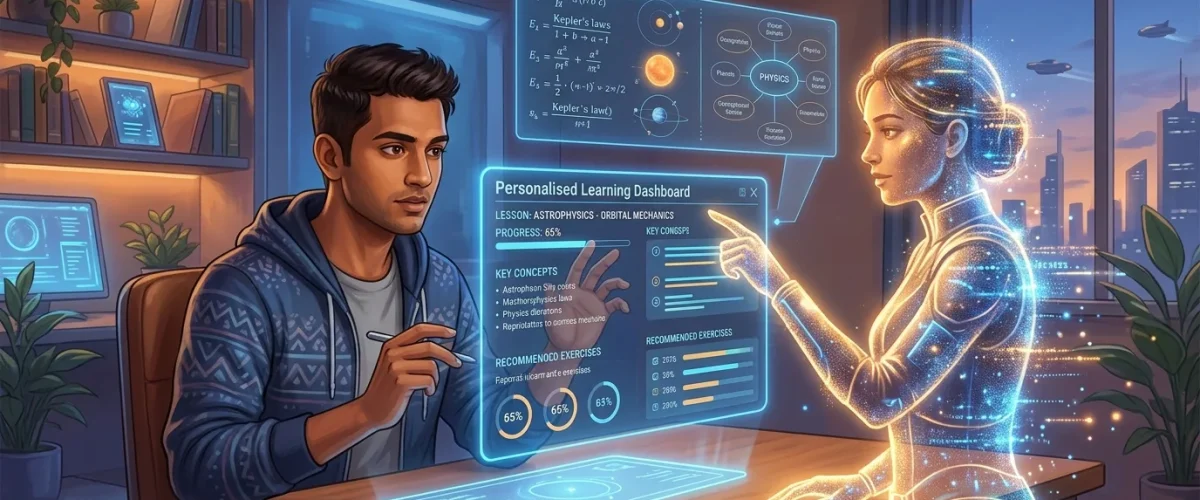
The integration of artificial intelligence into Indian edtech is no longer a futuristic promise—it is a present-tense reality that is fundamentally reshaping how millions of students learn, practice, and prepare for the examinations that define their academic and professional futures. In 2026, a new generation of AI tutors and personalised learning platforms is emerging from Indian startups that are building not just for India’s enormous domestic market but increasingly for the global education technology landscape. The shift is from content delivery to outcome engineering—and AI is the engine making it possible.
The Rise of AI Tutoring
The concept of an AI tutor—a conversational system that can explain concepts, answer questions, grade assignments, and adapt to a student’s learning pace—has been discussed in education technology circles for years. But it is only in 2025-2026, with the maturation of large language models (LLMs) and multimodal AI systems, that truly capable AI tutors have become feasible.
Several Indian startups are at the forefront of this shift. Sarvam AI, a Bangalore-based company focused on building AI models for Indian languages, has partnered with multiple edtech platforms to provide multilingual AI tutoring in 10 Indian languages. Their “Vidya” model can explain mathematical concepts in Hindi, grade essay responses in Tamil, and conduct oral viva-style assessments in Marathi—capabilities that address one of Indian education’s most persistent challenges: the language barrier.
Also read: IPL 2026 Season Preview: Key Transfers, Injuries, and Franchise Strategies
Also read: AI Summit 2026: India Showcases Ambitions but Structural Gaps Exposed
Doubtnut, which started as a photo-based doubt resolution app (students photograph a question, and the app returns a video explanation), has evolved into a full AI tutoring platform. Its “Doubtnut AI Teacher” can now conduct interactive tutoring sessions, generate personalised practice sets, and provide real-time feedback on student responses. The platform claims over 40 million monthly active users, predominantly from Tier 2 and Tier 3 cities, and generates 100 million doubt resolution queries per month.
Personalised Learning at Scale
The most transformative application of AI in Indian edtech is personalised learning—the ability to tailor the educational experience to each individual student’s strengths, weaknesses, pace, and preferred learning style. This has always been the holy grail of education, but it has been economically impossible to deliver at scale through human teachers alone. India has a student-to-teacher ratio of 26:1 in secondary schools and over 30:1 in many government schools, leaving little room for individualised attention.
AI changes this equation. Platforms like Embibe (owned by Adani Education) use machine learning algorithms that analyse student performance across thousands of micro-skills (e.g., “ability to solve quadratic equations with imaginary roots” or “comprehension of cellular respiration pathways”) and generate personalised learning pathways that prioritise the areas where the student needs the most improvement. Embibe claims that students using its AI-driven personalised learning system score, on average, 23 per cent higher on standardised tests than those using traditional linear curricula.
PhysicsWallah has integrated similar technology into its Vidyapeeth centres, where AI-generated diagnostic tests adapt in real-time to each student’s responses. If a student struggles with a particular concept, the AI immediately serves additional explanatory content and practice problems at the appropriate difficulty level. This closed-loop system—assess, identify gaps, remediate, reassess—mimics the behaviour of an expert human tutor but operates at a fraction of the cost.
AI-Powered Assessment and Credentialing
Beyond tutoring and personalised learning, AI is transforming assessment and credentialing in Indian education. Testbook, a platform that helps students prepare for government job examinations, uses AI to generate millions of unique practice questions calibrated to the difficulty and format of specific exams (UPSC, SSC, banking, railways). The AI also provides detailed performance analytics that predict a student’s probability of clearing an exam based on their practice test performance, enabling data-driven preparation strategies.
On the credentialing front, Indian companies are developing AI systems that can evaluate practical skills—coding assessments, language proficiency, professional competencies—in ways that go beyond multiple-choice testing. HackerRank (co-founded by Indian entrepreneurs) and its domestic competitors use AI to evaluate code quality, efficiency, and problem-solving approach, providing employers with richer assessments of candidate capabilities than traditional resume screening can offer.
The Challenges: Quality, Equity, and Trust
The AI revolution in Indian edtech is not without significant challenges. Quality control remains a concern: AI tutors can sometimes generate incorrect explanations (so-called “hallucinations”), and the consequences of inaccurate information in an educational context—particularly for students preparing for high-stakes exams—can be severe. Companies are investing heavily in human review systems and retrieval-augmented generation (RAG) architectures to minimise errors, but the problem is not fully solved.
Equity is another pressing issue. The students who stand to benefit most from AI-powered learning—those in rural areas with limited access to quality teachers—are often the same students with the least access to the smartphones, internet connectivity, and digital literacy needed to use these tools. Bridging this digital divide requires not just edtech innovation but infrastructure investment and policy coordination.
Finally, trust remains a barrier. Many Indian parents, particularly those from non-urban backgrounds, view AI-driven education with scepticism. The cultural preference for human teachers, the social status attached to coaching institutes, and concerns about screen time all contribute to resistance against fully AI-mediated learning. Successful edtech companies are navigating this by positioning AI as a supplement to—not a replacement for—human instruction.
Building for Outcomes
The Indian edtech companies that will define the next decade are those that use AI not just to deliver content more efficiently but to measurably improve student outcomes—exam scores, college admissions, job placements. The shift from “content delivery” to “outcome engineering” is the defining transition in Indian edtech in 2026, and artificial intelligence is the technology making it possible at a scale that India’s enormous student population demands.