India GDP Revised to 7.6 Per Cent in FY26 as Manufacturing Boom Powers Fastest Growth Among Major Economies

India’s gross domestic product (GDP) growth for the financial year 2025-26 has been revised upward to 7.6 per cent under the newly released statistical series, the government confirmed in March 2026. The revision — up from the 7.4 per cent estimated in the first Advance Estimate released in January under the old series — positions India as the fastest-growing major economy in the world for the fourth consecutive year, powered by a broad-based manufacturing-led expansion.
The upgraded figures provide a significant boost to the government’s economic narrative and offer reassurance to investors at a time when global growth remains uneven, trade tensions persist, and commodity prices are volatile.
What Changed With the New GDP Series
The National Statistical Office (NSO) introduced a revised GDP series with an updated base year and improved methodologies for capturing economic activity across sectors. The new series incorporates more comprehensive data on the informal economy, digital transactions, and the manufacturing sector — areas where previous estimates were believed to undercount actual output.
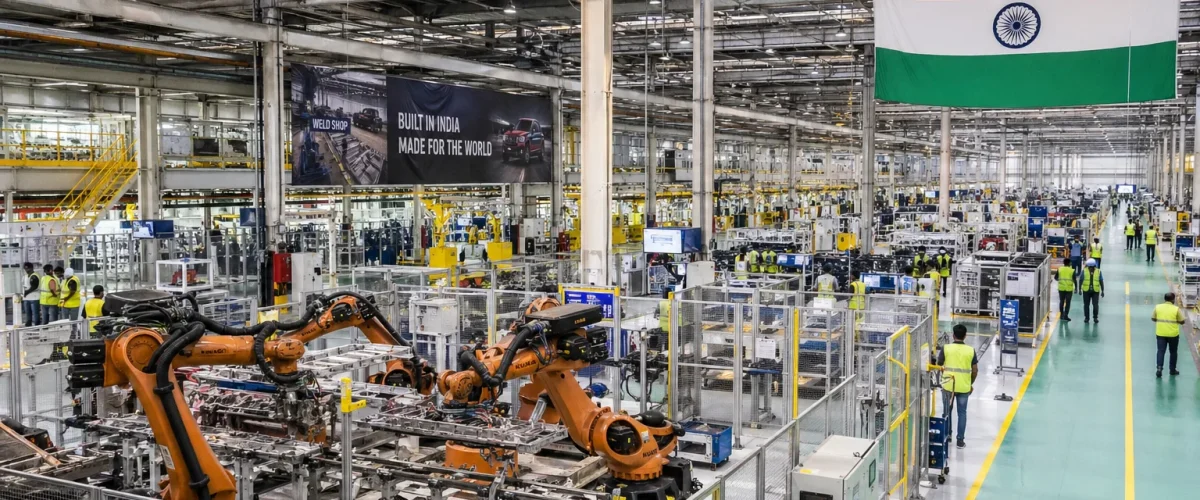
Under the revised framework, manufacturing growth has been recalculated at a significantly higher rate than previously estimated, reflecting the impact of government initiatives such as the Production-Linked Incentive (PLI) scheme, the Make in India programme, and the rapid expansion of electronics and automobile manufacturing. India’s emergence as a global hub for smartphone and semiconductor production, exemplified by record electric vehicle sales in FY26 and the operationalisation of new chip fabrication facilities, has contributed substantially to the upward revision.
Key Drivers of 7.6 Per Cent Growth
Several structural and cyclical factors have driven India’s strong economic performance in FY26.
Manufacturing and Industrial Output
The manufacturing sector expanded at its fastest pace in over a decade, supported by rising domestic demand, export competitiveness, and significant capital investment. The Index of Industrial Production (IIP) recorded consistent double-digit growth in several months, with automobile, electronics, and pharmaceutical manufacturing leading the charge.
Digital Economy and Services
India’s digital economy continued its rapid expansion, with UPI processing 228 billion transactions worth Rs 300 trillion in 2025. The services sector, which accounts for more than 50 per cent of GDP, grew at a healthy 8.1 per cent, driven by IT services, financial services, and the booming gig economy.
Capital Expenditure
Government capital expenditure remained robust, with the Union Budget for 2026-27 allocating record sums for infrastructure, defence, and social sector spending. Private sector investment also showed signs of revival, particularly in renewable energy, real estate, and logistics.
Trade and Exports
The historic India-US trade deal announced earlier in 2026, which includes an 18 per cent tariff agreement and a $500 billion investment commitment, has opened new avenues for Indian exporters. Goods exports grew 12 per cent year-on-year, with electronics, textiles, and engineering goods driving the gains.
How India Compares Globally
At 7.6 per cent, India’s GDP growth significantly outpaces China (estimated at 4.8 per cent for 2025-26), the United States (2.1 per cent), the Eurozone (0.9 per cent), and Japan (1.2 per cent). The International Monetary Fund (IMF) and the World Bank have both acknowledged India as the primary engine of global growth, with the IMF projecting India to contribute approximately 16 per cent of total world output growth over the next five years.
India’s nominal GDP is now estimated at approximately $4.3 trillion, making it the fifth-largest economy in the world behind the United States, China, Germany, and Japan. At current growth trajectories, India is on course to overtake Germany by 2028 and potentially Japan by the early 2030s.
Risks and Challenges Ahead
Despite the positive headline numbers, economists have flagged several risks that could slow momentum. Elevated crude oil prices — Brent crude has repeatedly breached $110 per barrel in April 2026 — pose a threat to India’s import bill, fiscal deficit, and inflation outlook. The volatility in equity markets and sustained FII outflows have also raised concerns about capital flight.
Rural demand, while improving, has not recovered to pre-pandemic levels in all regions. Agriculture growth remains dependent on monsoon performance, and the water crisis in several river basins could affect the kharif crop if the southwest monsoon is delayed or insufficient.
On the employment front, the quality of job creation remains a concern. While headline unemployment figures have improved, a significant proportion of new jobs are in the informal sector, where wages, benefits, and job security lag behind organised employment. The government’s push for formalisation through digital payments, GST compliance, and labour reforms is showing results, but the transition is far from complete.
What the GDP Revision Means for Investors and Consumers
For equity investors, the revised GDP figure reinforces India’s long-term growth story and supports the case for continued allocation to Indian assets, despite short-term volatility. For consumers, the manufacturing boom has translated into greater product availability, competitive pricing, and a wider range of choices — particularly in electronics, automobiles, and financial services.
As India enters FY27 with strong economic fundamentals, the challenge for policymakers will be to sustain growth while managing external risks, ensuring inclusive development, and maintaining macroeconomic stability. The 7.6 per cent figure is a statement of intent — the next chapter will determine whether India can convert potential into lasting prosperity.

- India’s Startup Funding Crosses $7.2 Billion in H1 2026 - July 1, 2026
- After Ireland Shock, India’s T20I Side Faces Bigger Test - July 1, 2026
- Ireland Stun World Champions India 2-0 in Belfast, Sooryavanshi Debate Rages On - June 29, 2026