India’s ₹2.2 Lakh Crore Maritime Bet: What the South Korea Shipbuilding Deal Actually Means

Two months after Modi and President Lee Jae Myung signed the VOYAGES framework in New Delhi, experts say execution — not ambition — will determine whether India becomes a genuine global shipbuilding power.
The numbers are large enough to attract headlines. The ambition is real enough to be taken seriously. What remains to be seen is whether India can build the ecosystem to make it happen.
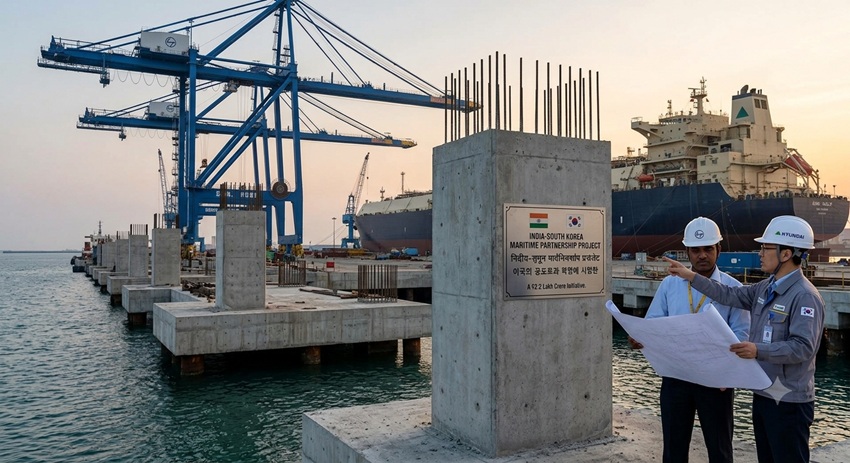
On 20 April 2026, Prime Minister Narendra Modi and South Korean President Lee Jae Myung sat down at Hyderabad House in New Delhi and formalised one of the most significant maritime agreements India has signed in years. The framework — branded VOYAGES, for Vision for Operation of Yard Assisted Growth with Efficiency and Scale — covers shipbuilding, port development, shipping logistics, and maritime technology. At its core is a plan for India to procure over 400 vessels in the years ahead, a pipeline valued at ₹2.2 lakh crore, or roughly $25 billion.
Two months on, the question being asked in maritime and industry circles is the harder one: can India actually absorb this ambition?
South Korea is, by most measures, the world’s most sophisticated commercial shipbuilding nation. Its yards function like automobile assembly lines — modular, serial, and brutally efficient. India’s large shipyards, by contrast, have historically focused on complex naval contracts for the government: prestigious work, but not the kind that builds commercial scale or the supply chain depth needed to produce bulk carriers and tankers competitively.
“In South Korea, a shipyard is supported by a 50 km radius of specialised vendors — valves, specialised steel, sensors,” Captain Ritesh Kumar, CEO of Broadside Marine Pvt Ltd, told Business Standard after the deal was announced. “In India, we often have to import these components, leading to higher costs and dead time during construction.”
The VOYAGES framework tries to address that gap through several interlocking agreements. South Korean firm HD Korea Shipbuilding & Offshore Engineering (HD KSOE) is positioned as a technical and strategic anchor for new greenfield shipbuilding clusters in India, including a large new yard planned for southern India. Existing Indian yards will be upgraded with new dry docks and block fabrication facilities capable of handling large, specialised vessels. A separate agreement between Bharat Earth Movers Limited and HD Hyundai targets joint design and manufacture of next-generation maritime cranes for Indian ports.
South Korea’s engagement extends to port infrastructure. Under an MoU between India’s Ministry of Ports, Shipping and Waterways and South Korea’s Ministry of Oceans and Fisheries, Korean companies can bid on India’s $13.3 billion port public-private partnership pipeline over the next five years. That includes the Vadhvan container port expansion in Maharashtra and new terminals in Odisha and Gujarat.
The strategic context sharpens the urgency. The 2026 West Asia conflict, which closed the Strait of Hormuz and sent freight costs surging — Brent crude went from $80 to $120 per barrel between 2 and 9 March — exposed a structural vulnerability that has existed for years: India is the world’s third-largest oil importer, yet most of its crude travels on foreign-flagged tankers. It pays the freight and absorbs the risk with none of the ownership.
India has set itself the goal of entering the top five shipbuilding nations by 2047, under its Maritime Amrit Kaal Vision. The South Korea deal is the most credible step yet toward that target. But financing long-cycle shipbuilding projects, training a qualified workforce, and developing a domestic component supply chain are challenges that cannot be solved with a framework document — they require sustained policy, capital, and institutional patience over a decade or more.
The VOYAGES agreement gives India a credible partner and a defined architecture. What it still needs is the will to build the factory, not just announce it.