India’s Defence Exports Hit Record ₹38,424 Crore in FY26, Rising 62% in a Single Year

From bulletproof vests to naval aircraft, Indian-made defence equipment now reaches more than 80 countries — and the government has set a target that is bolder still.
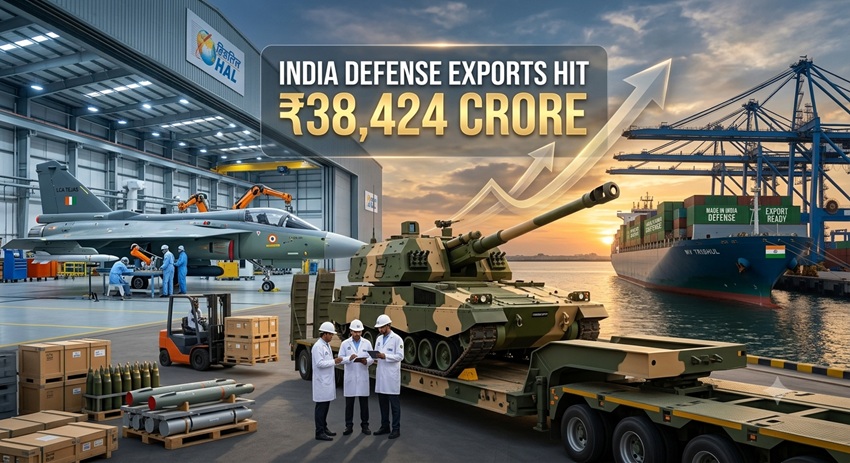
Twelve years ago, India exported ₹686 crore worth of defence equipment. Last financial year, it exported ₹38,424 crore worth. That number — confirmed by the Ministry of Defence and cited in a Press Information Bureau release in April 2026 — represents not just a record, but a 62.66 per cent jump over the previous year’s figure of ₹23,622 crore. It signals something the Indian defence establishment has been working toward for a decade: a fundamental shift from importer to exporter.
The surge places India on a trajectory that its government has been signalling since the launch of the Atmanirbhar Bharat initiative in 2020. Defence industrial licences, once numbering 258, have now more than tripled to 834 as of March 2026. The ecosystem supporting that export machine has expanded in parallel: 16 Defence Public Sector Undertakings, approximately 500 licensed private companies, and nearly 17,000 MSMEs now form the backbone of India’s indigenous manufacturing base. Defence production overall rose to ₹1.78 lakh crore in FY 2025-26, up from ₹46,429 crore a decade ago — a near four-fold increase.
What is India actually selling? Official material from the Ministry of Defence identifies export items including bulletproof jackets, Dornier Do-228 aircraft, Chetak helicopters, fast interceptor boats, and lightweight torpedoes. The private sector contributed approximately ₹15,000 crore to the total export figure, signalling that the push toward self-reliance is no longer confined to public sector undertakings. The government has not published a full country-by-country value breakdown for FY26, though earlier data identified the United States, France, and Armenia as top buyers in the prior financial year. More than 80 countries received Indian defence equipment in FY 2025-26.
The Innovation for Defence Excellence (iDEX) scheme has played a structural role in broadening the base. By March 2026, the programme had engaged 676 startups, MSMEs, and independent innovators, with 551 design and development contracts signed. That pipeline matters because defence exports are not simply about manufacturing capacity — they are about demonstrated technology quality that foreign militaries trust enough to buy and, critically, to sustain. Interoperability, maintenance chains, and training relationships all follow a procurement decision, which is why the composition of what India exports matters as much as the headline value.
The overall defence budget reached ₹7.85 lakh crore in FY 2026-27, up from ₹2.53 lakh crore in FY 2013-14. Capital expenditure alone climbed to ₹2.19 lakh crore, indicating continued commitment to both modernisation and procurement reform. The government has set a target of ₹50,000 crore in defence exports by 2029 — a goal that, if the current growth rate is maintained, would require roughly three more years of strong performance. The government also credits a revamped online export portal and simplified export authorisation procedures with reducing bureaucratic friction for smaller exporters.
One caveat worth noting: India simultaneously remains one of the world’s largest arms importers, a legacy of decades of underinvestment in domestic design and development that cannot be unwound overnight. The country still sources significant portions of its advanced weapons systems, fighter platforms and naval technology from abroad. The export story, for all its momentum, must be read alongside that continuing import dependency.
Nevertheless, the direction of travel is unambiguous. The gap between what India buys and what it builds is narrowing. And for countries in South Asia, Africa and the Middle East looking for reliable, competitively priced defence partnerships with a non-Western vendor, India is increasingly presenting itself as a credible alternative — one that comes with diplomatic value attached. The next test will be whether FY 2026-27 sustains this pace or whether the record-breaking FY26 figure was driven by a concentrated set of large deliveries that will not repeat.