Myanmar President Min Aung Hlaing Arrives in India on Historic Five-Day Visit to Strengthen Ties With Modi

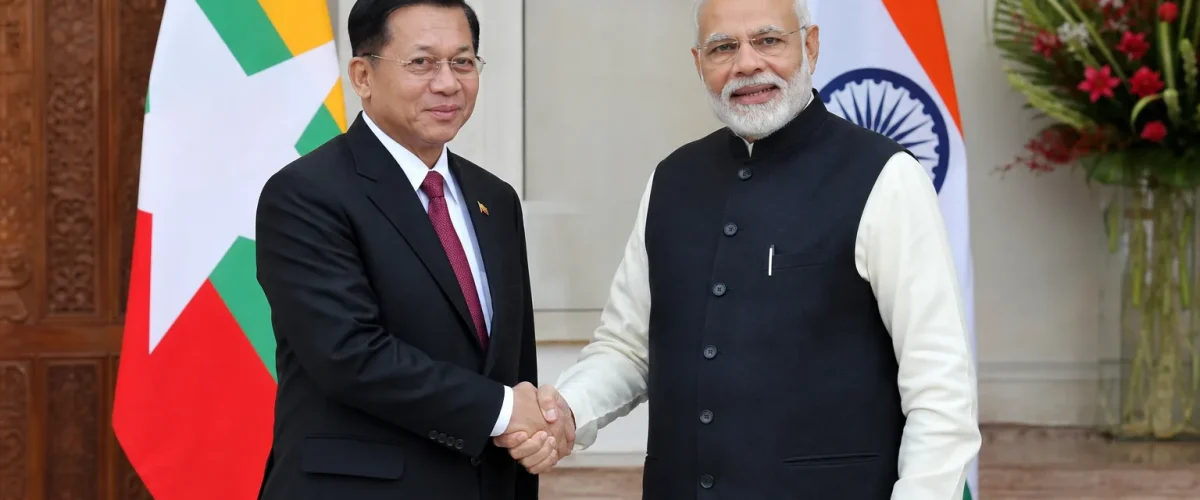
Myanmar President U Min Aung Hlaing arrived in India on Friday for a historic five-day official visit — his first to the country as head of state — that is expected to significantly deepen bilateral ties between the two neighbours at a time of shifting geopolitical alignments in the Indo-Pacific. The visit, from 30 May to 3 June 2026, comes at the invitation of Prime Minister Narendra Modi.
The Myanmar leader began his visit in Bodh Gaya, Bihar, on 30 May, where he offered prayers at the Mahabodhi Temple — one of the holiest Buddhist sites in the world and a location of deep spiritual significance for Myanmar, a predominantly Buddhist nation. He is accompanied by a high-level delegation comprising several Cabinet ministers, senior military and civilian officials, and prominent business leaders.
Diplomatic Agenda — What Modi and Min Aung Hlaing Will Discuss
The centrepiece of the visit will be formal discussions between President Min Aung Hlaing and Prime Minister Modi in New Delhi on 1 June. The Ministry of External Affairs has outlined several key areas of focus: border security, trade and investment, connectivity infrastructure, defence cooperation, and counterterrorism collaboration.
Border management is expected to dominate the agenda. India and Myanmar share a 1,643-kilometre border across four northeastern states — Arunachal Pradesh, Nagaland, Manipur, and Mizoram. The Free Movement Regime (FMR), which allows border residents to travel up to 16 kilometres into each other’s territory without a visa, was suspended by India in February 2024 amid concerns over drug trafficking and insurgent movement. Diplomatic sources suggest that a modified, more regulated version of the FMR is under negotiation.
Counterinsurgency cooperation will also feature prominently. India has long sought Myanmar’s help in tackling northeast Indian insurgent groups that maintain camps across the border. In return, Myanmar is expected to request Indian assistance in combating ethnic armed organisations operating in its border regions, particularly in Chin and Sagaing divisions where conflict has intensified since 2021.
Economic Dimensions — Trade, Connectivity, and the India-Myanmar-Thailand Highway
Bilateral trade between India and Myanmar stood at approximately $2.1 billion in 2025-26, a figure that both governments acknowledge is well below potential. The visit is expected to produce several economic agreements aimed at boosting this figure, including expanded border trade provisions and new investment protection frameworks.
The India-Myanmar-Thailand Trilateral Highway, a long-delayed 1,360-kilometre road connecting Moreh in Manipur to Mae Sot in Thailand via Myanmar, is expected to be a major discussion point. India has invested over $800 million in the project, which is approximately 70 percent complete. The remaining stretches in Myanmar’s Chin and Sagaing regions have been delayed by conflict and funding constraints. Completion of the highway is considered essential for India’s Act East Policy, linking northeast India to ASEAN markets.
The Kaladan Multi-Modal Transit Transport Project, connecting Kolkata to Sittwe port in Myanmar’s Rakhine State and then via river and road to Mizoram, is another critical infrastructure initiative on the agenda. India has also been building this connectivity corridor, and both sides are expected to set a 2028 operational target during the visit.
The Geopolitical Context — India’s Balancing Act
The visit is politically significant and carries diplomatic complexity. Min Aung Hlaing led the military coup that overthrew Myanmar’s elected government in February 2021, and the country has been under military rule since. Western nations, including the United States and the European Union, have imposed sanctions on the Myanmar junta and its leaders, making India’s engagement with Min Aung Hlaing a subject of international scrutiny.
India’s position has been characterised by a pragmatic balancing act. While New Delhi has called for the restoration of democracy and the release of political prisoners — including former State Counsellor Aung San Suu Kyi — it has avoided imposing sanctions, arguing that isolation would push Myanmar further into China’s orbit. China is Myanmar’s largest trading partner and arms supplier, and India views its own engagement with Naypyidaw as a strategic counterweight to Beijing’s influence.
This visit comes amid a flurry of Indian diplomatic activity. The Quad Foreign Ministers’ meeting in New Delhi earlier this month strengthened India’s strategic alignments in the Indo-Pacific, while ongoing India-Canada CEPA trade deal negotiations and the US-Iran ceasefire that has reshaped regional dynamics are reshaping India’s external engagement strategy.
Mumbai Leg — Business and Industry Interactions
President Min Aung Hlaing will travel to Mumbai on 2 June for business and industry interactions, including meetings with Indian corporate leaders. Myanmar is seeking Indian investment in infrastructure, agriculture, and telecommunications, sectors where Indian companies have expressed interest but been hesitant to commit due to political instability and Western sanctions risk.
The Confederation of Indian Industry (CII) is organising an India-Myanmar business forum during the Mumbai leg, with participation expected from major Indian conglomerates including Tata Group, Adani, and Essar. Areas of particular interest include solar energy development, mobile telecommunications infrastructure, and agricultural technology — sectors where Indian expertise aligns with Myanmar’s development needs.
What to Expect — Outcomes and Significance
The visit is expected to produce at least five bilateral agreements covering border management, trade facilitation, defence cooperation, cultural exchange, and connectivity infrastructure. A joint statement following the Modi-Min Aung Hlaing meeting on 1 June will likely reaffirm India’s commitment to Myanmar’s sovereignty and territorial integrity while expressing shared concern about cross-border security threats.
For India, the visit represents a strategic bet that engagement — not isolation — is the most effective way to protect its interests along one of its most sensitive borders and counter Chinese influence in a critical neighbouring state. For Myanmar, the visit signals that despite international isolation, the military government retains diplomatic options and strategic relevance. The outcomes of the next five days will likely define the trajectory of India-Myanmar relations for years to come.