Trump Administration’s $100,000 H-1B Supplemental Fee Raises Hiring Costs by 30 Percent and Hits Indian IT Workers Hardest

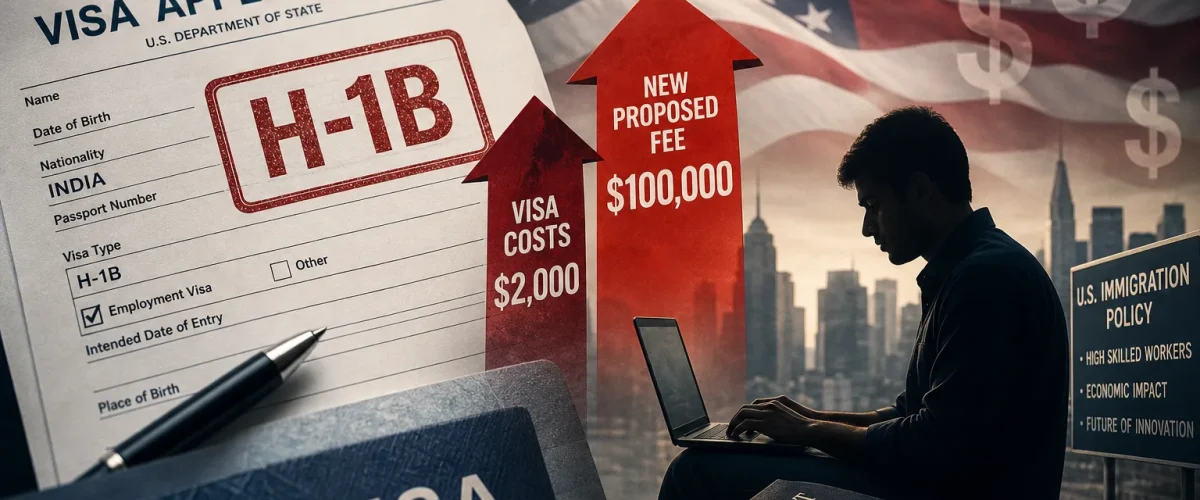
The Trump administration’s controversial $100,000 supplemental fee on certain H-1B visa petitions has sent shockwaves through the Indian IT industry, raising the total first-year cost of bringing a foreign worker to the United States by approximately 30 percent and triggering a measurable decline in H-1B-tagged job postings across the American technology sector. According to data compiled by job platform Dice, new job listings that offer H-1B sponsorship have fallen 12 percent since January 2026 — a decline that immigration attorneys say is directly attributable to the fee increase.
The supplemental fee, imposed in late 2025, applies to each new H-1B petition filed by employers where more than 50 percent of their workforce consists of non-immigrant visa holders and the company employs more than 50 people. This threshold effectively targets large Indian IT services firms — including Infosys, TCS, Wipro, and HCL Technologies — whose business models have historically relied on deploying H-1B workers to client sites across the United States.
How the Fee Works
Under the revised fee structure, qualifying employers must pay the standard H-1B filing fees — which already include a base fee, fraud prevention fee, ACWIA training fee, and public law surcharge — plus the new $100,000 supplemental fee per petition. For a typical H-1B filing that previously cost between $5,000 and $10,000, the total cost now exceeds $110,000 in many cases. This represents a fundamental shift in the economics of H-1B sponsorship.
Court filings published in February 2026 revealed that only 70 employers had paid the supplemental fee in the initial months, confirming what Indian IT services firms feared: the fee is functioning as a de facto deterrent rather than a revenue measure. Many mid-sized US consultancies have either postponed or cancelled sponsorship plans entirely, shrinking the pool of available positions for Indian nationals seeking work in the United States.
Impact on Indian IT Workers
India accounts for approximately 72 percent of all H-1B visas issued annually, making Indian professionals the demographic most affected by any changes to the programme. The supplemental fee has triggered several measurable effects on Indian workers and the broader IT ecosystem.
First, some employers are shifting roles to near-shore hubs like Toronto and Guadalajara or asking Indian consultants to work remotely from Bengaluru under contractual arrangements. This trend, while providing alternative employment, raises complex tax and permanent establishment questions for both Indian companies and their US clients.
Second, the fee has accelerated the trend toward global capability centres (GCCs) — dedicated offshore offices operated by US companies in India. With the cost of bringing an Indian engineer to the US now exceeding $110,000 before salary, many companies find it more economical to invest in their Indian operations instead. GCC headcount in India grew 18 percent in FY26, reaching over 1.6 million employees.
Third, Indian professionals already in the US on H-1B status face increased uncertainty about visa renewals and transfers. While the supplemental fee primarily applies to new petitions, the broader anti-immigration sentiment it signals has created anxiety among the estimated 600,000 Indian-born H-1B holders currently working in the United States.
Indian IT Services Companies Respond
India’s major IT services firms have responded to the fee increase by accelerating their localisation strategies — hiring more US citizens and permanent residents to reduce dependence on H-1B visas. Indian companies that previously led global salary benchmarks are now investing heavily in US campus recruitment and training programmes.
Infosys, India’s second-largest IT services firm, reported that its US local hiring now accounts for over 65 percent of its American workforce, up from approximately 50 percent five years ago. TCS and Wipro have made similar shifts. However, analysts note that certain specialised technology roles — particularly in artificial intelligence, cybersecurity, and cloud architecture — remain difficult to fill locally, making H-1B sponsorship a necessity despite the higher costs.
NASSCOM, the Indian IT industry’s apex body, has been lobbying both the US Congress and the Indian government to address the fee issue. “The H-1B programme benefits both countries,” a NASSCOM spokesperson said. “Indian IT professionals contribute billions of dollars to the US economy through taxes, innovation, and entrepreneurship. Pricing them out of the market hurts American competitiveness.”
Legal Challenges and Political Outlook
The supplemental fee faces ongoing legal challenges. Business associations and immigration advocacy groups have filed lawsuits arguing that the fee is discriminatory and exceeds the government’s statutory authority. A federal court in California is expected to rule on a consolidated challenge later this year.
Meanwhile, bipartisan legislation in Congress would sunset the surcharge in the next budget cycle, though the bill’s prospects in a Republican-controlled legislature remain uncertain. The Trump administration has defended the fee as necessary to “protect American workers” and ensure that foreign labour is priced at market rates.
The broader context of the India-US trade relationship adds complexity to the issue. India’s growing strategic importance to the United States — as a counterbalance to China, a major defence partner, and one of the world’s largest economies — creates diplomatic pressure to resolve irritants like the H-1B fee. However, immigration policy remains politically charged in America, and the administration has shown little willingness to compromise.
Alternative Pathways for Indian Talent
In response to the tightening US visa landscape, Indian professionals and companies are increasingly exploring alternative destinations. Canada’s Global Talent Stream, the UK’s Scale-Up visa, and Singapore’s Tech.Pass have all seen increased applications from Indian technology workers. These programmes offer faster processing, lower costs, and in some cases a clearer path to permanent residency.
India’s own technology sector continues to grow rapidly, with major AI and technology investments pouring into Bengaluru, Hyderabad, and Pune. Some industry observers argue that the H-1B restrictions, while painful in the short term, may ultimately benefit India by retaining more of its best talent domestically — a reversal of the brain drain that has characterised Indian migration patterns for decades.
As the global economy navigates geopolitical tensions, trade disputes, and the accelerating AI revolution, the movement of skilled workers across borders remains one of the most consequential policy questions of our time. The H-1B supplemental fee is not just an immigration issue — it is a signal of how the world’s two largest democracies are redefining their economic relationship in an era of rising nationalism and technological disruption.