Assam Election Results 2026: BJP Races Towards Record 100-Seat Sweep as Himanta Biswa Sarma Set for Dominant Second Term

BJP Storms Towards Unprecedented Dominance in Assam Assembly
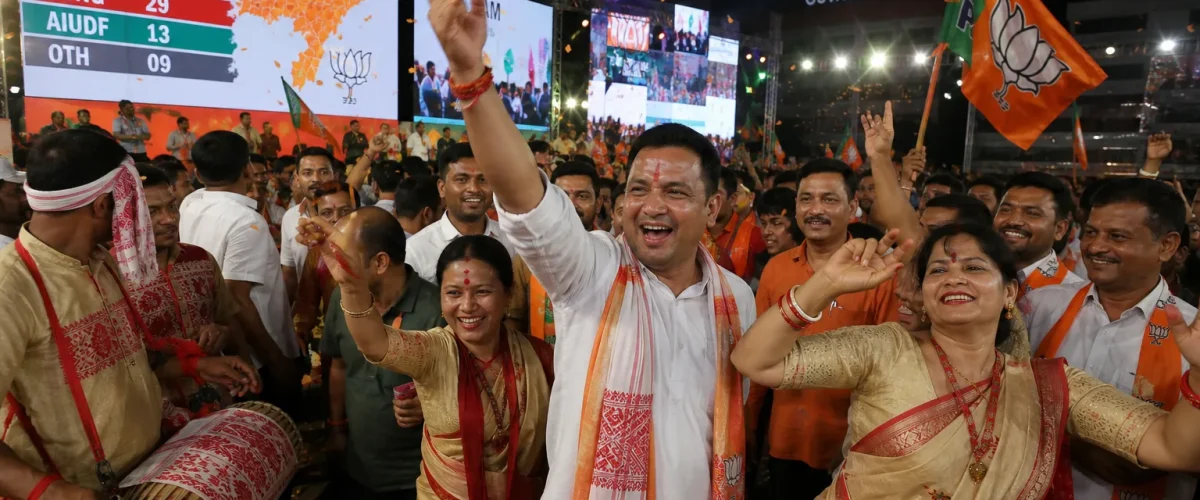
The Bharatiya Janata Party (BJP) is racing towards a record-breaking performance in the Assam Assembly Elections 2026, with early counting trends on Monday, 4 May 2026, showing the party nearing the 100-seat mark in the 126-member state legislature. Chief Minister Himanta Biswa Sarma, who led the party’s campaign with characteristic aggression, is cruising to victory in his Jalukbari constituency with a massive margin, setting the stage for a dominant second term.
Counting began at 8:00 AM IST, and within hours, the BJP’s dominance across Assam’s varied electoral landscape became apparent. With the majority mark at 64 seats, the BJP’s projected tally of close to 100 seats represents a historic mandate that would surpass even the party’s own expectations and establish BJP’s most comprehensive victory in any northeastern state.
Himanta Leads by Thousands in Jalukbari
In Jalukbari, constituency number 62 in the Kamrup Metropolitan district, Himanta Biswa Sarma has established a commanding lead of nearly 5,000 votes over Congress candidate Bidisha Neog in early rounds. The 57-year-old doctorate-holding Chief Minister, who has been the sitting MLA since defecting from Congress to BJP in 2015, appears headed for a comfortable victory that will validate his administrative and political approach over the past five years.
Sarma’s campaign focused on development achievements — including road infrastructure, healthcare expansion, and flood management improvements — while also pressing emotive issues around identity politics and demographic changes in the Brahmaputra Valley. His confrontational political style, which has made him both one of the BJP’s most effective regional leaders and a polarising figure, clearly resonated with the Assamese electorate.
Congress Faces Devastating Collapse
The Indian National Congress, which once dominated Assam politics and governed the state continuously from 2001 to 2016, is facing a devastating collapse. Early trends show the party leading in only a handful of constituencies — a result that, if confirmed, would represent its worst-ever performance in Assam. The party’s inability to present a credible alternative narrative to BJP’s development-plus-identity pitch has been exposed by the results.
The All India United Democratic Front (AIUDF) of Badruddin Ajmal and the Asom Gana Parishad (AGP), BJP’s regional ally, are also part of the unfolding picture. AGP, which fought as part of the BJP-led alliance, has contributed to the coalition’s overall seat tally, while the AIUDF’s support base in the Muslim-majority constituencies of lower Assam appears under pressure from both the Congress and BJP.
Tea Garden Workers and Tribal Belt Consolidate Behind BJP
A critical factor in BJP’s dominance has been the tea garden worker constituency, comprising about six million people across Upper Assam’s tea-growing districts. The party’s welfare schemes targeting tea garden workers — including free rations, housing assistance, and health insurance — have solidified support among this historically marginalised community that previously voted overwhelmingly for Congress.
In the Bodoland Territorial Region (BTR), the BJP’s alliance with the United People’s Party Liberal (UPPL) has held firm, maintaining the coalition’s grip over the autonomous council area’s constituencies. The peace accord with Bodo militant groups, signed during BJP’s first term, continues to pay electoral dividends in this conflict-affected region.
This contrasts with the political flux in other northeastern states, where the recent declaration of Mizoram as insurgency-free after the last militant group laid down arms illustrated the region’s complex security landscape.
What BJP’s Assam Sweep Means for Northeast India
BJP’s comprehensive victory in Assam consolidates its position as the dominant political force across Northeast India. The party now controls or leads the government in seven of the eight northeastern states — a remarkable transformation from a decade ago when it had virtually no presence in the region.
For the NDA government at the Centre, the Assam result provides additional political capital to pursue its development agenda in the northeast, including the multi-billion-dollar infrastructure projects along the India-Myanmar-Thailand corridor, the recently enhanced defence allocations for the eastern border region, and the ongoing expansion of air and rail connectivity.
The Congress’s decimation in Assam — once considered one of its safest states — sends a grim signal for the party’s organisational health nationally. Combined with its marginalisation in West Bengal and limited returns in other counting-day states, the party faces serious questions about its ability to mount effective state-level challenges to the BJP juggernaut outside a few remaining strongholds.
Flood Management and Development Delivered
The Himanta Sarma government’s handling of Assam’s perennial flood crisis — including expedited embankment repairs, improved early warning systems, and faster relief distribution — appears to have earned electoral goodwill. While floods continued to devastate parts of the state, the perception that the government was more responsive than previous administrations counted in BJP’s favour. Recent deadly storms across multiple Indian states have underscored the importance of disaster preparedness in voter calculations.
As counting progresses through the afternoon, the final seat tally will determine whether BJP achieves the historic 100-seat milestone. Regardless of the exact number, the message from Assam’s voters is clear: they have endorsed Himanta Biswa Sarma’s leadership emphatically, giving him a mandate that few chief ministers in Indian history have received for a second consecutive term.

- India’s Startup Funding Crosses $7.2 Billion in H1 2026 - July 1, 2026
- After Ireland Shock, India’s T20I Side Faces Bigger Test - July 1, 2026
- Ireland Stun World Champions India 2-0 in Belfast, Sooryavanshi Debate Rages On - June 29, 2026